

 English
 русский
 Español
 عربى

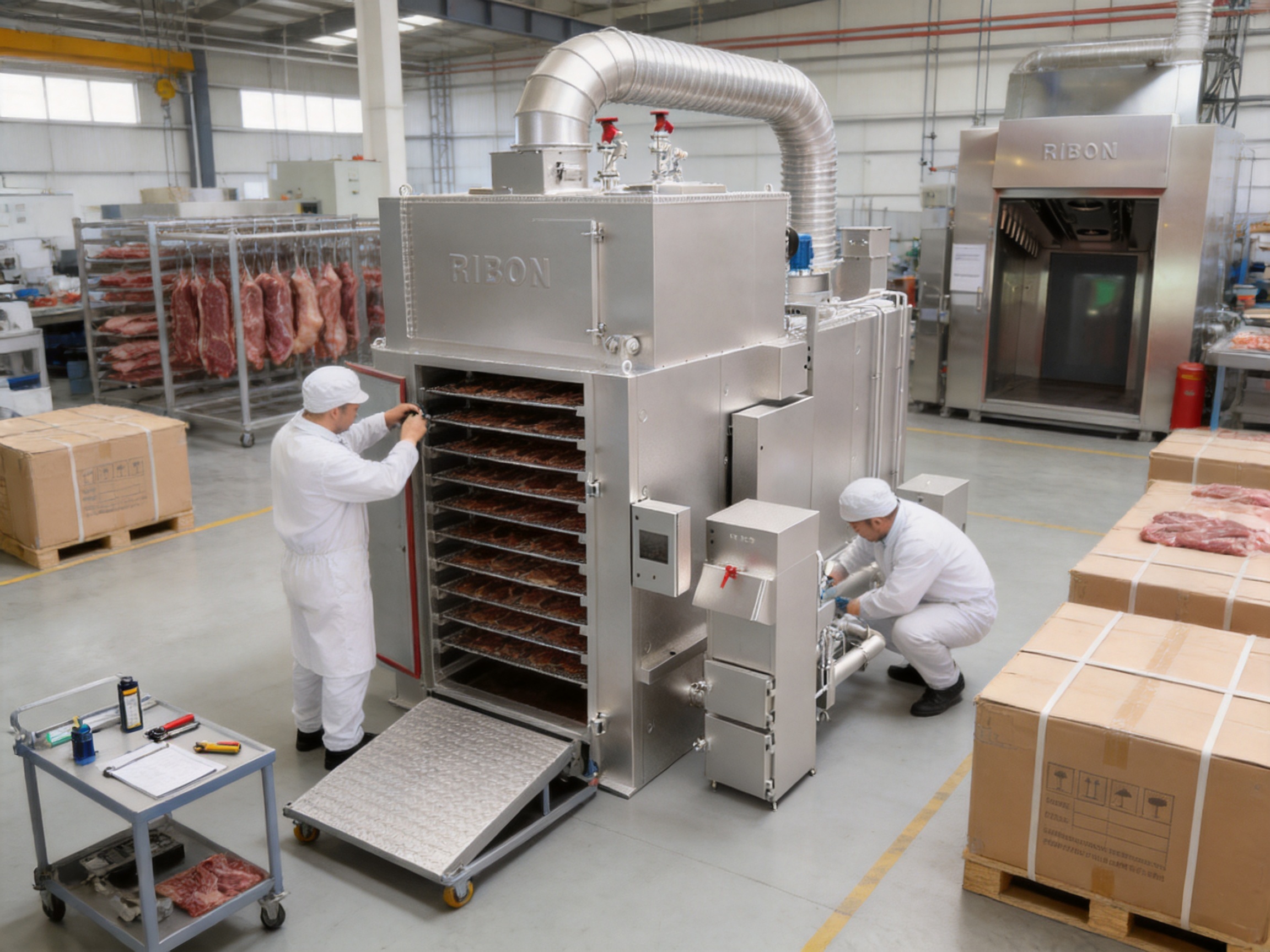
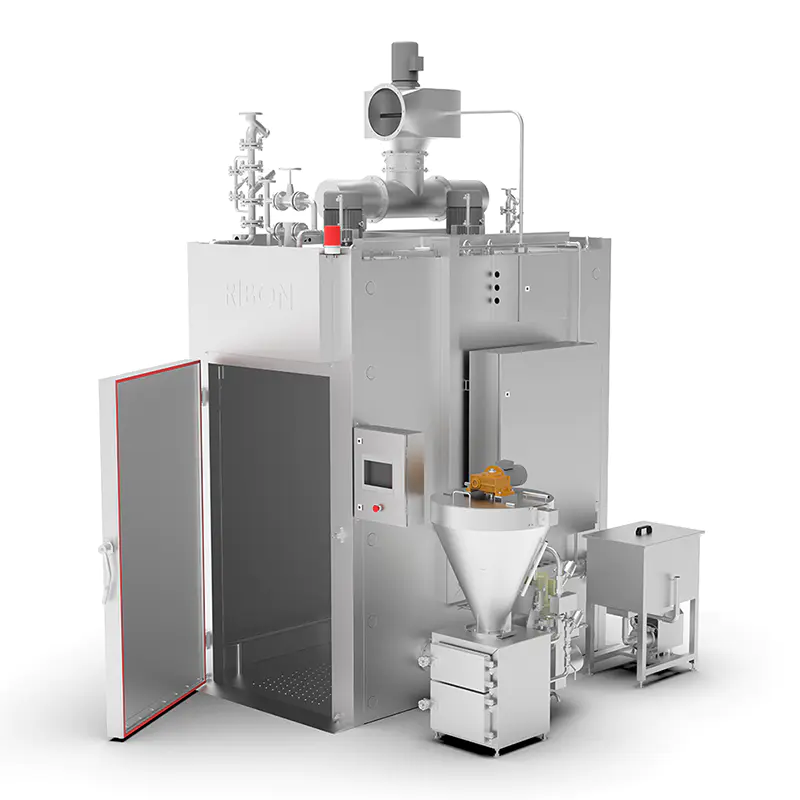
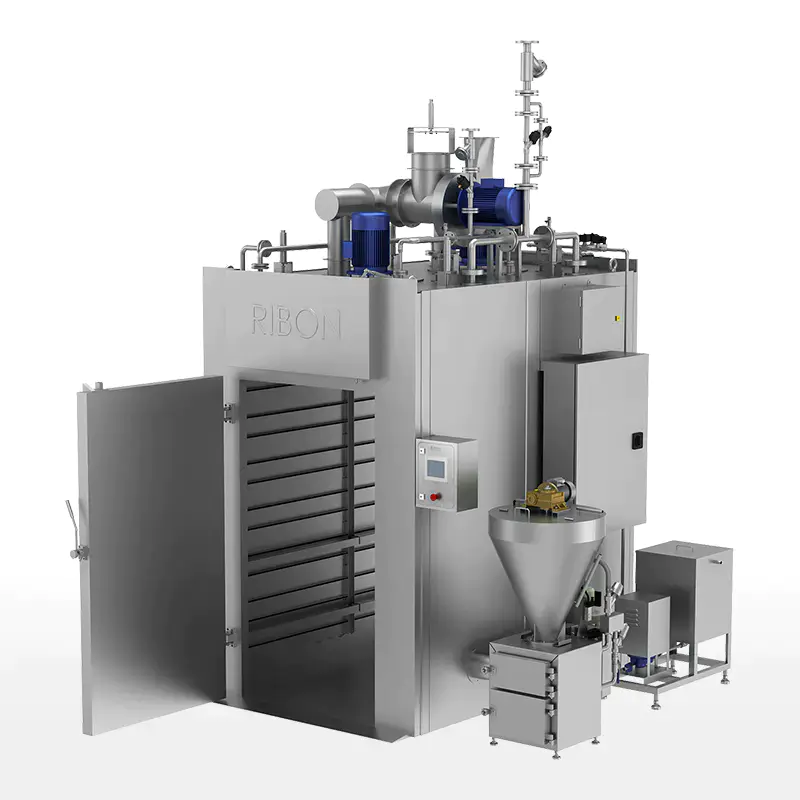
Modern meat processors need more than a heated chamber for cooking and smoking. They need a complete process system capable of controlling temperature, humidity, airflow, smoke density, drying conditions, cleaning procedures, production records, and operator safety. The Central Heating Smokehouse is designed to meet these requirements in one integrated piece of meat processing equipment.
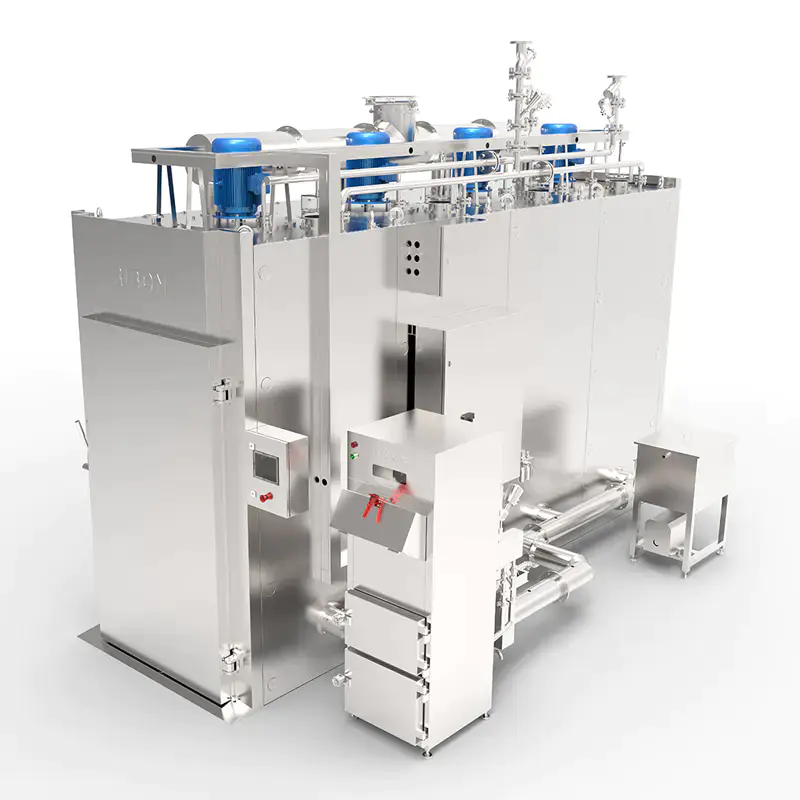
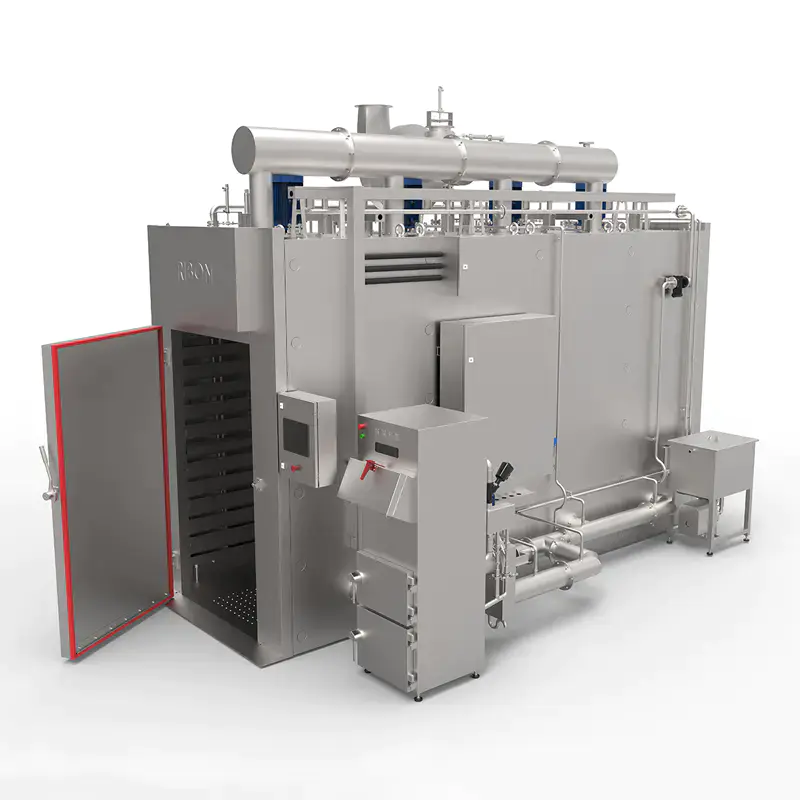
Developed for beef jerky, sausages, hams, poultry, and other processed meat products, this smokehouse combines reddening, drying, cooking, smoking, and showering functions. Its central heating arrangement, dual-duct air circulation, intelligent control system, active exhaust, and clean-in-place design help manufacturers achieve repeatable results while reducing unnecessary energy consumption, manual intervention, and sanitation difficulty.
The equipment is manufactured by Zhejiang Ribon Intelligent Equipment Co., Ltd., a specialist in meat processing machinery since 2003. The company focuses on meat processing smokehouses, vacuum tumblers, slaughtering equipment, cutting and deboning solutions, and related production technologies. Its long-term specialization allows the smokehouse to be developed around practical production requirements rather than as a general-purpose heating cabinet.
Content
- 1 Why a Modern Smokehouse Requires Integrated Process Control
- 2 Core Processing Functions
- 3 Advanced Air Circulation System
- 4 Optimized Interior Geometry
- 5 Aerodynamic Duct Design
- 6 Central Heating and Thermal Efficiency
- 7 Intelligent PLC Touch Screen Control
- 8 Humidity and Condensation Management
- 9 Active Exhaust System
- 10 Smoking Control and Safe Operation
- 11 High-Performance CIP Cleaning System
- 12 Modular Construction and Installation Efficiency
- 13 High-Quality Components and Reliability
- 14 Manufacturing Strength and Quality Assurance
- 15 Advantages Compared with Basic Smokehouse Designs
- 16 Fault Diagnosis and Power-Off Protection
- 17 Applications for Different Meat Products
- 18 Energy, Labor, and Operational Efficiency
- 19 Installation and Integration into a Meat Processing Line
- 20 Maintenance Considerations
- 21 Why Choose a Specialized Smokehouse Manufacturer
- 22 Conclusion
- 23 Questions and Answers
- 23.1 What products can be processed in the Central Heating Smokehouse?
- 23.2 What functions does the smokehouse provide?
- 23.3 How does the air circulation system improve processing?
- 23.4 What is the purpose of the central heat exchanger?
- 23.5 Can the smoke intensity be adjusted?
- 23.6 How does the smokehouse manage humidity?
- 23.7 Is the smokehouse easy to clean?
- 23.8 What control system is used?
- 23.9 What happens after a power outage?
- 23.10 How does the modular design help installation?
- 23.11 What components are used in the equipment?
- 23.12 How does the manufacturer control component quality?
- 23.13 Who manufactures the Central Heating Smokehouse?
- 24 References
- 25 Product: Central Heating Smokehouse
Why a Modern Smokehouse Requires Integrated Process Control
Smoking and cooking meat products involve several connected variables. Product appearance depends on the reddening stage, while texture is influenced by drying and cooking. Smoke flavor depends on the generation and distribution of smoke. Yield and product consistency are affected by humidity control, condensation management, air movement, and the time-temperature profile.
If these functions are handled by separate or poorly coordinated systems, operators may face uneven color, inconsistent moisture levels, excessive cooking loss, irregular smoke penetration, and longer cleaning periods. Variations can also occur between different trolley positions or between the front and rear areas of the chamber.
The Central Heating Smokehouse addresses these challenges through a coordinated design. Heating, air circulation, exhaust, humidity adjustment, smoke control, process programming, and cleaning are integrated into the equipment. This arrangement gives processors a more controlled working environment and supports the repeatable execution of production recipes.
The system is suitable for different product categories because the operator can set and modify process parameters through a PLC touch screen. Recipes and programs can be organized according to product type, product size, desired color, smoke intensity, cooking temperature, humidity requirements, and drying time. This flexibility is particularly valuable for facilities that produce several products on the same production line.
Core Processing Functions
The smokehouse is designed to perform five primary processing functions: reddening, drying, cooking, smoking, and showering. These functions can be combined into a complete production program or selected according to the requirements of a particular product.
Reddening
Reddening is an important stage for products where a stable and attractive surface color is required. A controlled chamber environment allows operators to establish appropriate air movement, temperature, and humidity conditions before the main cooking or smoking stages. Consistent conditions help reduce differences in appearance from one batch to another.
Drying
Drying removes surface moisture and prepares the product for smoke absorption, cooking, or further processing. The active exhaust system helps evacuate hot air and humidity from the chamber. This supports more efficient drying and prevents excessive moisture from remaining in the production environment.
Cooking
The heating system is designed to provide stable thermal conditions throughout the chamber. The centrally positioned heat exchanger offers a large heat transfer surface area, supporting thermal efficiency and uniform temperature distribution. The combination of controlled heating and balanced airflow helps reduce localized hot or cold areas.
Smoking
The smokehouse can be equipped with an external wood chip smoke generator. Smoke volume and density can be adjusted to suit the product and recipe. An optional liquid smoke atomizer is also available for applications requiring a smoke solution with no traditional smoke emissions and straightforward maintenance.
Showering
The showering function can be used as part of the finishing or cooling process, depending on the product program. Combining showering with the other treatment stages allows processors to manage the full sequence within one controlled chamber instead of transferring products between multiple machines.
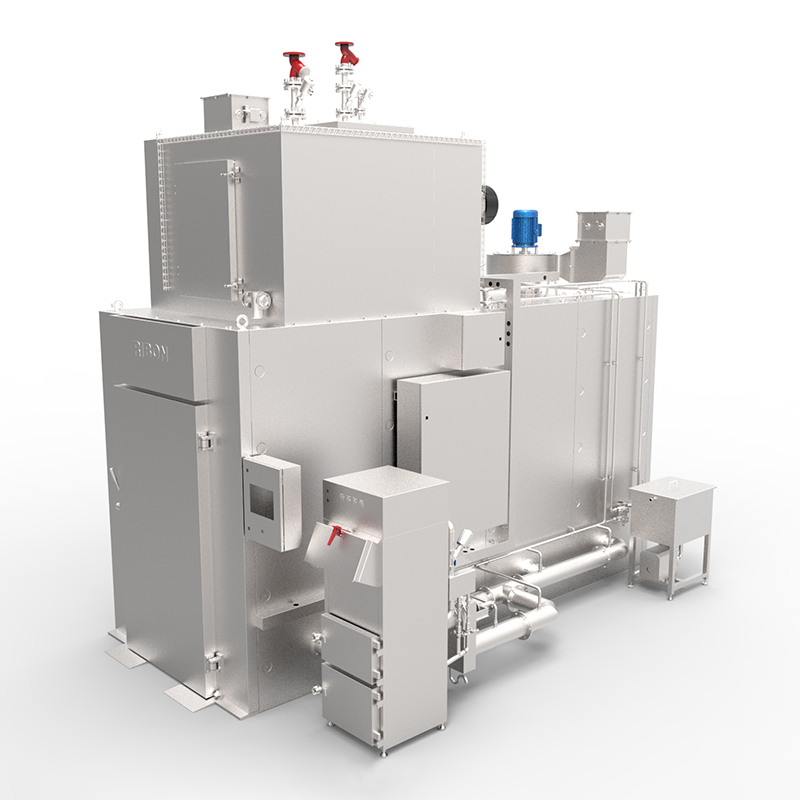
Central Heating Smokehouse
Advanced Air Circulation System
Air circulation is one of the most important factors in a smokehouse. Heat and smoke must move evenly around products loaded on different trolley levels. At the same time, excessive air velocity can affect product surfaces, while insufficient circulation can create uneven color, drying, or cooking.
The Central Heating Smokehouse uses two independent fan motors to drive a two-duct air circulation system. This configuration provides a separate source of air movement for the left and right sides of the chamber. Variable frequency drives precisely control the air velocity at the left and right outlets.
Independent control of the fan motors and outlet velocity provides several practical benefits. Operators can adjust circulation according to product loading, product shape, trolley arrangement, and processing stage. The air movement can be managed to support gentle treatment during sensitive stages and stronger circulation when rapid drying or heat transfer is required.
The two-duct design also helps distribute air more evenly than a simple single-direction circulation arrangement. Air enters the chamber through engineered outlets, travels through the product area, and returns through the corresponding air paths. The result is a more balanced chamber environment and reduced dependence on the position of individual products.
A centrally positioned heat exchanger provides a large heat transfer surface area. Locating the heat exchanger within the central air circulation arrangement supports efficient heat exchange as air moves through the system. The design is intended to deliver reliable thermal performance while reducing unnecessary energy use during repeated production cycles.
Variable Frequency Fan Control
Variable frequency drives allow fan speed to be adjusted instead of forcing the fans to operate at one fixed level. This is important because different stages require different air movement. A drying program may require active circulation and exhaust, while a more delicate smoking stage may benefit from carefully controlled airflow.
Adjustable fan speed also supports process flexibility. A processor can develop different programs for sausages, poultry, hams, beef jerky, and other products. The same smokehouse can therefore be adapted to various production needs without replacing the core air circulation equipment.
Low-Speed, High-Pressure Fan Design
The smokehouse uses special low-speed, high-pressure fans. This fan design is intended to provide effective air movement with high efficiency, lower energy consumption, and reduced operating noise. Lower noise can improve the working environment, while efficient airflow supports stable processing without excessive power demand.
Optimized Interior Geometry
The internal shape of a smokehouse affects airflow, drainage, cleaning, and product hygiene. Sharp internal corners can interrupt airflow and create areas where moisture, residue, or cleaning chemicals accumulate. These areas can increase sanitation difficulty and may require additional manual attention.
The Central Heating Smokehouse uses coved corners integrated into the bottom of the chamber. The curved geometry helps maintain airflow velocity and reduces airflow degradation near the lower sections of the chamber. It also eliminates difficult-to-clean sharp corners.
From a sanitation perspective, coved corners make it easier for water and cleaning solutions to reach surfaces and drain away. The design supports more consistent cleaning of the chamber floor and lower wall areas, where product residue and condensate may otherwise collect.
The optimized geometry is especially important in a high-frequency production environment. A machine that is easy to clean can help reduce the time between production batches and make sanitation procedures more consistent. It can also reduce the chance that operators overlook difficult areas during routine cleaning.
Aerodynamic Duct Design
Specially engineered air ducts are positioned on both sides of the smokehouse. Their primary purpose is to deliver uniform air distribution throughout the chamber. At the same time, the duct arrangement allows straightforward access for sanitation and inspection.
Air ducts must perform two functions at once. They must guide air efficiently during operation, and they must remain accessible enough for cleaning. The design of the smokehouse addresses both requirements by combining controlled air paths with practical sanitation access.
Uniform air distribution helps ensure that product position has less influence on final results. This is important when the smokehouse is loaded with multiple trolleys or when products have different shapes and densities. Balanced circulation supports more consistent exposure to heat, humidity, and smoke.
The ducts also work together with the dual fan motors and variable frequency drives. Instead of treating the chamber as a single undifferentiated space, the system provides controlled movement through two coordinated air paths. This gives the operator more control over the production atmosphere.
Central Heating and Thermal Efficiency
The central heat exchanger is a key component of the smokehouse. It provides a large surface area for heat transfer, helping convert heating energy into a stable chamber environment. Efficient heat exchange is important for both product quality and operating cost.
Thermal efficiency is not determined by the heat exchanger alone. It depends on the relationship between insulation, airflow, fan performance, exhaust control, humidity management, and process programming. The smokehouse therefore combines the central heat exchanger with insulated walls, controlled air circulation, and an active exhaust system.
The chamber walls can be insulated with polyurethane foam or rock wool. Insulation helps isolate the chamber from the external environment and reduces heat loss. It also supports more stable internal temperatures during long cooking or smoking programs.
Stable thermal conditions reduce the need for repeated manual adjustments. When heating performance, airflow, and exhaust work together, the smokehouse can follow programmed temperature changes more accurately. This contributes to repeatable products and better use of energy during production.
The small-angle solid trolley ramp is another practical design element. It supports safer trolley movement into the chamber and minimizes the risk of product contamination during loading. A well-designed ramp also helps operators move heavy loaded trolleys more conveniently.
Intelligent PLC Touch Screen Control
The PLC-based control system provides the central operating interface for the smokehouse. Through the touch screen, operators can set process parameters, select recipes, monitor the operating status, and adjust the program when necessary.
Real-time status display allows the operator to see the condition of the smokehouse during operation. Temperature, process stage, and other operating information can be monitored from the control interface. This reduces dependence on manual inspection and gives production personnel a clearer view of the active program.
The system supports recipe and program management. A processor can establish operating sequences for different products and save the relevant parameters for future batches. This helps reduce setup time and improves repeatability between production runs.
Automatic recording of operational data provides a useful production history. Recorded information can support internal quality management, process review, maintenance planning, and troubleshooting. It can also help managers identify differences between batches and improve recipes over time.
Touch screen parameter setting makes the machine easier to operate than a system that relies on multiple independent mechanical controls. Operators can modify appropriate values within the control interface and observe the effect of changes on the active process.
Recipe-Based Production
Recipe-based operation is valuable for manufacturers producing multiple products. For example, a sausage program may use different heating, humidity, smoke, and drying conditions from a poultry program. A beef jerky program may require another combination of drying time, air velocity, and smoke density.
By organizing these procedures as programs, the processor can standardize production across shifts. Operators do not need to recreate every setting manually for each batch. This reduces the possibility of setting errors and helps preserve the intended product characteristics.
Process Visibility
Clear process visibility is essential when a smokehouse is used for extended production cycles. The touch screen shows the operating status and allows the operator to identify the current phase. This supports faster decision-making and reduces unnecessary chamber opening, which can disturb temperature, humidity, and smoke conditions.
Humidity and Condensation Management
Humidity control directly affects drying, cooking, surface appearance, and product yield. Too much humidity can slow drying and influence surface texture. Too little humidity during certain stages can increase surface drying or affect product quality.
The smokehouse uses a humidity control valve to regulate moisture conditions. The operator can incorporate humidity adjustments into the process program and use the valve to support the desired chamber environment for each processing stage.
A Lind Weit drain valve collects condensate and improves steam utilization and temperature uniformity. Efficient condensate management helps prevent uncontrolled water accumulation and supports a more stable thermal environment.
Managing humidity and condensate also contributes to sanitation. Excess moisture can create additional cleaning requirements and may affect the performance of internal components. Controlled drainage helps keep the process environment more orderly and reduces unnecessary water retention.
Active Exhaust System
The powered exhaust system is designed to evacuate hot air and humidity from the chamber in a timely manner. This function is particularly important during drying, when excess moisture must be removed efficiently.
Active exhaust gives the operator greater control than passive ventilation. The exhaust system can operate as part of the programmed process and coordinate with heating, fan speed, and humidity management. This allows the chamber atmosphere to be changed deliberately according to the product stage.
Effective exhaust can improve drying efficiency and help maintain a more stable process environment. It can also reduce the accumulation of hot, humid air around the product surface. Combined with balanced circulation, exhaust control supports more consistent results across the trolley load.
The exhaust arrangement is also relevant to operator safety and the working environment. Removing hot air and moisture helps prevent unnecessary heat and humidity from remaining inside the production area when the chamber is opened or when the cycle is completed.
Smoking Control and Safe Operation
Smoke intensity is an important product variable. Different products and markets may require light, medium, or stronger smoke characteristics. The external wood chip smoke generator allows smoke volume and density to be adjusted according to the recipe.
Separating the smoke generator from the main chamber can make the system easier to manage and maintain. It also allows the smokehouse to control smoke delivery as part of the overall process rather than relying on uncontrolled smoke production inside the chamber.
The smokehouse includes a fire alarm to support safe operation and comply with food machinery standards. Safety monitoring is especially important when wood chips and elevated temperatures are used in the same production system.
For processors seeking an alternative smoking method, a liquid smoke atomizer is available as an option. This solution does not produce traditional smoke emissions and is designed to be easy to maintain. It can be selected according to the processor’s product requirements, plant conditions, environmental objectives, and preferred production method.
The ability to choose between wood chip smoke generation and liquid smoke atomization gives the equipment broader application potential. Producers can select the approach that best fits their products, facility layout, maintenance strategy, and local operating requirements.
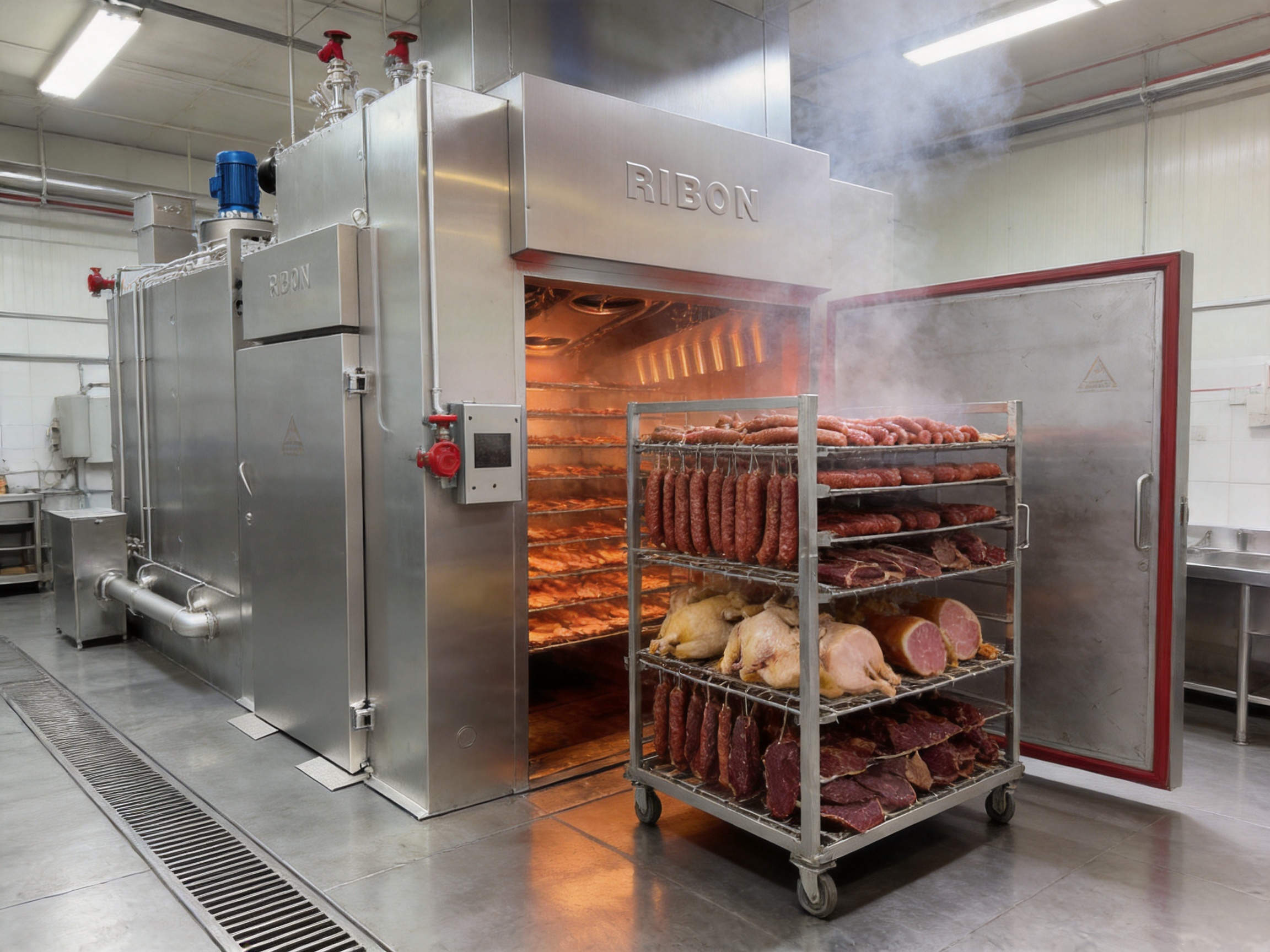
High-Performance CIP Cleaning System
Cleaning is a critical part of meat processing equipment operation. A smokehouse handles heat, moisture, smoke, grease, and food residues. If these elements are not removed effectively, they can affect hygiene, equipment reliability, and product quality.
The Central Heating Smokehouse uses a clean-in-place system designed to clean the main chamber, air chamber, and smoke pipe independently. Independent cleaning positions allow operators to direct cleaning resources to the areas that require attention.
The modular CIP cleaning system allows free selection of cleaning positions. This provides flexibility during routine cleaning and can improve cleaning efficiency. The operator can choose the appropriate area or sequence rather than applying the same cleaning procedure to every part of the machine at the same time.
Independent cleaning of the main chamber supports thorough sanitation of product-contact and near-product surfaces. Air chamber cleaning helps maintain the internal air circulation path, while smoke pipe cleaning addresses residue associated with smoke delivery.
The coved chamber corners, accessible aerodynamic ducts, effective drainage, and modular CIP design work together as a sanitary system. These features are more useful when considered collectively than when treated as isolated components. The result is equipment designed to support practical daily sanitation, not merely occasional deep cleaning.
Sanitary Design Advantages
The smokehouse uses insulated chamber walls and a hygienic internal arrangement. Smooth, accessible surfaces and minimized difficult corners help reduce the places where residues may remain. The trolley ramp is designed with a small angle and solid construction to support safe loading while minimizing contamination risks.
A sanitary design can also improve production planning. When cleaning is predictable and efficient, processors can schedule sanitation between batches with greater confidence. This is especially valuable for plants producing several product types in one working day.
Modular Construction and Installation Efficiency
The smokehouse uses a modular chamber design. Modular construction supports easier assembly and helps save container space during transportation. This is a significant advantage for international equipment delivery and for facilities with restricted access routes.
Modular equipment can be assembled at the installation location according to the project requirements. This may simplify transport into a building where a fully assembled chamber would be difficult to move through doors, corridors, or existing production areas.
Container space saving can also contribute to more efficient logistics. When the chamber is organized for transport as modules, the available shipping volume can be used more effectively. This may help reduce transportation complexity for overseas customers.
Modularity does not mean that the equipment is a temporary or lightweight solution. The chamber, air ducts, heating system, control system, and cleaning system are designed to operate as one integrated smokehouse after assembly. The modular approach focuses on transportation and installation practicality while maintaining complete processing functionality.
High-Quality Components and Reliability
Reliable meat processing equipment depends on the quality and compatibility of its key components. The smokehouse uses world-famous electrical and pneumatic components to support stable operation. The selection of recognized components can make maintenance, replacement, and troubleshooting more manageable for processors operating in different regions.
Component quality is supported by the company’s manufacturing control procedures. Key components are subject to incoming material inspection, in-process parameter monitoring, and dimensional accuracy verification. Each batch is tested against predefined specifications before being approved for assembly.
This approach is important because component problems can affect the entire process. A deviation in a fan component may influence airflow. An issue with a valve may affect humidity or drainage. An electrical control problem may interrupt a complete production cycle. Systematic inspection helps reduce the risk that unsuitable parts enter final assembly.
Low-speed, high-pressure fans combine effective performance with lower energy consumption and reduced noise. High-quality electrical and pneumatic parts support dependable operation of the control, heating, exhaust, smoke, and cleaning functions.
Manufacturing Strength and Quality Assurance
Zhejiang Ribon Intelligent Equipment Co., Ltd. was founded in 2003 by Mr. Shi Ming. Since its establishment, the company has specialized in the research, development, and manufacture of meat processing machinery. Its product scope includes meat processing smokehouses, vacuum tumblers, slaughtering equipment, cutting and deboning lines, and related meat processing solutions.
This specialization is a significant manufacturing strength. Rather than treating the smokehouse as one product among many unrelated industrial machines, the company focuses on equipment used in meat production. This supports a practical understanding of process hygiene, product handling, thermal treatment, smoke management, and factory workflow.
The company has exported meat processing solutions worldwide since 2003. International use exposes equipment to different plant layouts, production requirements, climate conditions, operator practices, and regulatory expectations. Such experience can contribute to continuous product improvement and more practical equipment design.
The company states that its production capacity reaches 1,000 smokehouse units per year. This production capability reflects dedicated manufacturing resources and the ability to support projects requiring repeatable equipment output. A high production capacity can also help provide a stronger supply foundation for customers planning new facilities or production expansion.
Manufacturing strength is not only a matter of quantity. It also depends on process control, assembly discipline, component inspection, testing, engineering coordination, and after-sales support. The smokehouse’s design includes multiple systems that must operate together, so manufacturing consistency is essential.
Strict Control of Key Components
The manufacturer applies quality control throughout the production process, with particular attention to components that directly affect performance and reliability. Incoming material inspection is used to evaluate parts before they enter production. In-process monitoring checks whether manufacturing parameters remain within the required range.
Dimensional accuracy verification helps confirm that components fit correctly during assembly. This is especially important for chamber modules, air ducts, doors, pipe connections, heating parts, and other components that influence sealing, airflow, drainage, or structural stability.
Each batch of key components is tested against predefined specifications. Only components that meet the established criteria are approved for assembly. This creates a controlled link between component quality and finished equipment performance.
Assembly Workshop Capability
A dedicated smokehouse assembly workshop supports the production of complete machines. The assembly process requires coordination between the chamber structure, heat exchanger, fans, air ducts, exhaust system, smoke generation equipment, control cabinet, sensors, valves, and CIP system.
Organized assembly procedures help ensure that these systems are installed in the correct positions and connected according to design requirements. They also support inspection before shipment and help identify potential problems before the equipment reaches the customer’s site.
The company’s focus on smokehouse production allows its assembly personnel to develop experience with the specific structure and operating principles of this equipment. Repeated production can improve familiarity with installation sequences, component interfaces, and common quality checkpoints.
Advantages Compared with Basic Smokehouse Designs
Many basic smokehouses can heat and smoke products, but they may not provide the same level of process integration. The Central Heating Smokehouse is differentiated by the way its systems work together.
| Design area | Central Heating Smokehouse approach | Practical production benefit |
|---|---|---|
| Air circulation | Dual independent fan motors and two-duct circulation with variable frequency control | More flexible and balanced control of air velocity across the chamber |
| Heating | Centrally positioned heat exchanger with a large heat transfer surface | Efficient heat exchange and stable thermal conditions |
| Control | PLC and touch screen with recipes, programs, status display, and data recording | Repeatable operation and easier process management |
| Humidity | Humidity control valve and condensate management | Better control of drying, steam use, and temperature uniformity |
| Exhaust | Powered active exhaust system | Faster removal of hot air and humidity during drying |
| Cleaning | Independent CIP cleaning for the main chamber, air chamber, and smoke pipe | More targeted and thorough sanitation |
| Interior geometry | Coved corners and accessible air ducts | Improved airflow and simpler cleaning |
| Smoke options | Adjustable wood chip smoke generator and optional liquid smoke atomizer | Greater flexibility for product and environmental requirements |
| Installation | Modular chamber design | Easier assembly and more efficient container transportation |
| Protection | Fault diagnosis, fire alarm, and power-off data retention | More convenient maintenance and reduced production loss |
These differences are particularly important for processors that require more than basic heating. Facilities producing multiple product categories, operating several shifts, or supplying demanding markets can benefit from greater automation, traceability, and sanitation control.
Fault Diagnosis and Power-Off Protection
The integrated fault diagnosis system is designed to simplify daily maintenance and troubleshooting. When a fault occurs, intelligent diagnosis displays the relevant information on the touch screen. This gives operators and maintenance personnel a clearer starting point for corrective action.
Fast fault identification can reduce unnecessary downtime. Instead of checking every system manually, personnel can use the displayed fault information to focus on the affected component or operating function. This is valuable in a production environment where delays may affect product schedules and labor planning.
The smokehouse also supports restart with the original data after a power outage or fault. Retaining the original process information can reduce production loss and help operators resume operation in a more controlled manner. It is important, however, that plant personnel follow their own safety procedures before restarting any equipment after an interruption.
Power-off protection is especially useful during long cooking, smoking, or drying programs. Without retained data, operators may need to reconstruct the process manually, which can create uncertainty about the product’s treatment history. Data retention supports more orderly recovery and better production documentation.
Applications for Different Meat Products
Beef Jerky
Beef jerky production often requires carefully managed drying and smoking. The active exhaust system, adjustable air circulation, controlled humidity, and smoke density adjustment can support the gradual removal of moisture while developing the desired surface characteristics.
Recipe programming allows operators to establish repeatable stages for reddening, drying, smoking, and cooking. The precise settings depend on the product formulation and target result, but the smokehouse provides the control structure needed to organize these stages.
Sausages
Sausages benefit from controlled reddening, drying, smoking, and cooking. Different casing types and sausage diameters may require different air velocities, humidity levels, smoke densities, and heating times. The variable frequency fan system and PLC control allow the operator to adapt programs to these differences.
Balanced circulation is especially important when sausages are loaded on several trolley levels. The two-duct system is designed to distribute air more evenly and reduce variations between product positions.
Hams
Hams may require extended thermal treatment and careful control of moisture. The insulated chamber, central heat exchanger, condensate management, and programmed humidity control support stable long-cycle operation.
Because hams can vary in size and loading density, process flexibility is important. Operators can adjust the recipe and air circulation settings to meet the characteristics of the specific product being processed.
Poultry
Poultry processing often places strong emphasis on hygiene, cooking consistency, surface appearance, and efficient cleaning. The smokehouse’s sanitary geometry, CIP system, active exhaust, and intelligent control help address these requirements.
The use of different smoking options allows processors to choose between wood chip smoke and liquid smoke atomization according to their product specifications and plant objectives.
Energy, Labor, and Operational Efficiency
Energy efficiency results from the coordinated performance of several systems. Insulated chamber walls reduce heat loss, while the central heat exchanger provides efficient thermal transfer. Low-speed, high-pressure fans support effective airflow with lower energy consumption, and variable frequency drives allow the system to avoid unnecessary fan operation.
The active exhaust system helps remove humidity when needed instead of relying on uncontrolled or prolonged ventilation. Controlled humidity and condensate management can also improve the use of steam and reduce inefficient heating conditions.
Labor efficiency is supported by automated recipes, touch screen operation, fault diagnosis, and CIP cleaning. Operators can spend less time repeating manual adjustments and more time supervising production, checking product quality, and managing the overall line.
Cleaning efficiency is equally important. Independent CIP positions and accessible internal structures can reduce manual cleaning effort and make sanitation more predictable. The actual cleaning program should be established according to the processor’s hygiene plan, detergent requirements, product residues, and applicable regulations.
When production, maintenance, and sanitation are all considered together, the smokehouse can support a lower total operating burden than a basic machine that requires frequent manual intervention.
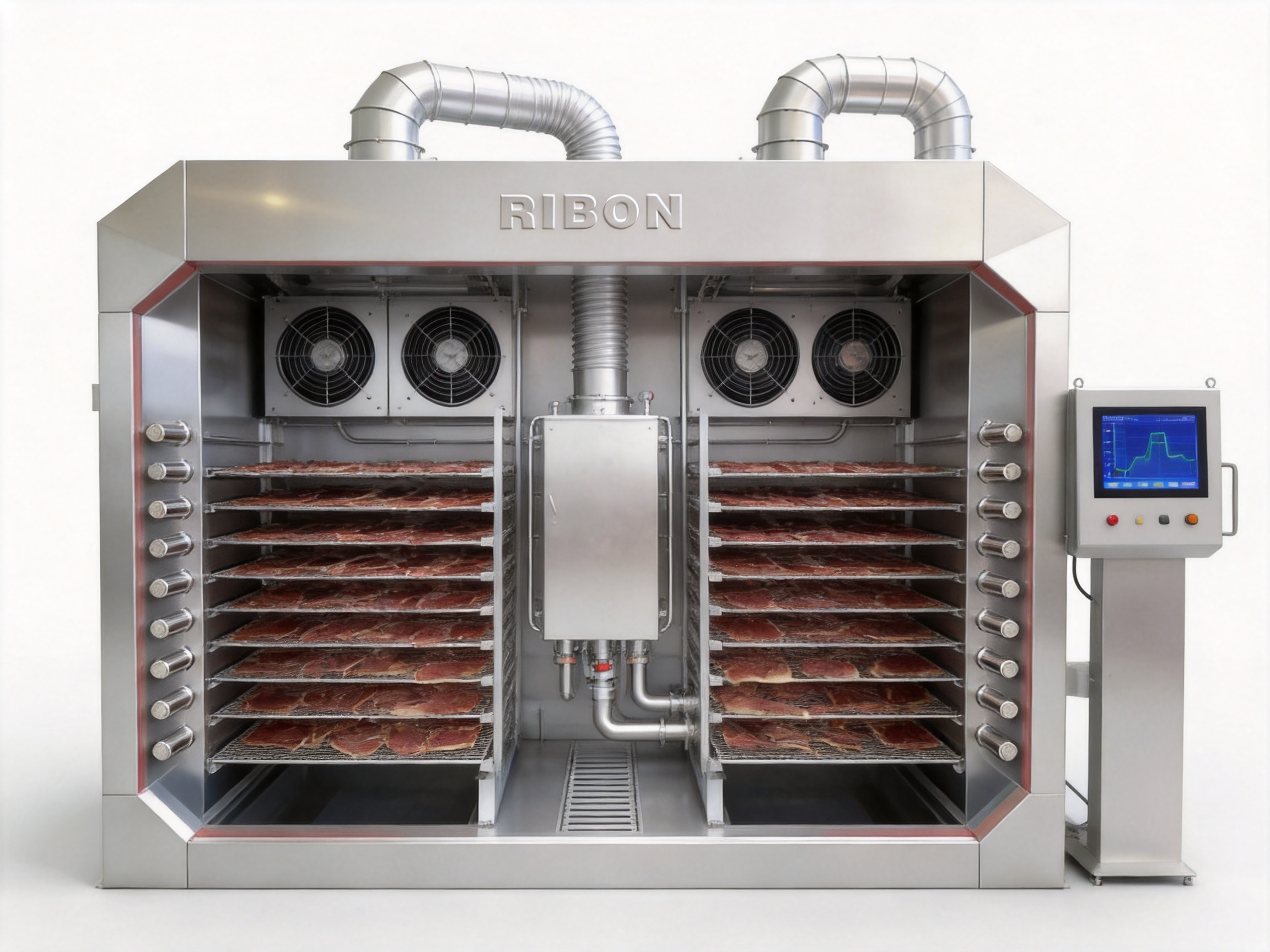
Installation and Integration into a Meat Processing Line
The Central Heating Smokehouse can be integrated into a broader meat processing operation. It may be positioned after preparation, marination, stuffing, or loading processes and before cooling, slicing, packaging, or further handling, depending on the product line.
Its compatibility with trolley-based loading provides flexibility for different production layouts. The modular construction helps address installation challenges where access is limited or where the equipment must be transported through existing plant structures.
Before installation, the processor should confirm the available floor area, ceiling height, trolley routes, utility connections, drainage, ventilation, and maintenance access. The smokehouse includes multiple functional systems, so adequate service space is important for safe operation and long-term maintenance.
The control system can become part of the plant’s broader production management approach. Recorded process data may support internal documentation, recipe control, batch review, and quality procedures. The level of integration depends on the plant’s control architecture and project requirements.
Maintenance Considerations
Routine maintenance is supported by the fault diagnosis system, accessible air ducts, modular CIP structure, and recognized electrical and pneumatic components. Operators can use the touch screen fault information to identify issues more efficiently.
Regular inspection should include fans, air outlets, heat exchanger surfaces, exhaust components, smoke pipes, valves, sensors, doors, seals, drainage points, and control components. Cleaning schedules should be followed according to the plant’s sanitation and maintenance plans.
The smoke generator and optional liquid smoke atomizer require their own maintenance procedures. Smoke pipes should be kept clean, and fire safety devices should be checked regularly. The exact inspection frequency should be determined by operating hours, product residues, smoke materials, local regulations, and the manufacturer’s technical documentation.
Preventive maintenance can help protect product consistency and reduce unplanned downtime. Since the smokehouse includes heating, air movement, smoke, humidity, exhaust, and cleaning systems, maintenance should address the equipment as a complete process unit rather than focusing on only one component.
Why Choose a Specialized Smokehouse Manufacturer
A specialized manufacturer understands that a smokehouse must satisfy several requirements simultaneously. It must heat efficiently, move air evenly, control humidity, distribute smoke, clean thoroughly, protect operators, record process information, and remain serviceable throughout its working life.
Zhejiang Ribon Intelligent Equipment Co., Ltd. has concentrated on meat processing machinery since 2003. Its product range includes smokehouses, vacuum tumblers, slaughtering equipment, cutting and deboning solutions, and other meat processing systems. This concentration supports the development of equipment around the actual needs of meat processors.
The company’s worldwide export experience provides exposure to different customer requirements and production environments. Its stated capacity of 1,000 smokehouse units per year demonstrates a dedicated production foundation. Strict quality control for key components further supports consistency between individual machines.
The manufacturer’s emphasis on practical design can be seen in the modular chamber, coved corners, accessible ducts, independent CIP positions, power-off protection, and fault diagnosis system. These details address daily operational issues that may not be visible in a basic product description but have a direct effect on productivity and maintenance.
Conclusion
The Central Heating Smokehouse is a complete solution for processors seeking controlled reddening, drying, cooking, smoking, and showering in one machine. Its dual independent fan motors, two-duct air circulation, variable frequency control, central heat exchanger, humidity valve, active exhaust, and adjustable smoke generation system work together to create a controlled production environment.
The equipment also places strong emphasis on hygiene and daily practicality. Coved corners, accessible aerodynamic ducts, modular CIP cleaning, condensate drainage, insulated walls, and a solid trolley ramp help support sanitation, safe handling, and efficient operation.
Its PLC touch screen provides recipe management, real-time status display, parameter adjustment, process recording, fault diagnosis, and power-off data retention. These functions help standardize production, reduce manual intervention, and simplify maintenance.
Compared with basic smokehouse designs, the Central Heating Smokehouse offers a broader combination of process control, energy-conscious operation, installation flexibility, sanitation access, and production data management. Supported by specialized manufacturing experience, strict quality control, and an annual production capacity stated at 1,000 smokehouse units, it is designed for meat processors that require reliable and scalable thermal processing equipment.
Questions and Answers
What products can be processed in the Central Heating Smokehouse?
The smokehouse is suitable for beef jerky, sausages, hams, poultry, and other processed meat products. Its programmable controls and adjustable airflow, humidity, heating, and smoke settings allow the equipment to be adapted to different product requirements.
What functions does the smokehouse provide?
The main functions are reddening, drying, cooking, smoking, and showering. These functions can be arranged into product-specific programs through the PLC touch screen.
How does the air circulation system improve processing?
Two independent fan motors drive a two-duct circulation system. Variable frequency drives regulate air velocity at the left and right outlets, helping provide more balanced and adjustable airflow throughout the chamber.
What is the purpose of the central heat exchanger?
The centrally positioned heat exchanger provides a large heat transfer surface area. It supports efficient thermal exchange and contributes to stable temperature distribution during processing.
Can the smoke intensity be adjusted?
Yes. The external wood chip smoke generator allows adjustment of smoke volume and density. An optional liquid smoke atomizer is also available for applications requiring no traditional smoke emissions.
How does the smokehouse manage humidity?
A humidity control valve regulates the chamber humidity. A Lind Weit drain valve collects condensate and helps improve steam utilization and temperature uniformity.
Is the smokehouse easy to clean?
The smokehouse includes a high-performance CIP system with independent cleaning of the main chamber, air chamber, and smoke pipe. Coved corners and accessible air ducts also support sanitation and reduce difficult-to-clean areas.
What control system is used?
The equipment uses a PLC-based control system with a touch screen interface. Operators can set parameters, manage recipes and programs, view operating status, record process information, and receive fault notifications.
What happens after a power outage?
The smokehouse is designed to restart with the original data after a power outage or fault. This helps reduce production loss and provides a more controlled recovery process, subject to the plant’s safety procedures.
How does the modular design help installation?
The modular chamber supports easier assembly and saves container space during transportation. It can also make delivery into facilities with restricted access more practical.
What components are used in the equipment?
The smokehouse uses world-famous electrical and pneumatic components. It also uses low-speed, high-pressure fans designed for efficient operation, lower energy consumption, and reduced noise.
How does the manufacturer control component quality?
Key components are checked through incoming material inspection, in-process parameter monitoring, dimensional accuracy verification, and batch testing against predefined specifications. Only components meeting the required criteria are approved for assembly.
Who manufactures the Central Heating Smokehouse?
The equipment is manufactured by Zhejiang Ribon Intelligent Equipment Co., Ltd., a Chinese meat processing machinery company founded in 2003. The company specializes in smokehouses, vacuum tumblers, slaughtering equipment, cutting and deboning solutions, and related meat processing systems.
References
Zhejiang Ribon Intelligent Equipment Co., Ltd. Product information for Central Heating Smokehouse.
Zhejiang Ribon Intelligent Equipment Co., Ltd. Company information and manufacturing profile.
Food processing equipment design principles concerning thermal processing, airflow management, humidity control, and hygienic construction.
General good manufacturing practice principles for sanitation and maintenance in meat processing facilities.
General industrial guidance on programmable logic controller operation, process data recording, and equipment fault diagnosis.