

 English
 русский
 Español
 عربى

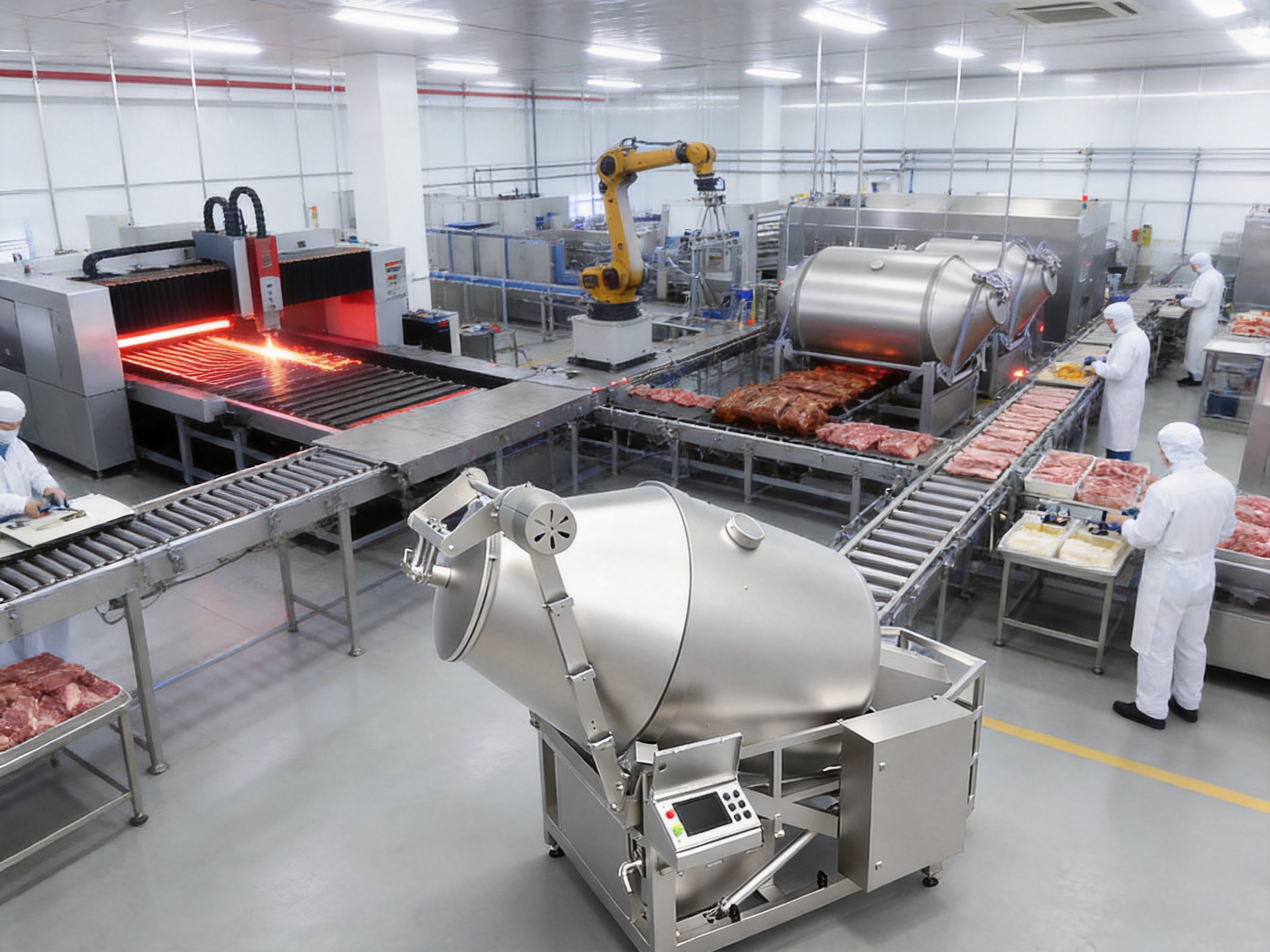
Modern meat processors require equipment that can improve product quality while maintaining reliable output, hygienic operation, and efficient use of labor and raw materials. A hydraulic vacuum tumbler is designed to meet these requirements by combining vacuum processing, controlled drum rotation, internal paddle action, and hydraulic tilting or loading functions in one integrated system.
Unlike a basic mixer or conventional marinating drum, a hydraulic vacuum tumbler works under carefully controlled vacuum and atmospheric pressure conditions. This alternating environment helps brine, marinades, seasonings, and other functional ingredients penetrate meat more effectively. At the same time, the rotating paddles massage and gently thresh the product, helping improve tenderness, texture, flavor distribution, and final yield.
The equipment is particularly suitable for large-scale meat processing operations handling beef, pork, poultry, seafood, sausages, cooked meat products, and other prepared foods. Its programmable controls, adjustable rotation speed, tiltable frame, hydraulic system, and optional cooling function allow processors to configure the machine according to the characteristics of different products and production processes.
Zhejiang Ribon Intelligent Equipment Co., Ltd. has specialized in meat processing machinery since 2003. The company focuses on meat processing smokehouses, vacuum tumblers, cutting and deboning equipment, and complete processing solutions. Its hydraulic vacuum tumblers are manufactured with automated laser cutting, fully automated welding, drum balancing, strict component inspection, and internationally sourced electrical parts.
This article explains the operating principles, technical characteristics, manufacturing strengths, applications, selection factors, and maintenance considerations of hydraulic vacuum tumblers. It also examines why advanced production methods and process-specific configuration are important when comparing equipment suppliers.
Content
- 1 1. What Is a Hydraulic Vacuum Tumbler?
- 2 2. Operating Principle of Vacuum Tumbling
- 3 3. Main Functions and Technical Characteristics
- 3.1 3.1 PLC and Touch Screen Control
- 3.2 3.2 Continuous Vacuum and Breathing Rotation
- 3.3 3.3 Adjustable Drum Speed
- 3.4 3.4 Tiltable Frame and Hydraulic System
- 3.5 3.5 Product-Specific Loading Options
- 3.6 3.6 V-Shaped and Blade-Shaped Paddles
- 3.7 3.7 Water-Sealed Vacuum Pump
- 3.8 3.8 Optional Cooling Function
- 4 4. Performance Advantages Compared with Conventional Tumblers
- 5 5. Manufacturing Excellence Behind the Equipment
- 6 6. Technical Specifications
- 7 7. Applications in the Meat Processing Industry
- 8 8. Possible Applications Beyond Meat
- 9 9. How to Select the Appropriate Model
- 10 10. Hygiene, Safety, and Maintenance
- 11 11. Manufacturing and Supplier Advantages
- 12 12. Installation and Commissioning
- 13 13. Common Questions and Answers
- 13.1 Q1: What is the main purpose of a hydraulic vacuum tumbler?
- 13.2 Q2: What products can be processed?
- 13.3 Q3: What is the difference between continuous vacuum and breathing rotation?
- 13.4 Q4: How fast can the drum rotate?
- 13.5 Q5: Why is the tiltable frame useful?
- 13.6 Q6: What loading options are available?
- 13.7 Q7: Why does paddle shape matter?
- 13.8 Q8: What vacuum level is specified for the models?
- 13.9 Q9: Does the machine include cooling?
- 13.10 Q10: How does automated manufacturing improve the equipment?
- 13.11 Q11: How should the machine be maintained?
- 13.12 Q12: Can one tumbler process different products?
- 14 14. Conclusion
- 15 References
- 16 Product: Hydraulic Vacuum Tumbler
1. What Is a Hydraulic Vacuum Tumbler?
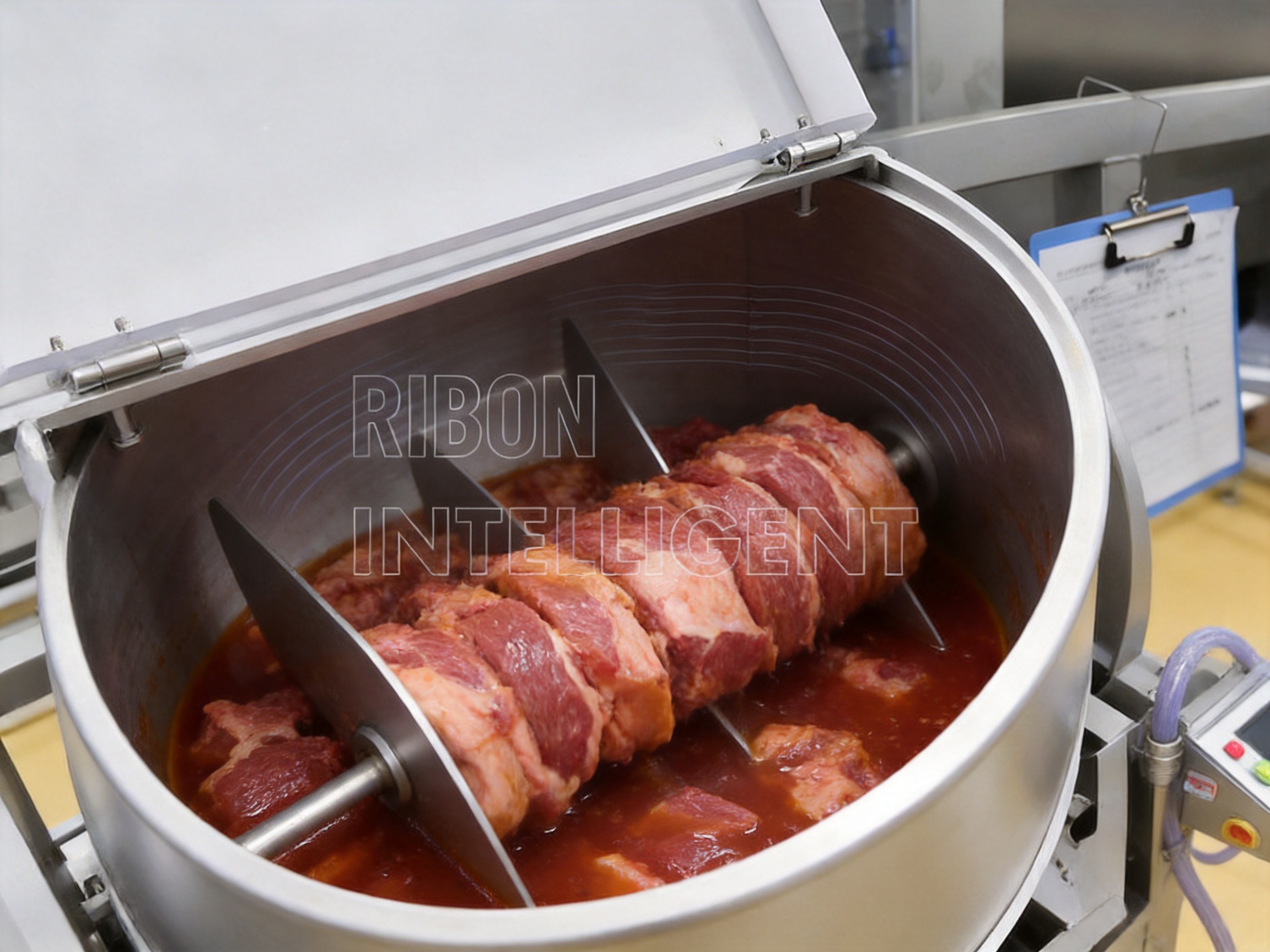
A hydraulic vacuum tumbler is an industrial machine used to massage, mix, marinate, tenderize, and condition food products inside a rotating drum. The drum operates under vacuum conditions, while internal paddles or carriers lift, turn, and gently work the product during rotation.
The hydraulic design generally provides two important functions. First, a hydraulic system can support drum tilting or positioning, allowing the operator to adjust the processing angle and create dynamic marination conditions. Second, hydraulic loading equipment can transfer raw materials into the tumbler, reducing manual handling and improving production efficiency.
The drum can be tilted through a range of angles, with the supplied equipment allowing adjustment from 0 to 20 degrees. This flexibility helps processors adapt the tumbling action to different raw materials, batch sizes, and product requirements. An inclined position can encourage product movement and improve contact between the meat and the marinade.
The machine uses a water-sealed vacuum pump to create a vacuum inside the drum. Under reduced pressure, air is removed from the product structure and from the surrounding processing environment. When the product is subsequently exposed to natural pressure, the marinade can move more efficiently into available spaces within the meat. Repeated vacuum and pressure changes support more uniform ingredient distribution.
A programmable logic controller and touch screen provide control over key operating parameters. Depending on the model and process design, the operator can set tumbling time, vacuum operation, breathing or continuous rotation, drum speed, and other production conditions. The speed can be adjusted from 2 to 12 revolutions per minute through a frequency inverter.
2. Operating Principle of Vacuum Tumbling
Vacuum tumbling combines mechanical action with controlled pressure conditions. The process begins when meat and marinade are loaded into the drum. As the drum rotates, internal paddles or carriers lift the product and allow it to fall or roll back through the batch. This repeated movement massages the meat and distributes the liquid ingredients.
The vacuum pump removes air from the drum. The lower pressure can help loosen the product structure and encourage the movement of brine into the meat. The rotation then spreads the brine across the surface and helps maintain consistent contact between the product and the marinade.
In breathing rotation mode, the equipment alternates between vacuum and natural pressure conditions according to the programmed process. This repeated pressure change can support the infiltration of brine and other ingredients. Continuous vacuum operation can also be selected when a particular product requires a stable reduced-pressure environment.
The mechanical action has several related effects. It can improve the distribution of salt, phosphate solutions, seasonings, sauces, and other marinades. It can also support protein extraction from the meat surface. The extracted proteins help bind individual pieces together in products such as formed meats, restructured meat, cooked ham, and certain sausage applications.
The term “parapeptone” is sometimes used in descriptions of meat tumbling to refer to soluble protein components produced or extracted during processing. The controlled combination of pressure, rotation, and massage can accelerate the dissolution and extraction of these components. In suitable formulations, this may improve binding, sliceability, cohesion, and cooking yield.
Processing conditions must be selected according to the raw material. Excessive speed, overlong tumbling, or unsuitable paddle geometry can damage delicate products. Conversely, insufficient mechanical action may lead to uneven seasoning, poor extraction, or inadequate absorption. The ability to adjust speed, angle, vacuum mode, and paddle configuration is therefore a major advantage.
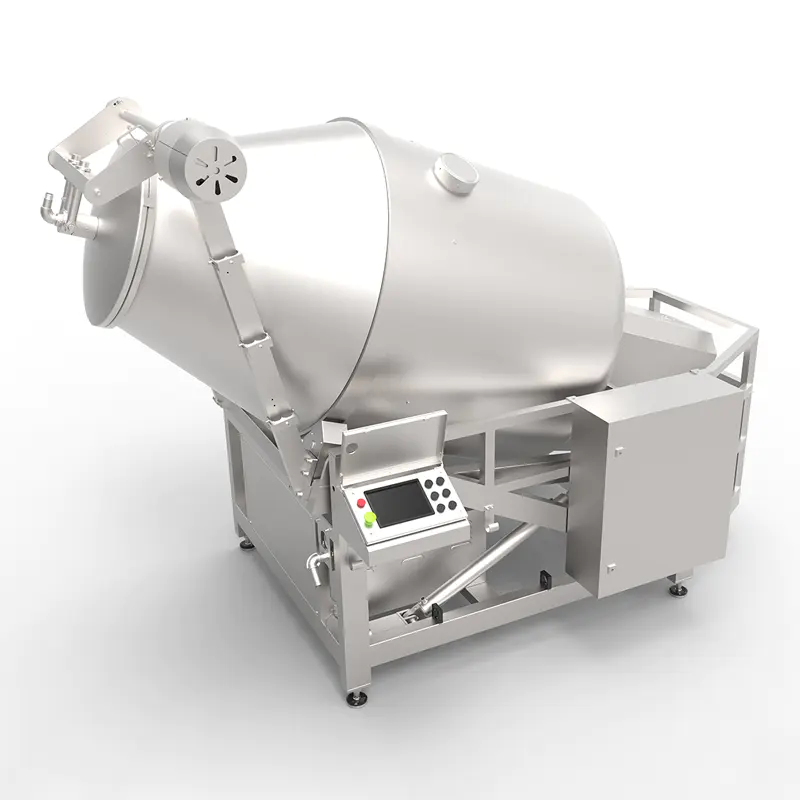
Hydraulic Vacuum Tumbler
3. Main Functions and Technical Characteristics
3.1 PLC and Touch Screen Control
The hydraulic vacuum tumbler is controlled through a PLC and touch screen interface. This arrangement allows operators to manage production parameters from a centralized control panel rather than relying on manual switches or inconsistent operating practices.
Programmable control supports repeatable batch processing. A processor can establish standard recipes for different products, including rotation speed, vacuum mode, processing duration, and other relevant settings. Consistent recipes are important for maintaining uniform flavor, texture, moisture retention, and yield across multiple production shifts.
The touch screen also makes the system easier to operate. Operators can monitor the selected settings and make controlled adjustments when necessary. In a modern production environment, clear controls reduce the risk of operating errors and make it easier to train new personnel.
3.2 Continuous Vacuum and Breathing Rotation
The machine supports continuous vacuum or breathing rotation. Continuous vacuum keeps the drum under a stable vacuum condition during the selected processing cycle. This mode may be useful when the product benefits from uninterrupted exposure to reduced pressure.
Breathing rotation alternates vacuum and natural pressure conditions. This action can encourage the marinade to move into the product and may be particularly useful for products requiring improved absorption. The best mode depends on product structure, marinade viscosity, loading ratio, and the desired final texture.
3.3 Adjustable Drum Speed
The drum speed can be adjusted from 2 to 12 rpm using a frequency inverter. This range allows the operator to select gentle or more active tumbling conditions.
Lower speeds are generally appropriate for fragile meat pieces, delicate poultry products, seafood, or processes where product integrity is a priority. Higher speeds can provide stronger mixing and more intensive mechanical action for robust cuts, dense batches, or products requiring greater protein extraction.
Variable-speed operation is more flexible than fixed-speed equipment. A fixed-speed machine may be acceptable for one product but unsuitable for another. Adjustable speed helps one tumbler serve several production lines or product categories, reducing the need to purchase separate machines for every application.
3.4 Tiltable Frame and Hydraulic System
The tiltable frame is a central feature of the hydraulic configuration. The drum can be adjusted to different angles, including positions from 0 to 20 degrees. This angle adjustment can affect how the product moves inside the drum and how the marinade contacts the meat.
Dynamic marination is supported by the combination of drum rotation and controlled inclination. The angle may be adjusted according to the batch size, raw material dimensions, product fragility, and required tumbling intensity. The hydraulic system provides controlled movement and supports the machine during loading, processing, and discharge operations.
A hydraulic structure can also simplify product discharge. By tilting the drum, the processor can direct the finished product toward a receiving container, conveyor, or subsequent production line. This may reduce manual shoveling and improve workplace ergonomics.
3.5 Product-Specific Loading Options
Different products and plant layouts require different loading methods. The equipment can be configured with different loading solutions, including a movable hydraulic loading device and a rail-type loading device.
A movable hydraulic loader can assist with lifting and transferring raw material containers. This is useful when containers must be moved between multiple machines or when the plant requires flexible equipment positioning.
A rail-type loading system can provide a more structured transfer path. It may be suitable for plants with fixed production routes and standardized container dimensions. Selecting the correct loading option can improve material flow and reduce unnecessary handling.
3.6 V-Shaped and Blade-Shaped Paddles
Internal paddle design has a direct effect on product movement and mechanical treatment. V-shaped paddles and blade-shaped paddles are available as options for different products.
V-shaped paddles may provide a balanced lifting and rolling effect. They can be useful when the processor wants to distribute product movement across the drum without applying excessively aggressive cutting or scraping action.
Blade-shaped paddles can create a different lifting and folding pattern. They may be selected for products requiring more intensive mixing or a particular tumbling trajectory. Paddle selection should be based on the product’s size, structure, moisture content, and target texture.
Using the correct paddle configuration can help reduce product damage, improve marinade coverage, and achieve a more consistent batch. This is one reason a technical consultation with the equipment manufacturer is valuable before ordering.
3.7 Water-Sealed Vacuum Pump
The equipment adopts a water-sealed vacuum pump. Water-sealed pumps are widely used in food-processing environments because their operating principle is suitable for applications involving moisture and vapor.
The vacuum system must be correctly matched to the drum volume, expected loading conditions, and processing cycle. A properly selected pump helps the machine reach the specified vacuum level efficiently and maintain stable operation during production.
The listed vacuum specification for the supplied models is -0.085 MPa. Actual performance can depend on sealing condition, ambient temperature, product loading, pump maintenance, and the integrity of the vacuum piping system.
3.8 Optional Cooling Function
An optional cooling function can help control product temperature during processing. Temperature management is important because mechanical action can generate heat, while meat quality is sensitive to temperature changes.
Maintaining an appropriate product temperature can support texture, color, water retention, and food safety management. The exact cooling method and capacity should be selected according to the product, batch size, processing duration, and plant refrigeration system.
4. Performance Advantages Compared with Conventional Tumblers
4.1 Improved Marinade Penetration
A conventional drum may distribute marinade across the outside of the product, but vacuum tumbling can assist with deeper and more uniform absorption. Reduced pressure helps remove air, while pressure recovery encourages the marinade to enter available spaces in the meat.
This does not eliminate the need for a suitable formulation or adequate processing time. However, it provides a controlled physical environment that can improve the efficiency of the marination step.
4.2 More Consistent Product Quality
Programmable control and adjustable rotation speed support repeatability. When an operator uses a defined recipe, batches can be processed under similar conditions rather than depending entirely on manual judgment.
Consistency is valuable for retail products, foodservice products, contract manufacturing, and export production. Consumers expect the same flavor and texture each time they purchase a product, while processors need predictable yield and production scheduling.
4.3 Better Yield Potential
Improved marinade distribution and protein extraction can help increase the usable yield of suitable products. The machine’s internal movement and inclined carriers are designed to improve contact between the meat and marinade. The drum can be tilted to support dynamic marination and absorption.
Yield depends on many factors, including raw material quality, formulation, injection or mixing strategy, product temperature, tumbling time, and cooking conditions. Nevertheless, a properly specified vacuum tumbler can contribute significantly to the overall yield improvement program.
4.4 Flexible Processing for Multiple Products
The speed range, paddle options, vacuum modes, tilting function, and loading alternatives allow the machine to handle a broad range of applications. A processor may use the same equipment for marinated meat, poultry, seafood, sausage materials, and selected ready-to-cook products after establishing appropriate recipes.
This flexibility can be more cost-effective than purchasing several specialized machines with limited functions. It also supports product development because new recipes can be tested on the same platform.
4.5 Reduced Manual Handling
Hydraulic loading and tilting functions can reduce the amount of manual lifting, pushing, and unloading required from production staff. Reduced manual handling may improve workplace safety and help maintain a more organized production flow.
In large processing facilities, the effect can be significant. A suitable loading system can connect raw material containers, the tumbler, conveyors, and downstream equipment, reducing bottlenecks between processing steps.
4.6 Stronger Process Integration
A hydraulic vacuum tumbler can be installed as part of a broader meat processing solution. It may be positioned after weighing, cutting, injecting, or preparation operations and before stuffing, forming, cooking, smoking, packaging, or freezing.
Because the machine can be supplied with different loading configurations, it can be adapted to various factory layouts. The equipment can therefore serve as an integrated production unit rather than a stand-alone drum requiring extensive manual support.
5. Manufacturing Excellence Behind the Equipment
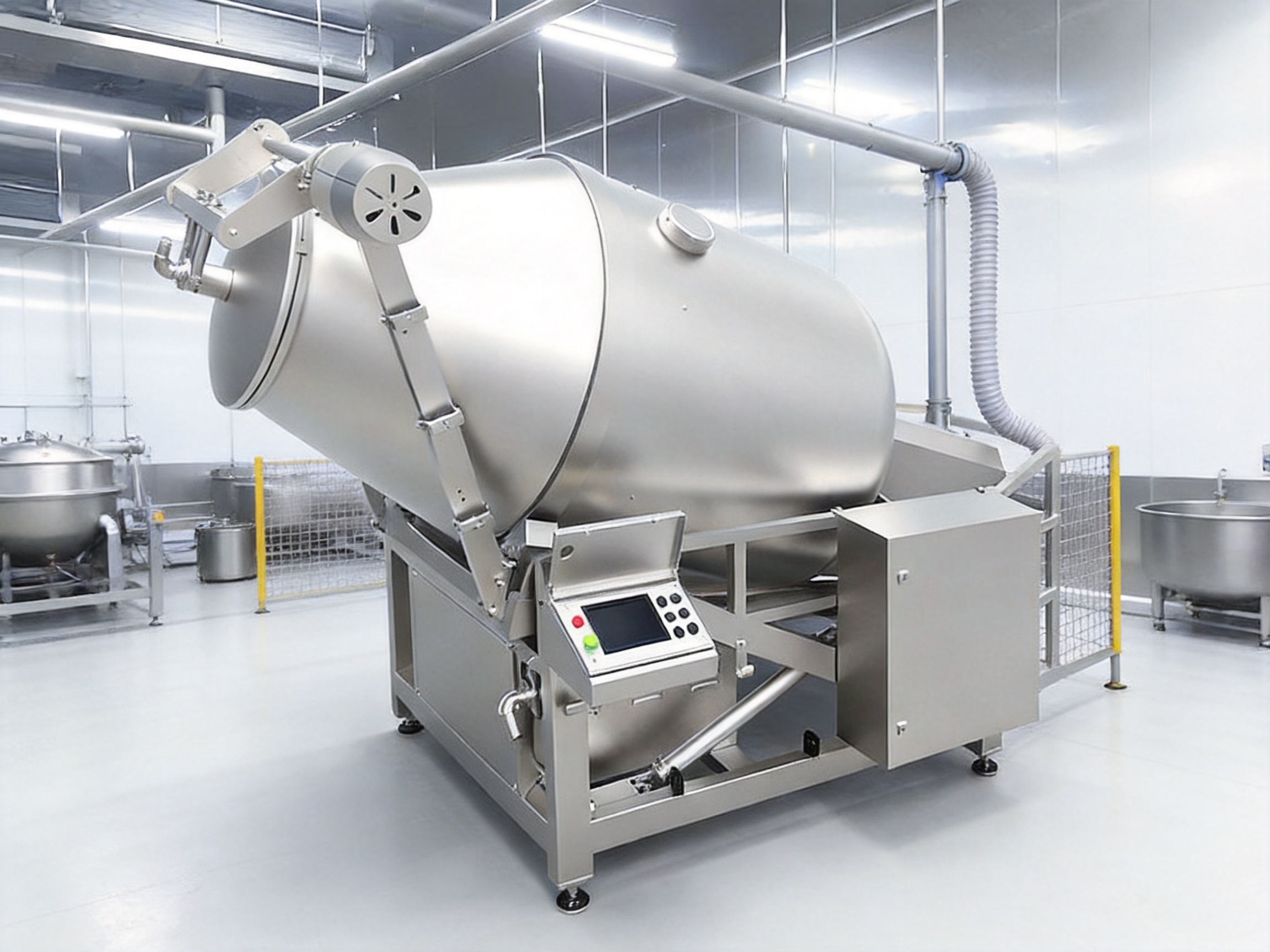
Equipment performance is not determined only by its feature list. The manufacturing process affects dimensional accuracy, drum balance, welding reliability, sanitation, operating stability, and long-term maintenance requirements. Zhejiang Ribon Intelligent Equipment Co., Ltd. emphasizes several manufacturing controls for its hydraulic vacuum tumblers.
5.1 High Production Capacity and Specialized Focus
The company reports a production capacity of approximately 1,000 vacuum tumbler units per year. This scale indicates a dedicated manufacturing focus rather than occasional production of tumblers alongside unrelated equipment.
High production capacity can provide several practical benefits. Repeated manufacturing experience helps engineers refine designs, identify common service requirements, standardize component selection, and improve assembly procedures. A specialized production team is also better positioned to understand the relationship between drum geometry, paddle movement, vacuum performance, and product quality.
Production scale must be combined with quality control. Capacity alone does not guarantee performance. The value of a specialized manufacturer lies in its ability to combine repeatable production with process verification, component control, and application knowledge.
5.2 Automated Laser Cutting
Related parts are cut using fully automated laser cutting equipment. Laser cutting supports accurate dimensions, clean edges, and repeatable production across batches of components.
Dimensional accuracy is important for a vacuum tumbler because drum sections, supports, covers, brackets, and other parts must fit correctly during assembly. Inaccurate cutting may create alignment problems, uneven gaps, unnecessary rework, or stress concentrations.
Automated cutting also reduces variation caused by manual fabrication. When parts are produced from controlled digital specifications, the manufacturer can maintain closer consistency between machines. This supports easier replacement, more predictable assembly, and stable equipment geometry.
5.3 Fully Automated Gas-Shielded Welding
The tumbler lid and drum are welded using fully automatic welding machines with gas-shielded welding technology. This process is intended to provide strong, consistent weld penetration and a clean external finish.
Compared with less controlled manual welding, automated welding can reduce variation in travel speed, heat input, weld placement, and penetration. Stable welding parameters are particularly important for a drum that must withstand repeated rotation, loading, vibration, cleaning, and vacuum cycles.
Strong welds help protect the structural integrity of the drum. Smooth and well-finished welds are also important in food-processing machinery because rough areas, incomplete welds, or difficult-to-clean joints can create sanitation challenges.
The manufacturer describes the welding process as supporting deep penetration and long-term, maintenance-free performance. Actual service life depends on operating conditions, cleaning practices, maintenance, loading, and correct installation, but controlled welding provides a strong foundation for reliability.
5.4 Drum Balancing After Welding
Drum balancing is performed after welding has been completed. This sequence is important because welding can introduce small changes in geometry or weight distribution.
An unbalanced drum may create vibration, noise, bearing stress, and unstable operation. These problems can become more serious as operating speed increases or as the equipment is used with heavy loads. Balancing the drum after fabrication helps ensure that the final assembled drum operates smoothly.
Operational stability benefits both the equipment and the product. Reduced vibration can lower mechanical stress, protect drive components, and create a more controlled tumbling environment. It can also improve working conditions around the machine.
5.5 Inspection of Key Components
The manufacturer applies strict quality control to components that directly affect performance and reliability. Controls include incoming material inspection, in-process parameter monitoring, and dimensional accuracy verification.
Each batch of key components is tested against predefined specifications. Only components that meet the required criteria are approved for assembly. This approach is important because a machine can be weakened by a single unreliable component, even if the main frame and drum are properly manufactured.
Quality inspection may cover materials, dimensions, surfaces, drive components, vacuum-related parts, hydraulic elements, electrical items, and other assemblies. A systematic inspection process provides greater confidence than relying solely on final visual inspection.
5.6 International Electrical Components
Electrical components are sourced from internationally recognized brands. The purpose is to support reliability and convenient local replacement.
Using widely available electrical components can simplify maintenance for overseas customers. Local technicians may already be familiar with the components, and replacement parts may be easier to obtain through regional distributors. This can reduce downtime compared with equipment built around obscure or proprietary electrical parts.
Electrical reliability is especially important in a PLC-controlled machine. Sensors, inverters, control modules, switches, and protective devices must work together to maintain safe and repeatable operation.
6. Technical Specifications
The following table summarizes the principal specifications of three hydraulic vacuum tumbler models. Actual configuration may vary according to loading equipment, paddle design, cooling requirements, electrical standards, and customer-specific options.
| Specification | RGR-1700HY | RGR-2500HY | RGR-3500HY |
|---|---|---|---|
| Driving power | 2.2 kW | 3 kW | 4 kW |
| Vacuum pump power | 3 kW | 4 kW | 5.5 kW |
| Hydraulic power | 2.2 kW | 2.2 kW | 2.2 kW |
| Drum capacity | 1,700 L | 2,500 L | 3,500 L |
| Maximum loading | 1,000 kg | 1,500 kg | 2,100 kg |
| Drum speed | 2–12 rpm | 2–12 rpm | 2–12 rpm |
| Vacuum level | -0.085 MPa | -0.085 MPa | -0.085 MPa |
The 1,700-liter model is suitable for processors that need substantial batch capacity while maintaining a relatively compact production footprint. The 2,500-liter model provides a higher loading capacity for medium-to-large processing operations. The 3,500-liter model is intended for high-volume production and can handle up to 2,100 kilograms under the stated conditions.
Maximum loading should not be interpreted as a universal value for every product. Meat density, cut size, marinade ratio, product temperature, paddle design, and required tumbling space can all affect the practical working load. A partially filled drum may be preferable for certain products because adequate free space is needed for effective product movement.
7. Applications in the Meat Processing Industry
7.1 Beef Processing
Hydraulic vacuum tumblers can be used for beef cuts, sliced beef, diced beef, and prepared beef products. Vacuum marination may help distribute brine, sauces, and seasoning across the product surface and into suitable muscle structures.
For restructured or formed beef products, controlled mechanical action can help extract soluble proteins and improve binding. The selected speed and paddle configuration should be adjusted to avoid excessive damage to the meat.
7.2 Pork Processing
Pork products are commonly processed with brines, marinades, and seasoning systems. Vacuum tumbling can support the production of marinated pork, bacon-related products, cooked pork, ham, and other prepared items.
For products intended for slicing after cooking, uniform ingredient distribution and protein extraction can be important. The tumbler can be integrated into a wider line that includes injection, forming, cooking, smoking, cooling, and packaging.
7.3 Poultry Processing
Poultry pieces and boneless poultry products can benefit from controlled marination. The adjustable speed range allows processors to choose gentler conditions for delicate pieces or more intensive conditions for robust products.
Temperature control is particularly important in poultry processing. An optional cooling function may support a stable process environment, although the complete food safety program must also include hygienic design, sanitation, monitoring, and validated operating procedures.
7.4 Seafood Processing
Fish, shrimp, scallops, and other seafood products can be processed with marinades, seasonings, or sauces. Because seafood may be more fragile than some red-meat products, operators should carefully select paddle type, speed, batch size, vacuum mode, and tumbling time.
A gentle process can improve ingredient coverage while protecting the appearance and structure of the seafood. Product trials are recommended before commercial production.
7.5 Sausage and Deli Products
Vacuum tumbling can support the preparation of sausage mixtures, deli meats, cooked ham, and other products requiring protein extraction and binding. The mechanical action helps distribute ingredients while vacuum conditions may reduce entrapped air.
Reduced air inclusion can be valuable for appearance, slicing behavior, and product cohesion. The correct formulation, temperature, and process sequence remain essential for achieving the desired result.
7.6 Ready-to-Cook and Prepared Foods
Ready-to-cook meat products often require uniform seasoning and reliable batch-to-batch flavor. Hydraulic vacuum tumblers can process marinated strips, skewered meat components, seasoned poultry, prepared seafood, and other products before packaging or cooking.
The equipment may also be used in foodservice production, central kitchens, catering operations, and contract manufacturing facilities that prepare large quantities of consistent products.
8. Possible Applications Beyond Meat
The fundamental actions of mixing, vacuum treatment, and controlled product movement can be relevant to selected non-meat applications. However, the hydraulic vacuum tumbler described here is primarily designed for meat processing, and any alternative application should be evaluated for material compatibility, hygiene, cleaning, and regulatory requirements.
Vegetables and fruits may be processed for seasoning, flavor infusion, or pickling in suitable systems. Pharmaceutical, cosmetic, chemical, and textile applications may use vacuum mixing or tumbling principles, but these industries normally require different materials, seals, validation procedures, cleaning standards, and explosion or contamination controls.
For this reason, processors should not assume that a meat-processing tumbler is automatically appropriate for every material. Non-food or non-meat use should be discussed with the manufacturer before purchase and confirmed through application testing.
9. How to Select the Appropriate Model
9.1 Determine Batch Size
The first selection factor is the required batch size. The 1,700-liter, 2,500-liter, and 3,500-liter models serve different production capacities. The correct model should provide sufficient working volume without being unnecessarily oversized.
Overloading can restrict product movement and reduce marination uniformity. Underloading may also reduce tumbling efficiency because the product may not interact properly with the paddles. The ideal filling ratio depends on the raw material and should be established through testing.
9.2 Evaluate Product Sensitivity
Delicate products require gentler handling than dense or robust cuts. Seafood, thin slices, small poultry pieces, and fragile prepared foods may need lower speed, shorter tumbling time, and a suitable paddle design.
Dense beef, pork, and formed meat products may tolerate more intensive mechanical action. Selecting V-shaped or blade-shaped paddles should be based on the desired movement and degree of mechanical treatment.
9.3 Consider Plant Layout
The available space, ceiling height, container dimensions, and downstream equipment influence the choice of loading system. A movable hydraulic loading device may be preferable in a flexible facility, while a rail-type system may be more suitable for a fixed production route.
The position of the vacuum pump, control cabinet, hydraulic system, discharge area, and cleaning access should be reviewed during project planning.
9.4 Review Utilities and Electrical Standards
Buyers should confirm electrical voltage, frequency, phase requirements, compressed-air requirements if applicable, water connections, drainage, and cooling utilities. International projects may require different electrical configurations or safety documentation.
Because electrical components are sourced from internationally recognized brands, replacement may be convenient, but the exact component selection should still be confirmed for the destination country.
9.5 Define the Desired Process Outcome
A processor should identify whether the primary objective is marinade absorption, tenderization, protein extraction, air removal, flavor distribution, yield improvement, product binding, or a combination of these goals.
The manufacturer can then recommend a suitable drum capacity, paddle style, loading method, speed range, vacuum mode, and cooling configuration. Clear process objectives lead to better equipment selection than choosing a machine based only on nominal capacity.
10. Hygiene, Safety, and Maintenance
Food-processing equipment must be operated within a documented hygiene and safety program. The tumbler should be cleaned according to an established procedure after each production cycle or as required by the product and facility standards.
Operators should inspect product-contact surfaces, seals, covers, discharge areas, paddles, and drainage points. Any residue that remains in difficult-to-access areas can create sanitation risks. Smooth welds and accessible surfaces support cleaning, but correct procedures remain essential.
Vacuum seals should be checked regularly. Leaks can reduce vacuum performance, increase pump running time, and affect the repeatability of the process. The water-sealed vacuum pump should be maintained according to the manufacturer’s instructions, including appropriate water quality and operating checks.
Drive components, bearings, hydraulic connections, and safety devices should be inspected at planned intervals. Unusual vibration, noise, temperature, or movement should be investigated promptly. The post-welding drum-balancing process helps support stable operation, but maintenance is still necessary throughout the service life of the equipment.
The PLC and touch screen should be protected from water ingress and inappropriate cleaning chemicals. Electrical cabinets must be serviced by qualified personnel, and lockout procedures should be followed before maintenance or internal inspection.
Operators should never enter the drum or remove guards while the machine is energized. The equipment must be stopped, isolated, and secured before any internal work is performed. Training should cover loading, unloading, vacuum operation, emergency stopping, cleaning, and basic fault reporting.
11. Manufacturing and Supplier Advantages
When comparing hydraulic vacuum tumbler suppliers, buyers should evaluate more than purchase price. Important factors include manufacturing specialization, process control, customization ability, component availability, technical support, documentation, and experience with similar products.
Zhejiang Ribon Intelligent Equipment Co., Ltd. has operated in the meat processing machinery field since 2003. Its product focus includes smokehouses, vacuum tumblers, and cutting and deboning solutions. This specialization allows the company to understand how tumbling equipment interacts with other production stages.
The reported production capacity of approximately 1,000 vacuum tumblers per year provides experience in repeated manufacturing and project delivery. Automated laser cutting improves component consistency, while automated gas-shielded welding supports structural strength and clean fabrication. Balancing the drum after welding addresses a common source of vibration and instability.
Strict inspection of key components adds another level of control. Incoming materials, production parameters, and dimensional accuracy are checked against defined requirements. International electrical components can help customers obtain replacement parts through local supply channels.
The company also offers multiple configuration options, including drum sizes, paddle forms, loading devices, tilting functions, vacuum modes, and optional cooling. Such flexibility is important because meat processors rarely have identical products, plant layouts, or production targets.
12. Installation and Commissioning
Before installation, the processor should prepare a level foundation with sufficient load-bearing capacity. The working area should provide access for loading, discharge, cleaning, inspection, and maintenance. Clearance around the machine should also allow safe movement of operators and material-handling equipment.
Utility connections should be checked against the approved technical documentation. Electrical supply, grounding, hydraulic requirements, vacuum piping, drainage, and cooling connections must be installed correctly before commissioning.
Commissioning should begin with an empty-machine test. The technician can verify drum rotation, speed adjustment, hydraulic tilting, loading movement, vacuum generation, control functions, safety switches, and emergency stops. A water or non-production test may then be used to inspect sealing and drainage.
Product trials should follow the mechanical inspection. Trials should record loading weight, marinade quantity, speed, angle, vacuum mode, temperature, processing time, and final product results. This information can be used to establish repeatable production recipes.
Commissioning is also an opportunity to train operators and maintenance staff. Training should include normal operation, cleaning, troubleshooting, safe access, component inspection, and procedures for reporting abnormal conditions.
13. Common Questions and Answers
Q1: What is the main purpose of a hydraulic vacuum tumbler?
The main purpose is to massage, mix, marinate, tenderize, and condition meat products under vacuum and natural pressure conditions. The rotating drum and paddles distribute ingredients, while the vacuum environment can improve brine penetration and support protein extraction.
Q2: What products can be processed?
The machine can process beef, pork, poultry, seafood, sausages, deli meats, formed meat products, and many ready-to-cook products. Product trials are recommended because speed, paddle design, loading ratio, and processing time must be matched to the raw material.
Q3: What is the difference between continuous vacuum and breathing rotation?
Continuous vacuum maintains reduced pressure during the selected processing period. Breathing rotation alternates vacuum and natural pressure conditions. Breathing operation can encourage marinade movement into the product, while continuous vacuum may be preferred for processes requiring stable reduced pressure.
Q4: How fast can the drum rotate?
The drum speed can be adjusted from 2 to 12 rpm using a frequency inverter. Lower speeds are generally suitable for delicate products, while higher speeds can provide more intensive mechanical action for robust products.
Q5: Why is the tiltable frame useful?
The tiltable frame allows the drum angle to be adjusted from 0 to 20 degrees. This changes the product movement inside the drum, supports dynamic marination, and can assist with discharge and material handling.
Q6: What loading options are available?
Available loading solutions include a movable hydraulic loading device and a rail-type loading device. The appropriate option depends on container design, plant layout, production flow, and the required level of automation.
Q7: Why does paddle shape matter?
Paddle shape affects how the product is lifted, folded, rolled, and released inside the drum. V-shaped and blade-shaped paddles provide different movement patterns and can be selected according to product sensitivity and processing objectives.
Q8: What vacuum level is specified for the models?
The listed specification is -0.085 MPa for the RGR-1700HY, RGR-2500HY, and RGR-3500HY models. Actual operating performance depends on sealing condition, pump status, product load, temperature, and installation quality.
Q9: Does the machine include cooling?
Cooling is available as an optional function. The need for cooling depends on the product, process duration, ambient conditions, and the plant’s temperature-control strategy.
Q10: How does automated manufacturing improve the equipment?
Automated laser cutting improves dimensional accuracy and repeatability. Automated gas-shielded welding provides consistent weld quality, while post-welding drum balancing helps reduce vibration. Together with component inspection, these processes support stable and reliable equipment performance.
Q11: How should the machine be maintained?
Maintenance should include regular inspection of seals, vacuum pump condition, hydraulic connections, drive components, bearings, electrical systems, safety devices, and drum balance. Cleaning and sanitation should be performed according to documented plant procedures and the manufacturer’s instructions.
Q12: Can one tumbler process different products?
Yes. The adjustable speed, vacuum modes, paddle options, tilting system, and programmable controls make the equipment suitable for multiple products. Each product should have its own validated recipe to protect quality and consistency.
14. Conclusion
A hydraulic vacuum tumbler is a versatile and highly functional machine for modern meat processing. By combining controlled vacuum conditions, programmable rotation, adjustable speed, hydraulic tilting, product-specific paddles, and flexible loading solutions, it can improve marination, tenderization, flavor distribution, protein extraction, product cohesion, and potential yield.
The equipment’s value extends beyond its operating functions. Manufacturing quality has a direct effect on long-term performance. Automated laser cutting, fully automated gas-shielded welding, post-welding drum balancing, strict inspection of key components, and internationally sourced electrical parts contribute to a reliable industrial platform.
The available models provide drum capacities from 1,700 to 3,500 liters and maximum listed loading capacities from 1,000 to 2,100 kilograms. With adjustable speeds from 2 to 12 rpm and a specified vacuum level of -0.085 MPa, the equipment can be configured for a wide range of meat products and production requirements.
Zhejiang Ribon Intelligent Equipment Co., Ltd. combines specialized experience in meat processing machinery with a broad range of configuration options. Its focus on vacuum tumblers, smokehouses, cutting equipment, deboning solutions, and complete processing systems enables customers to evaluate tumbling equipment as part of a larger production strategy.
For processors seeking consistent marination, improved material handling, reduced manual labor, and dependable large-scale production, a properly selected hydraulic vacuum tumbler can become an important part of an efficient and flexible processing line.
References
1. Product technical information for hydraulic vacuum tumblers, including operating functions, configuration options, and model specifications.
2. Manufacturing process information covering automated laser cutting, gas-shielded welding, drum balancing, component inspection, and electrical component selection.
3. General principles of vacuum marination, meat tumbling, protein extraction, brine absorption, and mechanical tenderization in food processing.
4. General food-processing equipment practices for hygiene, sanitation, temperature control, operator safety, and preventive maintenance.
5. General industrial guidance on programmable logic controllers, frequency inverters, hydraulic material handling, and water-sealed vacuum pump systems.