

 English
 русский
 Español
 عربى

Content
- 1 Introduction
- 2 What Is a Vertical Airflow Smokehouse?
- 3 Core Processing Functions
- 4 How the Vertical Airflow System Works
- 5 RUN-FLOW Technology for Product Uniformity
- 6 Heating and Smoking Configurations
- 7 Temperature and Humidity Control
- 8 Intelligent PLC Control and Data Management
- 9 Fault Diagnosis and Power-Off Protection
- 10 Hygienic and Sanitary Design
- 11 Modular Construction and Installation Benefits
- 12 Capacity and Technical Configurations
- 13 Manufacturing Strengths and Quality Control
- 14 Competitive Advantages
- 15 Applications in Meat Processing
- 16 Installation, Operation, and Maintenance Considerations
- 17 Q&A
- 17.1 What products can be processed in the Vertical Airflow Smokehouse?
- 17.2 How does vertical airflow improve product quality?
- 17.3 Can the smokehouse use steam and electricity?
- 17.4 What smoking methods are available?
- 17.5 What is the capacity range?
- 17.6 Can the machine perform cold smoking?
- 17.7 How precise is the temperature control?
- 17.8 Does the smokehouse include humidity control?
- 17.9 Is cleaning automated?
- 17.10 What happens if there is a power outage?
- 17.11 How does the manufacturer control quality?
- 17.12 Why is modular construction useful?
- 18 Conclusion
- 19 References
- 20 Product: Vertical Airflow Smokehouse
Introduction
Modern meat processors need more than a heated chamber and a smoke generator. They need a complete processing system that can deliver repeatable product quality, reliable production capacity, controlled operating costs, hygienic operation, and straightforward maintenance. A smokehouse must be able to dry, cook, smoke, redden, shower, and, when required, perform cold smoking or baking. It must also maintain stable temperature, humidity, airflow, and smoke density throughout every production cycle.
The Vertical Airflow Smokehouse is designed to meet these requirements through a combination of vertical air circulation, intelligent control, modular construction, high-quality components, and carefully engineered sanitation features. It is suitable for a wide variety of meat products and can be configured for operations ranging from small-scale production to large industrial manufacturing. Its flexible trolley capacity, multiple heating options, and selectable smoking systems allow processors to match the equipment to their recipes, facility conditions, and production plans.
Manufactured by Zhejiang Ribon Intelligent Equipment Co., Ltd., a specialist in meat processing machinery, the smokehouse reflects more than two decades of experience in research, development, manufacturing, and international supply. The company focuses on smokehouses, vacuum tumblers, and slaughtering, cutting, and deboning solutions. This product-focused approach enables the manufacturer to refine its equipment around the practical needs of food processors rather than offering a general-purpose machine with limited customization.
This article explains the operating principles, technical features, manufacturing strengths, and competitive advantages of the Vertical Airflow Smokehouse. It also examines how the equipment supports product consistency, energy efficiency, hygienic production, process automation, and long-term operational reliability.
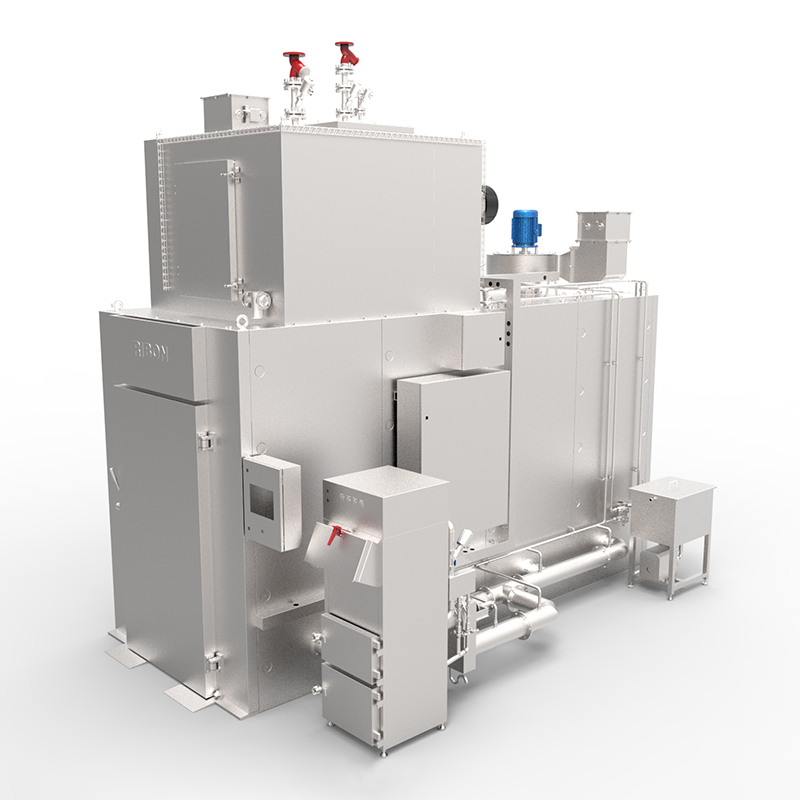
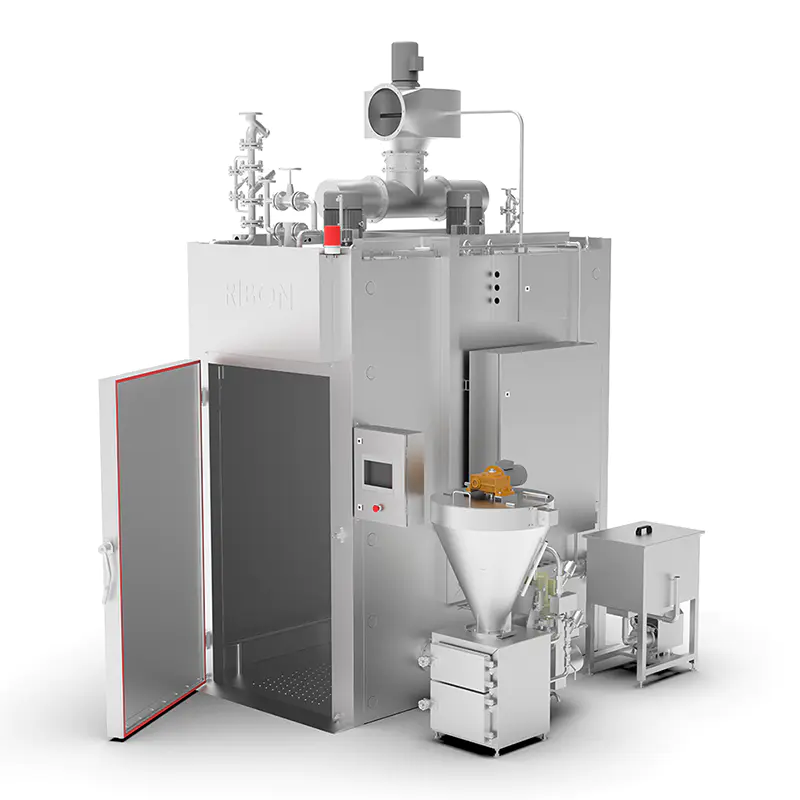
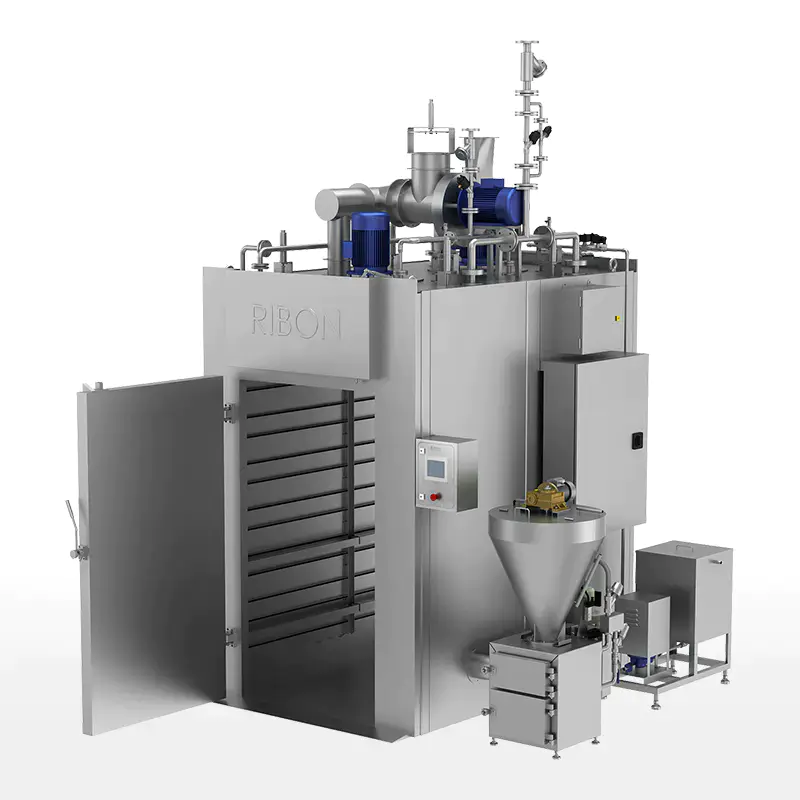
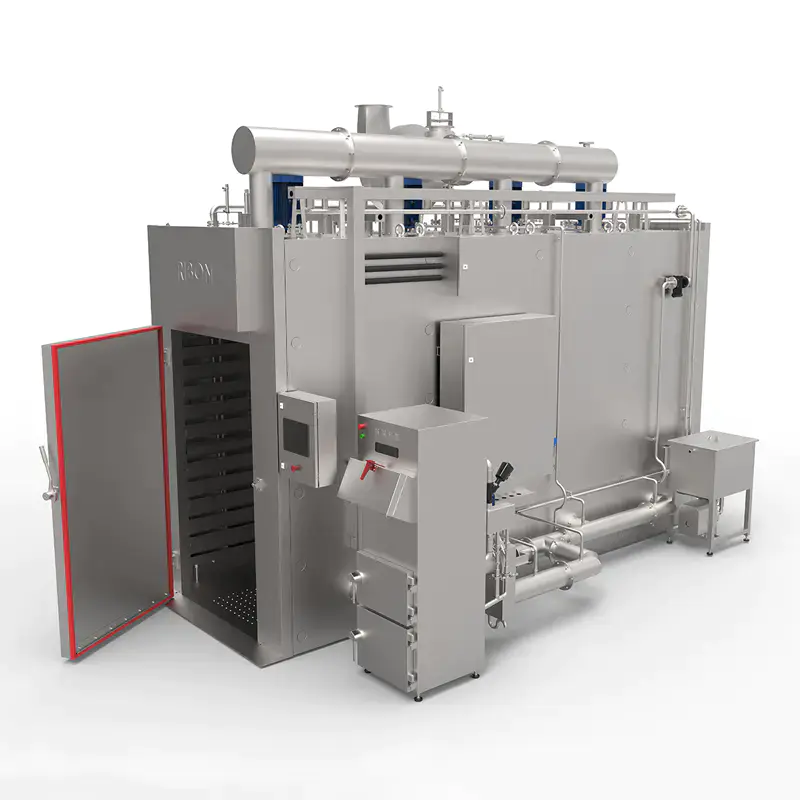
Vertical Airflow Smokehouse
What Is a Vertical Airflow Smokehouse?
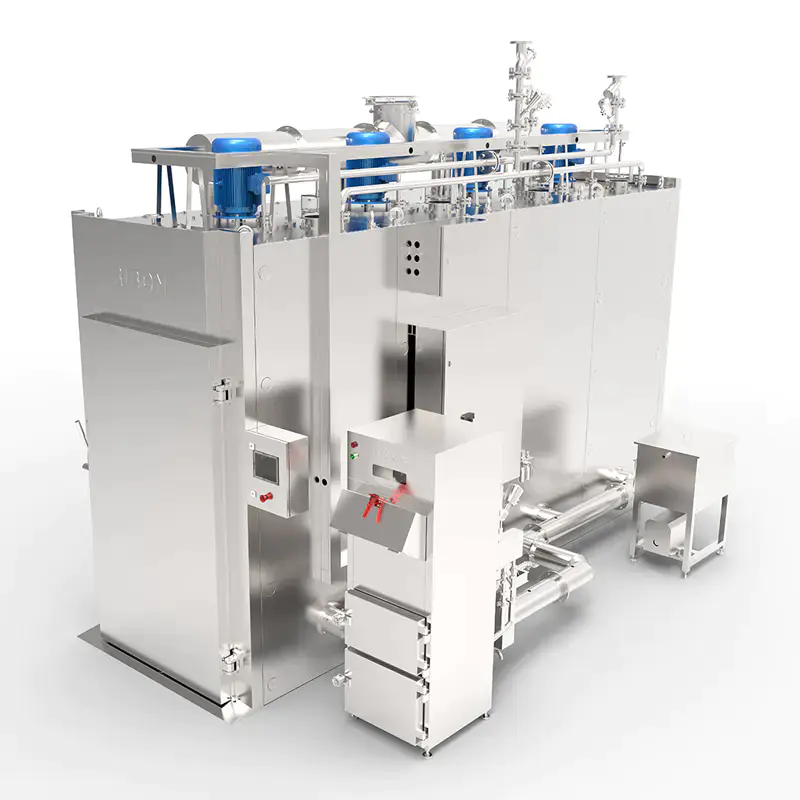
A Vertical Airflow Smokehouse is an industrial meat processing chamber that circulates heated, humidified, and smoked air vertically through the product space. The airflow design is intended to distribute heat and smoke more evenly than systems that rely on poorly controlled horizontal circulation or natural convection alone.
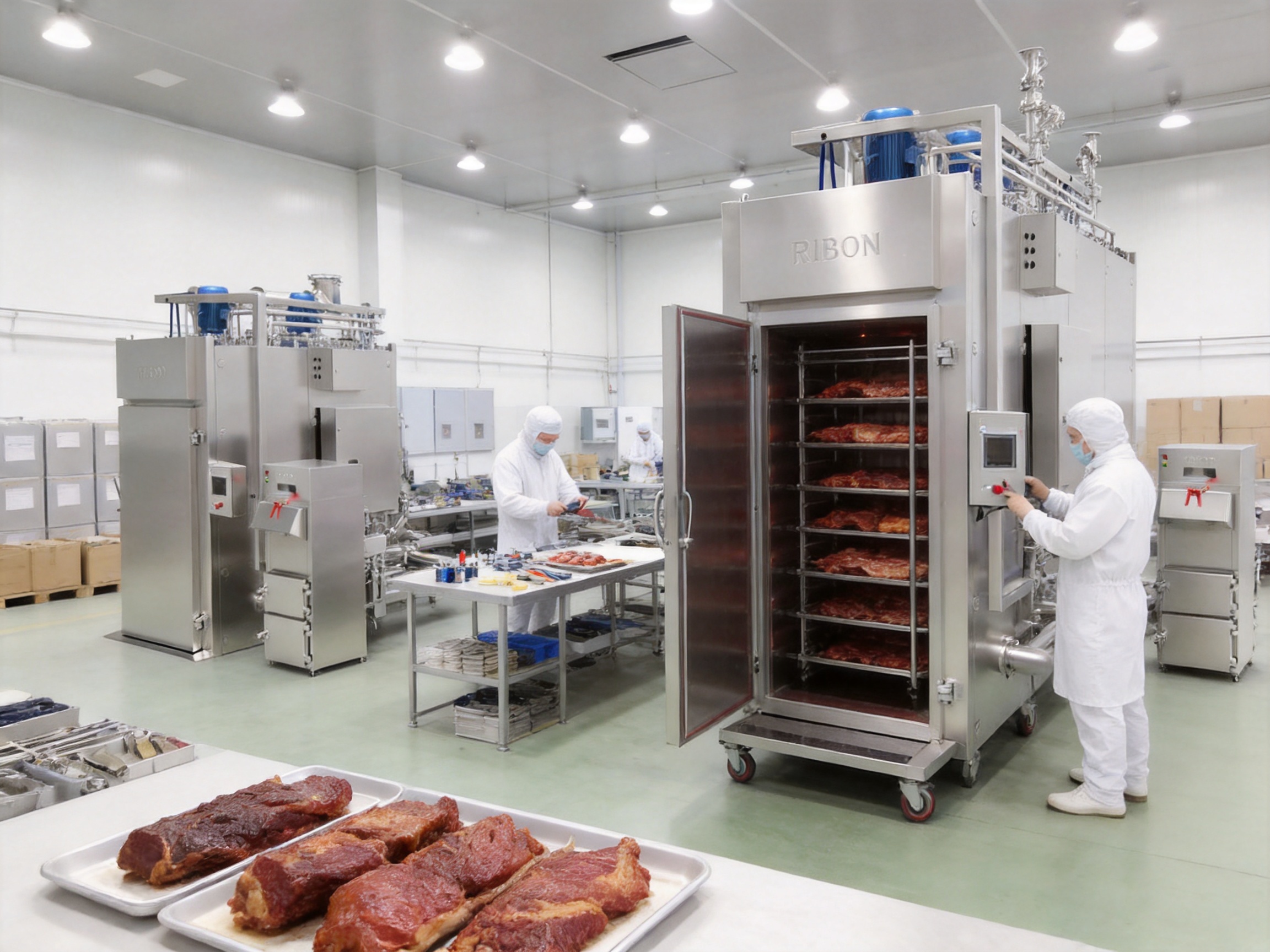
Products are loaded onto trolleys and moved into the smokehouse chamber. Depending on the recipe, the machine can first dry the surface of the product, then apply smoke, raise the cooking temperature, control humidity, shower the product, and complete a reddening or color-development stage. Each phase can be set through the control system and repeated through stored recipes.
The smokehouse supports several heating resources, including steam, electricity, natural gas, and liquefied petroleum gas. Smoking can be carried out using woodchip smoke or liquid smoke. The selection of heating and smoking methods gives processors the ability to choose a configuration based on available utilities, desired flavor, emissions requirements, facility layout, and production economics.
With a flexible design for one to eight trolleys, the equipment can be adapted to different output levels. The supplied technical data includes models with capacities from approximately 250 kilograms to 1,000 kilograms for the listed configurations, while larger multi-trolley arrangements can be designed according to customer requirements and plant conditions.
Core Processing Functions
Drying
Drying is often the first major stage in a smokehouse recipe. It reduces surface moisture and prepares the product for more effective smoke adhesion, color development, and heat transfer. Controlled drying helps prevent uneven surface coloration and supports a stable transition into the smoking or cooking stage.
Because the Vertical Airflow Smokehouse is designed to circulate air throughout the chamber, the drying environment can be maintained more uniformly around products positioned at different trolley levels. This is particularly important when the chamber is fully loaded and air resistance varies between rows of products.
Cooking
The cooking function raises the product to the required internal and chamber temperatures according to the selected recipe. Steam, electric heating, natural gas, or LPG can be used as the heating source. The appropriate method depends on the processor’s existing infrastructure, energy cost, desired heating response, and preferred installation arrangement.
Stable temperature control is essential for product safety, texture, yield, and consistency. Excessive temperature variation may cause some products to be underprocessed while others become dry or overcooked. The smokehouse uses sensors, automatic control, and airflow management to reduce these differences and create a more predictable cooking environment.
Smoking
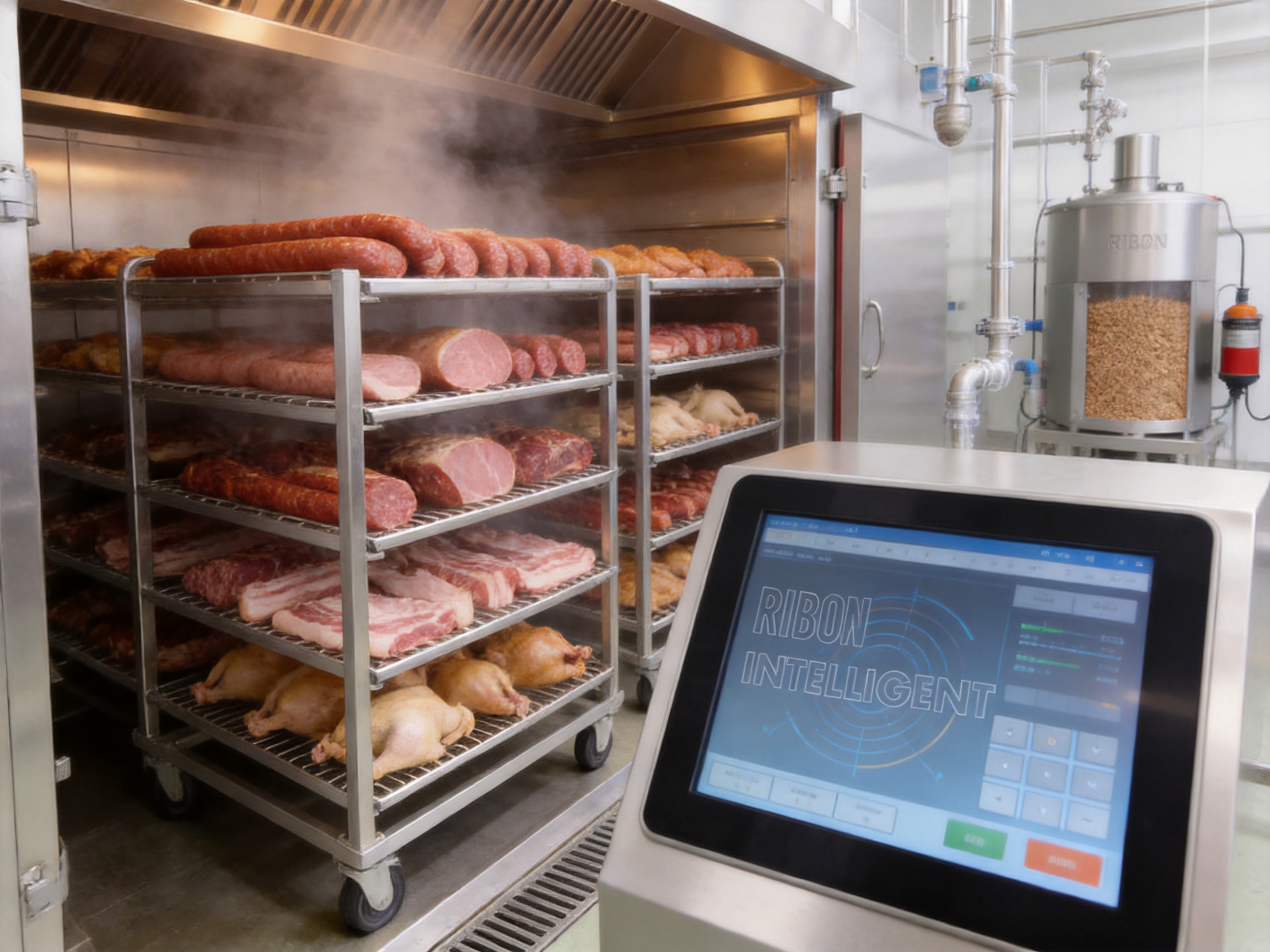
Smoking contributes flavor, aroma, color, and, depending on the process, a degree of surface preservation. The equipment can use an external woodchip smoke generator to produce traditional smoke or an optional liquid smoke atomizer for controlled application.
Woodchip smoking allows processors to develop characteristic smoke profiles using selected wood materials. The smoke volume and density can be adjusted according to the product and recipe. Liquid smoking provides another option where emissions control, simplified maintenance, or exact repeatability is a priority. The liquid smoke system is designed to avoid conventional smoke emissions and can be easier to maintain in facilities with strict environmental requirements.
Reddening
Reddening is used to improve the visual appearance of selected meat products. It can be integrated into the programmed processing cycle so that color development is performed under controlled temperature and humidity conditions. Stable airflow helps reduce color differences between products located near the air inlet, near the return path, or in the center of the chamber.
Showering
The showering function can be used as part of product cooling, surface treatment, or recipe-specific processing. Its application depends on the product type and the processor’s process design. By integrating multiple functions into one chamber, the system reduces the need to transfer products between separate machines and can help simplify production flow.
Optional Cold Smoking and Baking
In addition to standard drying, cooking, and hot smoking processes, the smokehouse can be configured for optional cold smoking and baking applications. Cold smoking requires more careful control of temperature and smoke delivery, while baking may require higher-temperature operation and precise control of residence time. These optional capabilities broaden the range of products that can be processed on the same platform.
How the Vertical Airflow System Works
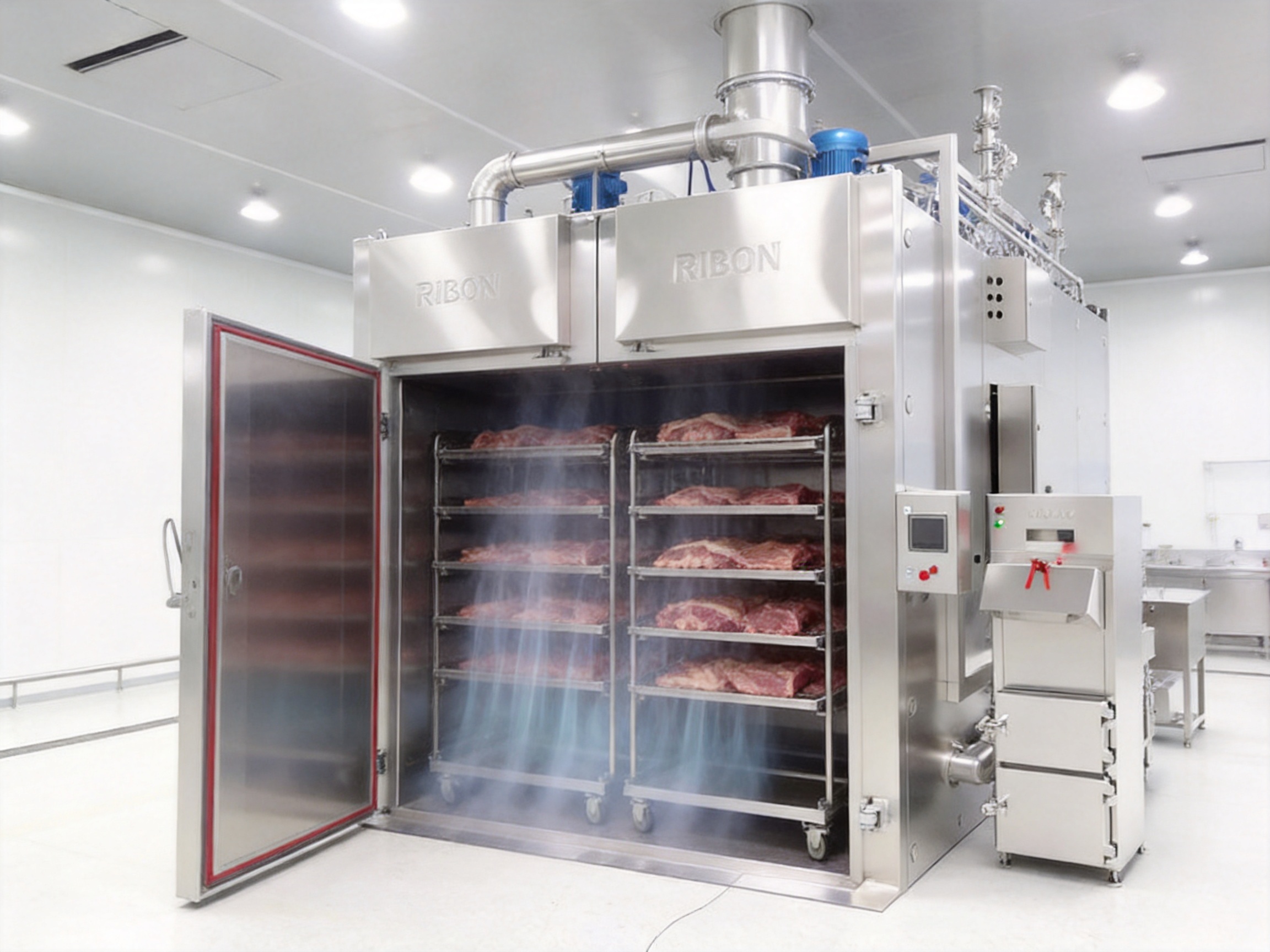
The central feature of the equipment is its vertical airflow system. Air is circulated through the chamber in a controlled vertical direction. Fans draw and move air through the heating and smoking zones, after which the conditioned air passes across the products and continues through the chamber circulation path.
In a typical operating cycle, air is heated by the selected heating source or receives smoke from the external generator. The fan then distributes this air through the product area. As the air moves vertically, it transfers heat and smoke to the products. The circulation pattern is designed to minimize stagnant areas and reduce the formation of hot or cold spots.
The system is not simply a natural rising-air arrangement. It uses mechanically driven airflow and controlled fan performance. The special low-speed, high-pressure fan is designed to provide effective air movement while limiting noise and unnecessary energy consumption. High pressure is important because loaded trolleys create resistance to airflow, particularly when products are densely arranged.
Vertical airflow also supports a compact chamber arrangement. Products can be loaded on several trolley levels without requiring an excessively wide chamber. This makes it possible to use floor space efficiently while maintaining access for loading, unloading, cleaning, and service.
Advantages Compared with Less Controlled Airflow Designs
The first advantage is uniformity. When air is properly distributed, products in different positions receive a more similar heat and smoke exposure. This helps produce consistent color, texture, moisture loss, and flavor.
The second advantage is process efficiency. Controlled circulation improves the contact between the conditioned air and the product surface. Better heat and smoke utilization can reduce unnecessary processing time and help lower energy consumption.
The third advantage is recipe flexibility. A controllable airflow system can be adapted to different products, load patterns, and process stages. The airflow required for drying may differ from the airflow required for smoking or cooking, and the control system can support these changes through programmed parameters.
The fourth advantage is equipment compactness. Vertical circulation is compatible with multi-level trolley loading, allowing significant production volume within a relatively efficient footprint.
The fifth advantage is quality repeatability. Once the temperature, humidity, airflow, smoke density, and time parameters have been established, they can be stored and reused. This reduces dependence on manual operator judgment and helps standardize production between shifts.
RUN-FLOW Technology for Product Uniformity
The smokehouse incorporates RUN-FLOW technology to support uniform vertical airflow. This technology is intended to stabilize the temperature and humidity environment around the products during processing.
Uniformity is especially important in commercial meat processing because differences between trolley levels can create visible and sensory inconsistencies. One section of a batch may develop a darker color, another may retain more moisture, and a third may require additional cooking time. Such variation can increase rework, reduce yield, and complicate quality control.
RUN-FLOW is designed to reduce these differences by creating a more balanced airflow pattern through the chamber. The result is a controlled process environment in which products are exposed to a more consistent combination of heat, humidity, and smoke.
The technology also supports process stability when the chamber is loaded to a high capacity. A smokehouse must continue to circulate air effectively even when trolley positions, product sizes, and loading density create resistance. The combination of a high-pressure fan, carefully designed airflow paths, and automatic control helps the equipment maintain reliable operating conditions.
For processors, the practical value of uniform airflow is directly connected to product quality. Consistent airflow can support even drying, uniform smoking, stable cooking, improved color development, and more predictable final moisture. It can also make recipe development easier because the operator is working with a repeatable chamber environment.
Heating and Smoking Configurations
The Vertical Airflow Smokehouse offers several heating resource options. Steam heating is suitable for plants that already have a central boiler system and want fast, evenly distributed heat. Electric heating can be attractive where electrical infrastructure is available and precise, clean operation is important. Natural gas and LPG provide additional flexibility for facilities that prefer direct fuel-based heating.
The choice of heating source affects installation, operating cost, maintenance, heat-up behavior, and environmental performance. Offering multiple options allows the machine to be integrated into different factories instead of forcing every customer to adopt one utility configuration.
Configuration Item |
Available or Listed Option |
Operational Benefit |
Heating resource |
Steam, electric, natural gas, or LPG |
Adaptation to plant utilities and energy strategy |
Smoking method |
Woodchip smoke or liquid smoke |
Traditional flavor or controlled low-emission processing |
Processing functions |
Drying, cooking, smoking, reddening, showering |
Multiple process stages in one chamber |
Optional functions |
Cold smoking and baking |
Broader product and recipe range |
Loading design |
One to eight trolleys, flexible design |
Scalable capacity for different production levels |
Woodchip smoke is generated outside the main chamber and introduced according to the selected recipe. An external generator makes the smoke supply easier to adjust and service. Smoke volume and density can be controlled to match different product requirements.
The optional liquid smoke atomizer provides an alternative method. It can reduce emissions associated with conventional woodchip smoke and simplify cleaning in some applications. It also allows accurate dosing and repeatable flavor application when the liquid smoke formulation has been validated for the product.
A fire alarm is included as part of the safety approach for woodchip smoking. Fire detection and protective controls are essential in any system that handles combustible smoking materials. These features support safer operation and help the equipment comply with applicable food machinery expectations when correctly installed and operated.
Temperature and Humidity Control
Temperature and humidity are two of the most important variables in smokehouse processing. Temperature influences cooking speed, microbial reduction, texture, and moisture loss. Humidity influences surface drying, smoke absorption, color development, and yield.
The smokehouse uses automatic control to regulate these variables during the production cycle. Operators can set process parameters through the touch-screen interface, while sensors provide real-time feedback. The control system can then adjust heating, airflow, humidity, and other functions to keep the process close to the selected values.
Many smokehouse applications require accurate control within a narrow operating range. The supplied product information describes precise temperature control using sensor feedback and automatic regulation. Exact accuracy depends on configuration, installation, product load, calibration, and recipe conditions, so processors should validate performance during commissioning and routine quality checks.
The available processing range depends on the selected design and application. Smokehouses of this type may support low-temperature cold smoking at approximately 10°C and high-temperature hot smoking or cooking at approximately 150°C or above, subject to the actual configuration and validated operating limits.
A humidity control valve regulates moisture inside the chamber. This allows the operator to create a drier environment during surface drying or a more humid environment during cooking and other stages. The system also includes a Lind Weit drain valve for condensate collection. Removing condensate helps improve steam utilization and supports temperature uniformity.
Effective condensate management is often overlooked, but it has a direct effect on process stability. Excess water accumulation can alter humidity, create uneven heating, increase cleaning requirements, and affect product appearance. A dedicated drain arrangement helps the equipment manage this moisture more effectively.
Intelligent PLC Control and Data Management
The PLC-based control system is designed to automate the processing cycle. Operators can enter temperature, humidity, time, airflow, smoke, and other recipe parameters through a touch-screen interface. The system displays real-time process status and allows authorized users to monitor and adjust operation.
Recipe management is valuable for manufacturers producing multiple product types. Sausages, hams, bacon, poultry products, cooked meats, and specialty smoked foods may require different drying, smoking, and cooking profiles. Stored recipes reduce setup time and help operators reproduce approved process conditions.
Data management also supports production traceability and process improvement. Recorded operating information can help a processor compare batches, investigate deviations, identify maintenance needs, and optimize energy use. When connected to the factory’s broader management system, the smokehouse may become part of a more comprehensive production and quality documentation process, subject to the selected control configuration.
The touch-screen display is intended to make operation more accessible. Instead of adjusting several independent controls manually, the operator can view the process through a central interface. This can reduce training requirements and support more consistent execution between operators and shifts.
Automation does not eliminate the need for skilled personnel. Product loading, recipe validation, sanitation, sensor calibration, and quality inspection remain essential. However, automatic control reduces unnecessary manual intervention and helps the operator focus on production supervision and quality assurance.
Fault Diagnosis and Power-Off Protection
Production interruptions can be costly, particularly when a batch is already in the middle of a long cooking or smoking cycle. The smokehouse includes intelligent fault diagnosis that displays fault information on the touch screen. Clear fault messages can help maintenance personnel identify the source of a problem more quickly.
The system also supports restart operation using original data after a power outage or fault, depending on the actual control configuration and event conditions. This function can reduce production losses by preventing the complete abandonment of a batch after a temporary interruption.
Protective functions may include alarms, over-temperature protection, fire detection, and interlocks. The exact safety package depends on the configured machine and applicable site requirements. Proper installation, operator training, preventive maintenance, and compliance with local regulations remain necessary for safe operation.
From a maintenance perspective, fault records can provide useful information about recurring issues. If a fan, sensor, valve, heater, or actuator generates repeated alarms, the maintenance team can investigate the underlying cause instead of treating each event as an isolated problem.
Hygienic and Sanitary Design
Food hygiene is a primary consideration in meat processing equipment. The chamber must be easy to clean, resistant to moisture, and designed to reduce locations where product residues or dirty water can accumulate.
The smokehouse chamber walls are insulated with polyurethane foam or rock wool. This insulation helps isolate the process heat, reduce energy losses, and maintain stable chamber conditions. A well-insulated chamber also helps improve operator comfort by reducing the transfer of heat to the surrounding production area.
The solid trolley ramp is designed with a small angle. This arrangement supports safer trolley movement while reducing the risk of product contamination associated with difficult or unstable loading. Smooth movement is important because trolleys may be heavy when fully loaded, and sudden movement can damage products or create safety hazards.
A modular clean-in-place system is available. The CIP system allows cleaning positions to be selected according to the chamber design and process requirements. Modular cleaning can improve efficiency by directing water and cleaning solution to areas that require attention while reducing unnecessary manual effort.
Cleaning performance still depends on the correct chemical concentration, water temperature, cleaning time, mechanical action, and final inspection. The equipment’s CIP design should therefore be integrated into the processor’s validated sanitation program rather than treated as a substitute for hygiene management.
Sanitary design also includes the selection of suitable materials, accessible components, reliable drainage, and a layout that supports inspection. These details are particularly valuable in plants operating multiple shifts, where cleaning time must be controlled without compromising food safety.
Modular Construction and Installation Benefits
The smokehouse uses a modular design that supports easier assembly and more efficient transportation. Modular chamber construction can reduce container space requirements and make the equipment more practical to ship to international destinations.
For customers expanding an existing factory, modular construction may simplify the installation process. Components can be delivered in manageable sections and assembled at the destination. The final installation must still be completed by qualified personnel, with attention to chamber alignment, utilities, drainage, ventilation, control wiring, and safety systems.
Modularity also supports customization. A processor may begin with a smaller trolley configuration and select a design suited to current output, while larger facilities may require several chambers or high-capacity arrangements. The one-to-eight-trolley flexible design enables the equipment to serve different production scales.
Space efficiency is an important advantage in meat processing plants. Floor area is expensive, and equipment must be positioned so that raw materials, finished products, workers, cleaning equipment, and maintenance personnel can move safely. A vertically organized smokehouse can provide substantial output without requiring an unnecessarily large footprint.
Capacity and Technical Configurations
The listed RYX series includes one- to four-trolley configurations. The one-trolley model has a stated capacity of 250 kilograms, while the two-, three-, and four-trolley models have stated capacities of 500, 750, and 1,000 kilograms respectively. The corresponding listed power values range from 6.1 kW to 18.1 kW, while electric heating power ranges from 30 kW to 120 kW. Steam consumption is listed from 40 kg/h to 160 kg/h.
The RYXN series includes two- and four-trolley models with stated capacities of 500 and 1,000 kilograms. Listed power values are 9 kW and 17 kW, with steam consumption of 80 kg/h and 160 kg/h.
Series |
Trolleys |
Capacity |
Power |
Electric Heating Power |
Steam Consumption |
RYX |
1 |
250 kg |
6.1 kW |
30 kW |
40 kg/h |
RYX |
2 |
500 kg |
10.1 kW |
60 kW |
80 kg/h |
RYX |
3 |
750 kg |
14.1 kW |
90 kW |
120 kg/h |
RYX |
4 |
1,000 kg |
18.1 kW |
120 kW |
160 kg/h |
RYXN |
2 |
500 kg |
9 kW |
Not specified |
80 kg/h |
RYXN |
4 |
1,000 kg |
17 kW |
Not specified |
160 kg/h |
The technical values are provided for reference and may change according to the selected configuration. Actual capacity can depend on product density, trolley layout, product spacing, recipe duration, utility conditions, and the required final quality. Processors should confirm all technical specifications during project engineering and quotation review.
Manufacturing Strengths and Quality Control
The manufacturer has specialized in meat processing machinery since 2003. Its product scope includes meat processing smokehouses, vacuum tumblers, and cutting and deboning solutions. This specialization is important because smokehouse performance depends on detailed knowledge of food processing, not only on general metal fabrication or industrial heating.
The company states that it has exported meat processing solutions worldwide and continuously optimized its technologies through practical application. International experience can support a better understanding of different plant layouts, utility standards, production requirements, and customer expectations.
Manufacturing capacity is another stated strength. The company reports a smokehouse production capacity of approximately 1,000 units per year. This level of production capability indicates an established manufacturing system rather than a purely custom, low-volume workshop. It can support larger projects, repeat orders, and standardized spare-parts planning.
Strict quality control is applied to key components that directly affect performance and reliability. Incoming materials are inspected before entering production. During manufacturing, process parameters are monitored, and dimensional accuracy is verified. Batches of critical components are tested against predefined specifications before they are approved for assembly.
This approach is significant because smokehouse reliability depends on many components working together. Fans, heating devices, valves, sensors, electrical components, pneumatic components, doors, insulation panels, drainage parts, and control systems must all meet their design requirements. A defect in one key component can affect the entire process.
Incoming inspection helps prevent unsuitable materials from entering production. In-process inspection identifies deviations before they become difficult or expensive to correct. Dimensional verification helps ensure that components fit correctly during assembly. Final testing provides another opportunity to confirm that the completed machine operates as intended.
The use of well-known electrical and pneumatic components further supports stability and serviceability. Widely recognized components may be easier to identify, replace, and maintain than obscure parts, especially for international customers. The specific brands and configurations should be confirmed for each project.
Manufacturing quality is also supported by assembly experience. A smokehouse is a complex system that combines mechanical construction, thermal insulation, air movement, process control, electrical wiring, safety devices, and sanitation features. An experienced assembly team can identify installation issues early and improve the consistency of completed equipment.
Competitive Advantages
Integrated Multi-Function Processing
One of the most important advantages is the ability to combine drying, cooking, smoking, reddening, and showering in one machine. Optional cold smoking and baking further extend its application range. This can reduce product transfers, save floor space, and simplify production planning.
Flexible Energy Selection
The choice of steam, electricity, natural gas, or LPG gives processors more freedom during project design. Competitors that offer only one heating method may be less suitable for factories with different utility conditions. Flexible energy selection also allows customers to consider local energy pricing and long-term infrastructure plans.
Traditional and Low-Emission Smoking
Woodchip and liquid smoke options allow the processor to choose between traditional smoke generation and a more controlled, lower-emission alternative. This is useful for manufacturers serving different markets or producing a broad product portfolio.
Uniform Vertical Airflow
The RUN-FLOW airflow concept, supported by a low-speed, high-pressure fan, is designed to provide even heat and smoke distribution. Uniform airflow can be a decisive advantage over basic systems that produce inconsistent chamber conditions.
Intelligent Process Control
PLC operation, touch-screen recipe management, real-time status monitoring, and fault diagnosis help improve repeatability. These functions can reduce operator workload and support more reliable process documentation.
Energy and Heat Management
Insulated chamber walls, efficient airflow, controlled humidity, condensate management, and the use of a low-speed fan contribute to energy-conscious operation. Exact energy savings depend on the process, product, utilities, loading pattern, and operating practices, but the design features are aligned with reducing unnecessary heat and airflow losses.
Scalable Modular Design
Modular construction supports transportation, installation, customization, and capacity planning. It is particularly valuable for international projects where container space and on-site assembly must be carefully managed.
Manufacturing Depth
A specialist manufacturing base with stated annual smokehouse production of approximately 1,000 units provides an advantage in production organization, component sourcing, assembly experience, and customer support. The company’s broader product portfolio also means that it understands upstream and downstream meat processing requirements.
Applications in Meat Processing
The smokehouse can be used for various processed meat products requiring controlled drying, smoking, cooking, color development, or cooling stages. Potential applications include sausages, ham products, bacon, poultry products, cooked meat specialties, smoked meat snacks, and other recipe-specific foods.
For sausage production, the machine can support surface drying, smoke application, cooking, reddening, and showering. For larger whole-muscle products, controlled humidity and airflow can help manage surface conditions during long processing cycles. Poultry products may benefit from programmable cooking and color development, while specialty products may require cold smoking or baking.
The actual suitability of a recipe must be confirmed through trials. Product diameter, casing type, fat content, initial temperature, loading density, target internal temperature, desired smoke intensity, and final moisture all influence the process. A reliable smokehouse provides the control platform, but product-specific validation remains essential.
Installation, Operation, and Maintenance Considerations
Before installation, the processor should confirm available utilities, drainage, ventilation, floor loading, access routes, ceiling height, trolley dimensions, and cleaning arrangements. Steam, electricity, gas, compressed air, water, and drainage requirements should be evaluated during the engineering stage.
The chamber should be positioned to support a logical production flow. Raw product loading, smokehouse operation, cooling, packaging, and finished product movement should be arranged to reduce cross-contamination risks and unnecessary transportation.
Operators should receive training in recipe selection, trolley loading, start-up, shutdown, alarm response, cleaning, and emergency procedures. Product spacing is particularly important because overloaded or tightly packed trolleys can restrict airflow and change the expected processing performance.
Routine maintenance should include inspection of fans, motors, heating components, valves, sensors, door seals, drainage systems, smoke generators, control panels, and safety devices. Sensors should be calibrated according to the plant’s quality system. Cleaning chemicals should be compatible with the machine materials and used according to documented procedures.
Preventive maintenance is generally more economical than waiting for a major failure. Replacing a worn seal or cleaning a partially blocked drain can prevent larger problems involving heat loss, humidity instability, contamination, or unplanned downtime.
Q&A
What products can be processed in the Vertical Airflow Smokehouse?
The smokehouse is suitable for many processed meat products, including sausages, ham, bacon, poultry, smoked specialties, and other products requiring drying, cooking, smoking, reddening, or showering. Product trials should be completed to establish the correct recipe for each item.
How does vertical airflow improve product quality?
Vertical airflow distributes conditioned air through the chamber and helps reduce hot spots, cold spots, and uneven smoke exposure. This supports more consistent cooking, drying, color, moisture, and flavor across products loaded at different positions.
Can the smokehouse use steam and electricity?
Yes. Steam and electric heating are available options. Natural gas and LPG are also available, allowing the equipment to be configured according to the customer’s utilities and operating strategy.
What smoking methods are available?
The smokehouse can use woodchip smoke or an optional liquid smoke atomizer. Woodchip smoking supports traditional smoke flavor, while liquid smoke can provide controlled application, reduced emissions, and simplified maintenance in suitable applications.
What is the capacity range?
The design is flexible from one to eight trolleys. Listed technical configurations include capacities from 250 kilograms to 1,000 kilograms for the supplied RYX and RYXN models. Larger or different arrangements should be confirmed according to the project requirements.
Can the machine perform cold smoking?
Cold smoking is available as an optional function. The actual operating temperature and recipe must be validated according to the product, smoke source, cooling arrangement, and required food safety controls.
How precise is the temperature control?
The smokehouse uses sensors and automatic PLC-based control to maintain the selected process conditions. Precision depends on the configuration, calibration, load, recipe, and installation. Many systems of this type can operate from low-temperature smoking conditions near 10°C to high-temperature cooking conditions of approximately 150°C or higher, subject to the specific machine design.
Does the smokehouse include humidity control?
Yes. A humidity control valve regulates moisture in the chamber, and a condensate drain arrangement supports steam utilization and temperature uniformity.
Is cleaning automated?
A modular CIP cleaning system is available. It allows cleaning positions to be selected for efficient sanitation. Manual inspection and supplementary cleaning may still be required as part of the processor’s validated hygiene program.
What happens if there is a power outage?
The intelligent control system is designed to support fault diagnosis and restart using original process data after a power outage or fault, depending on the specific event and control configuration. This can help reduce product loss and shorten recovery time.
How does the manufacturer control quality?
Quality control includes incoming material inspection, in-process parameter monitoring, dimensional accuracy verification, batch testing of key components, and approval before assembly. The company also uses recognized electrical and pneumatic components and maintains dedicated smokehouse manufacturing experience.
Why is modular construction useful?
Modular construction simplifies assembly, supports container space saving, and makes the machine easier to adapt to different factory layouts and capacity requirements. It is especially useful for international projects and future production expansion.
Conclusion
The Vertical Airflow Smokehouse is a comprehensive processing platform for manufacturers that require consistent quality, flexible production, and reliable automation. Its core advantage is the controlled vertical airflow system, which works with high-pressure, low-speed fan technology and RUN-FLOW principles to distribute heat, humidity, and smoke more uniformly throughout the chamber.
The equipment combines drying, cooking, smoking, reddening, showering, and optional cold smoking and baking in one modular system. Steam, electric, natural gas, and LPG heating options support different plant conditions, while woodchip and liquid smoke choices provide flexibility in flavor development, emissions management, and maintenance.
Insulated chamber walls, sanitary trolley access, condensate management, modular CIP cleaning, intelligent PLC operation, recipe storage, real-time monitoring, fault diagnosis, and power-off recovery all contribute to practical value beyond basic heating and smoking performance.
The manufacturer strengthens the product through specialist experience in meat processing machinery, international supply capability, large-scale smokehouse production, and strict quality control for critical components. Incoming inspection, in-process monitoring, dimensional verification, and final approval procedures help support equipment reliability.
For processors evaluating a new smokehouse, the most important considerations are not only nominal capacity or purchase price. Long-term value depends on consistent product quality, energy use, sanitation, serviceability, recipe repeatability, installation flexibility, and the manufacturer’s ability to deliver dependable technical support. By addressing these factors in one integrated design, the Vertical Airflow Smokehouse offers a strong solution for modern meat processing operations.
References
1. Product technical information for the Vertical Airflow Smokehouse, including functions, configurations, capacity data, airflow features, control systems, and sanitation options.
2. Technical data sheets for the RYX and RYXN smokehouse series.
3. Manufacturer-provided information concerning modular construction, component quality control, production capacity, and meat processing equipment manufacturing experience.
4. General principles of industrial smokehouse operation, including controlled drying, smoking, cooking, humidity management, condensate removal, and hygienic processing.
5. General food machinery engineering principles concerning process automation, preventive maintenance, thermal insulation, airflow control, and sanitation system design.