

 English
 русский
 Español
 عربى

The modern meat-processing industry requires more than individual machines. Processors need complete systems that can receive carcasses, divide them into primal sections, debone the meat efficiently, move products hygienically, and prepare finished cuts for packaging and distribution. A well-designed pig cutting and deboning solution brings these activities together into a coordinated production process that improves productivity, worker safety, sanitation, product consistency, and operational control.
Zhejiang Ribon Intelligent Equipment Co., Ltd. develops complete pig cutting and deboning solutions for meat processors seeking practical, scalable, and hygienic production systems. The solution is designed as a turnkey project that may include process planning, workshop layout, equipment manufacturing, installation, commissioning, and technical support. Instead of supplying isolated machines that operators must connect themselves, the company provides an integrated production concept based on the customer’s carcass volume, available workshop space, labor organization, hygiene standards, and packaging requirements.
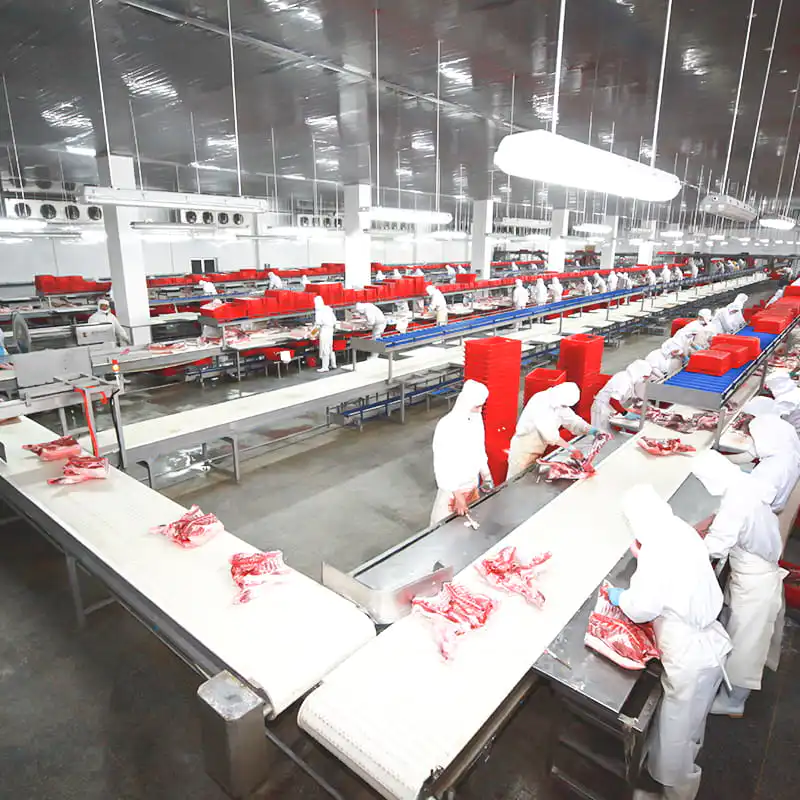
A typical system is divided into three closely connected sections: the pre-cutting line, the cutting and deboning line, and the packaging line. Each section performs a distinct function, yet all three are designed to work as one continuous process. The result is an organized flow from slaughtering output to primary cuts, deboned meat, filled crates, cleaned crates, and final packaging.
The solution is particularly suitable for processing plants that want to improve manual cutting operations without losing the flexibility required for different products and production volumes. Its modular conveyor design, carefully arranged workstations, crate circulation system, cleaning provisions, and customized layout make it adaptable to a broad range of processing environments.
Pig Cutting And Deboning Solution
Content
- 1 Why an Integrated Pig Cutting and Deboning Solution Matters
- 2 Complete Process Structure
- 3 Key Equipment and Functional Components
- 4 Advantages Compared with Conventional or Disconnected Systems
- 5 Manufacturing Strengths and Project Capabilities
- 6 Layout Planning for Different Processing Plants
- 7 Hygiene, Cleaning, and Food-Safety Support
- 8 Operator Safety and Ergonomic Design
- 9 Integration with Existing Processing Equipment
- 10 Quality, Yield, and Production Control
- 11 Installation and Commissioning Process
- 12 Maintenance and Long-Term Operating Value
- 13 Environmental and Resource Considerations
- 14 How the Solution Creates Competitive Advantage
- 15 Recommended Evaluation Criteria for Buyers
- 16 Q&A: Pig Cutting and Deboning Solutions
- 16.1 What are the main sections of the solution?
- 16.2 How is the cutting and deboning line structured?
- 16.3 What major cuts are made during pre-cutting?
- 16.4 What is the function of the vertical circular blade saw?
- 16.5 Can the packaging line connect to existing equipment?
- 16.6 How are empty crates supplied to operators?
- 16.7 How are filled crates handled?
- 16.8 How does the system support cleaning?
- 16.9 Is the system suitable for different workshop sizes?
- 16.10 Does the solution require complete automation?
- 16.11 What does turnkey project delivery include?
- 16.12 Why is workstation design important?
- 16.13 What type of company can benefit from this solution?
- 17 Conclusion
- 18 References
- 19 Product: Pig Cutting And Deboning Solution
Why an Integrated Pig Cutting and Deboning Solution Matters
Pig carcasses must be handled quickly and accurately after leaving the slaughtering area. Delays, poor material flow, unsuitable working heights, inadequate crate movement, or difficult-to-clean equipment can create bottlenecks throughout the factory. These issues may increase labor costs, reduce yield, affect product quality, and create unnecessary hygiene risks.
An integrated cutting and deboning solution addresses these challenges by coordinating equipment, people, products, and containers. The carcass is divided into major sections at the beginning of the process. These sections are then distributed to dedicated processing areas, where operators perform cutting, trimming, and deboning operations. Finished meat is placed into plastic crates, while empty crates are supplied through a separate clean-crate route. Filled crates are subsequently transferred toward packaging and dispatch.
This arrangement offers several operational advantages. First, it reduces unnecessary handling because the product follows a defined route. Second, it gives workers access to appropriate platforms and tools at each stage. Third, it separates clean crate circulation from filled crate circulation, making the material flow easier to understand and manage. Fourth, it provides a structure that can be expanded or modified when production requirements change.
Compared with a collection of disconnected machines, a complete solution also simplifies project responsibility. The customer can work with one equipment partner for design coordination, manufacturing, installation, commissioning, and process integration. This reduces the risk that conveyors, cutting stations, crate handling equipment, and washing systems will be incompatible or arranged inefficiently.
Complete Process Structure
Pre-Cutting Line
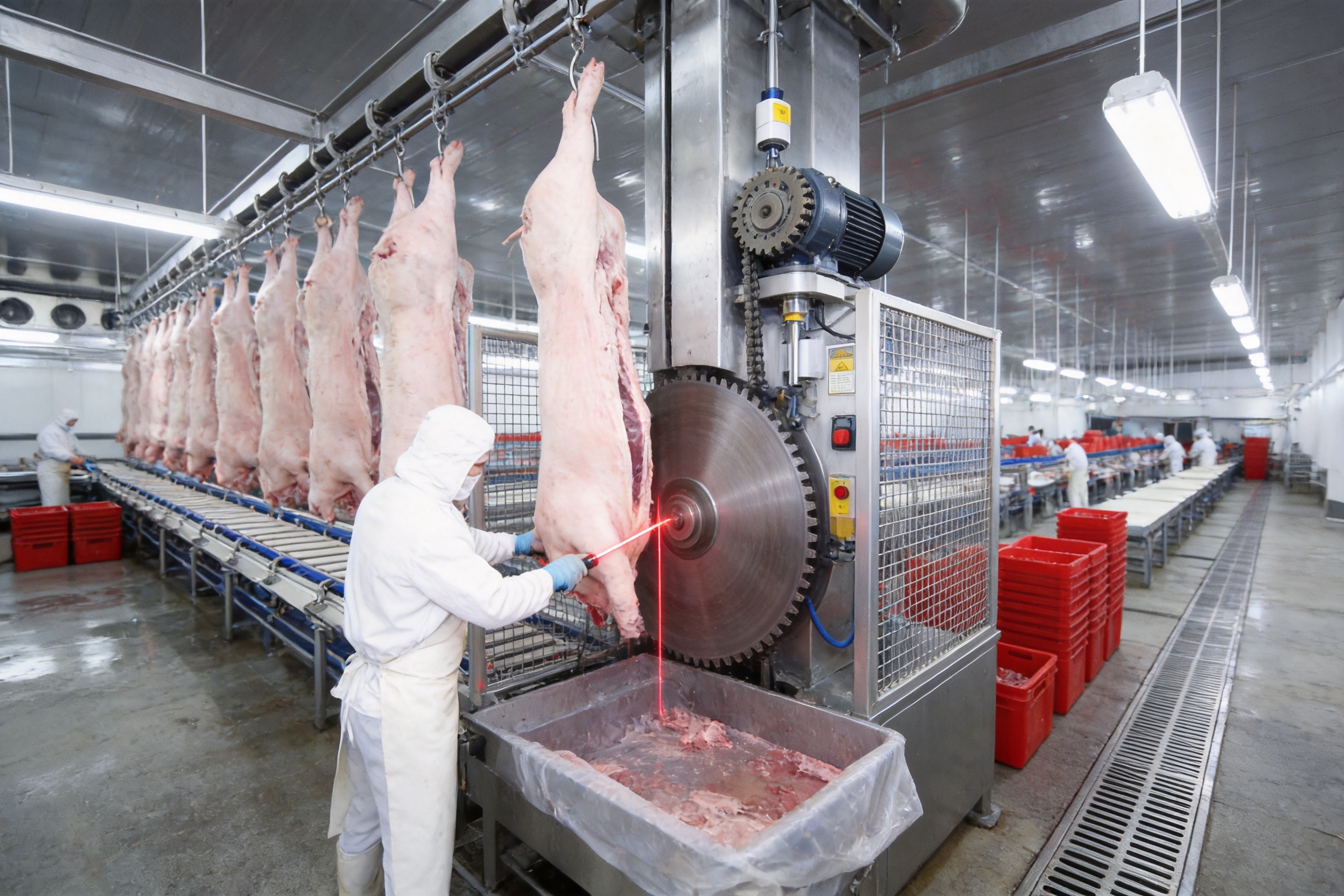
The pre-cutting line receives pig carcasses after the slaughtering stage. Its primary function is to make the major cuts required before detailed cutting and deboning. In the standard arrangement, a vertical circular blade saw is installed above the conveyor. An operator positions the carcass using a laser beam indicator, after which the saw makes the principal divisions.
The carcass is generally divided into three major sections: shoulder, belly, and ham. These parts are then directed to the corresponding processing areas on the cutup line. The pre-cutting stage is important because accurate initial division supports a balanced workload for downstream operators. It also ensures that each primal section arrives at the right workstation in a predictable orientation.
The design minimizes the number of workers required for positioning and initial cutting. Rather than depending on several operators to manually coordinate the carcass, the line uses a defined conveyor position, a laser guide, and a powered saw. This arrangement can improve cutting consistency while making the operator’s task easier to understand and repeat.
Cutting and Deboning Line
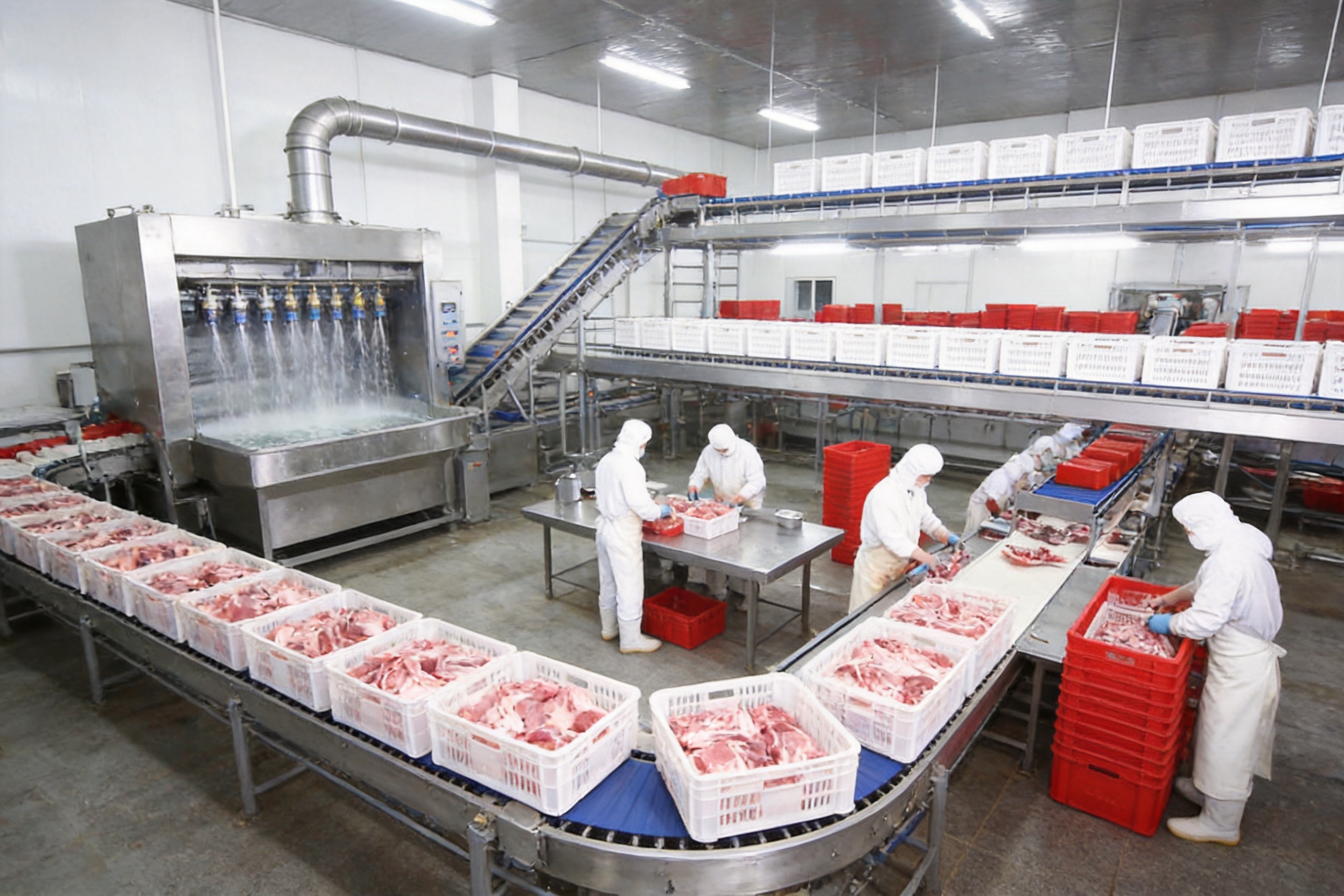
The cutting and deboning line is the central production area. It is divided into three layers or circulating routes: the clean crate line, the cutup line, and the filled crate line. These three routes work together to support the continuous processing of carcass sections.
The clean crate line transports empty and sanitized plastic crates to the appropriate workstations. Operators use these crates to collect deboned meat and finished cuts. The cutup line transports the shoulder, belly, ham, and other carcass sections through the processing area. The filled crate line carries crates containing deboned meat away from the cutting stations and toward packaging or subsequent handling.
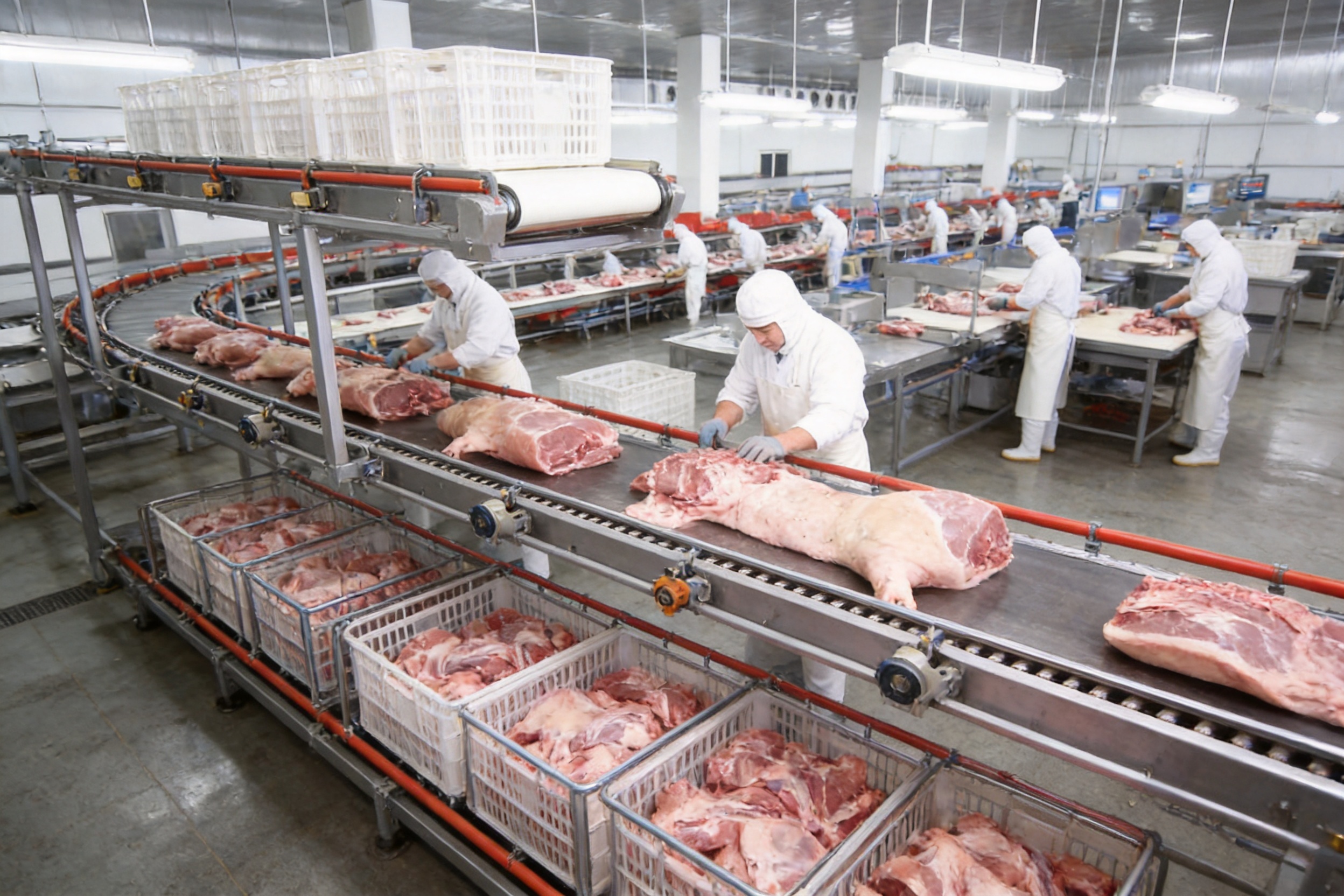
Operating tables are arranged along the cutup line. The tables are positioned on one side of the conveyor, and each workstation includes a crate frame for temporary product storage. When a crate becomes full, it can be pushed into the filled crate line. At the same time, operators can obtain a clean crate from the upper clean-crate line. This creates a practical exchange system that limits interruptions during production.
The three-layer arrangement helps separate incoming materials, work-in-process products, and completed meat cuts. It also supports better organization of the workshop because operators do not need to move filled crates across the main processing route or search for empty containers on the floor.
Packaging Line
The packaging line continues the organized movement of products and crates. It generally includes an upper line and a lower line. The lower line transports plastic crates filled with deboned meat cuts. The upper line transports empty and clean plastic crates back toward the processing stations.
Used crates are directed to an automatic crate washer. The washing system can sterilize and dry the crates before they return to the clean-crate route. This repeated circulation reduces the need for manual crate handling and supports a more controlled hygiene process.
Packaging platforms are designed as two-level work areas. This arrangement can improve space utilization and increase working efficiency by allowing products and containers to move through the packaging area in an organized vertical arrangement. Modular conveyors and crate-stabilizing cams help maintain reliable transport, particularly when plastic crates are transferred between different levels or sections.
Key Equipment and Functional Components
Vertical Circular Blade Saw
The vertical circular blade saw performs the major division of pig carcasses during pre-cutting. The saw is driven by a geared motor with a protective cover. The covered drive arrangement helps protect the transmission components and gives the equipment a more orderly external structure.
A laser beam indicator helps the operator identify the intended cutting position. This is useful when the plant requires repeatable separation of the shoulder, belly, and ham. By providing a visible reference, the laser can reduce positioning uncertainty and help operators work more consistently.
The saw is also equipped with an inductive detector. This safety-related feature is intended to help prevent incorrect operation by detecting the relevant operating condition before the saw is activated. Such features are important in areas where sharp powered equipment is used and where safe coordination between the operator, carcass, and machine is essential.
The saw can be swirled through 180 degrees using a hydraulic pump. This design makes it easier to access the equipment during cleaning and maintenance. The blade area can be moved into a more suitable position so that workers can inspect and wash the surfaces more thoroughly.
A saw-waste collector gathers cutting residues generated during operation. This helps prevent waste from accumulating around the equipment and contributes to a cleaner working environment. Easier waste collection can also reduce the time required for routine housekeeping.
Modular Belt Conveyors
Modular belt conveyors are used throughout the cutting, deboning, and packaging areas. Their segmented construction allows individual sections of a conveyor or processing platform to be dismantled and washed separately. This is advantageous in a food-processing environment because cleaning requirements apply not only to the belt surface but also to the sides, supports, frames, and product-contact areas.
The modular structure also supports maintenance. If a section is damaged or needs adjustment, the relevant part can be accessed without necessarily dismantling the entire production line. This may reduce service time and help keep the rest of the processing system available.
Two-sided protecting rails are installed along the conveyors. These rails help prevent the belt from slipping or moving off track. They also help keep meat trimmings and smaller product pieces on the conveyor rather than allowing them to fall onto the floor. This contributes to better yield control, a cleaner floor area, and safer movement for workers.
Operating Tables and Crate Frames
Operating tables provide dedicated areas for cutting, trimming, and deboning work. Their dimensions and height can be planned according to the physical requirements of the operators and the intended product flow. Proper working height is important because employees may perform repetitive cutting tasks for long periods. A suitable table arrangement can reduce unnecessary bending, reaching, and twisting.
Each table is equipped with a crate frame. The frame gives operators a stable location for placing meat cuts during deboning. It also helps maintain a consistent relationship between the work surface, product, and container. When a crate is full, it can be transferred directly to the filled crate line without requiring extensive manual carrying.
The design of the workstations also considers contamination risk. Product-contact surfaces, drainage, access for washing, and the separation of incoming and finished materials should all be considered during the layout stage. Ribon’s approach is to design platforms according to the customer’s processing requirements and workshop conditions rather than applying a single fixed arrangement to every plant.
Clean Crate and Filled Crate Circulation
Crate circulation is an essential part of the complete solution. In a manual factory, employees may spend significant time collecting empty crates, moving full crates, and returning used containers for cleaning. This consumes labor that could otherwise be used for cutting and deboning.
The three-route design provides a clear solution. Clean crates are delivered through the upper route, product is processed on the cutup route, and filled crates leave through the lower route. Once used crates are emptied, they can be washed, sterilized, dried, and returned to the clean-crate circulation system.
This process supports a one-directional material flow. It does not eliminate the need for proper sanitation procedures, but it gives the plant a stronger physical basis for separating clean and used container movement.
Automatic Crate Washer
The automatic crate washer is integrated into the packaging and crate-recirculation process. Used plastic crates are transferred to the washer, where they undergo cleaning and sanitation before being dried and sent back into production.
Automated washing can improve consistency compared with irregular manual washing. It can also reduce the amount of labor required for handling containers. The exact washing parameters can be selected according to the crate material, contamination level, production volume, and food-safety procedures of the processing plant.
Advantages Compared with Conventional or Disconnected Systems
Improved Material Flow
One of the most important advantages of the solution is its organized material flow. Conventional facilities may rely on forklifts, hand carts, or manual carrying to move carcass sections, meat cuts, and empty crates. These methods can create crossing paths and make it more difficult to control the movement of clean and used materials.
The integrated solution uses dedicated conveyor routes. Carcass sections move on the cutup line, empty crates arrive on the clean-crate line, and filled crates depart on the filled-crate line. This arrangement can reduce unnecessary transport and make the status of each material easier to identify.
Better Use of Labor
Automation in the solution is focused on practical assistance rather than replacing every manual operation. Deboning and trimming remain tasks that may require skilled workers, product judgment, and attention to yield. However, the system reduces time spent on non-value-adding activities such as carrying crates, repositioning products, and searching for containers.
The pre-cutting saw assists with major carcass divisions, while conveyors bring products to the appropriate work areas. Operators can concentrate on cutting quality, trimming accuracy, product inspection, and crate filling. This division of responsibilities can improve labor productivity without removing the flexibility needed for different cuts.
Enhanced Sanitation Potential
Food-processing equipment must be designed with cleaning in mind. Difficult-to-access surfaces, enclosed dirt traps, and poorly arranged conveyors can increase the time and effort needed for sanitation. The solution addresses this concern through modular belt construction, removable platform sections, accessible belt sides and backsides, protective covers, waste collection, and an automatic crate-washing system.
The conveyor design allows individual processing-platform sections to be dismantled and washed. A CIP cleaning system can wash the belt thoroughly, while accessible structures allow workers to visually inspect and manually clean relevant surfaces. These features support the plant’s own sanitation procedures and help establish a more repeatable cleaning routine.
Improved Ergonomics
Workers are central to cutting and deboning operations. Even when conveyors and saws are used, operators must perform accurate and repetitive tasks. Workstations designed around worker height and reach can help reduce physical strain.
Well-planned tables, crate frames, conveyor heights, and product presentation angles make it easier for operators to handle meat. Improved ergonomics may contribute to more stable productivity and lower fatigue during extended shifts. It can also support safer working behavior because workers are less likely to adopt awkward postures or perform unnecessary lifting.
Flexible Customization
No two meat-processing plants have exactly the same requirements. Differences may include daily slaughter capacity, number of shifts, available floor space, product specifications, labor availability, hygiene zoning, storage arrangements, and packaging formats.
The solution is designed to be customized according to the customer’s workshop and production requirements. Conveyor lengths, platform locations, crate routes, saw positions, workstation quantities, and packaging arrangements can be planned around the actual factory. This flexibility is a major advantage over standard equipment that cannot be adapted to an existing building.
More Efficient Space Utilization
The compact arrangement of the cutting, deboning, crate, and packaging systems allows the plant to use its available space more efficiently. The layered crate routes make use of vertical space, while two-level packaging platforms help reduce unnecessary floor expansion.
Efficient layout design is important for both new factories and existing plants. A new facility can be planned around a complete production flow from the beginning. An existing facility may need to add modern equipment without removing all current infrastructure. A customized layout makes both scenarios more manageable.
Manufacturing Strengths and Project Capabilities
Experience in Meat-Processing Machinery
Zhejiang Ribon Intelligent Equipment Co., Ltd. was founded in 2003 by Mr. Shi Ming and specializes in the research, development, and manufacture of meat-processing machinery. Its product scope includes meat-processing smokehouses, vacuum tumblers, and cutting and deboning lines.
This focused industry experience is valuable because meat-processing equipment must satisfy requirements that differ from those of general industrial machinery. Equipment must withstand frequent washing, repeated operation, contact with food products, demanding production schedules, and strict hygiene expectations. Understanding these conditions helps a manufacturer develop more suitable structures, surfaces, controls, and maintenance arrangements.
Research and Development Orientation
The company’s solutions have been continuously optimized through practical application. Continuous improvement may include refining conveyor structures, simplifying cleaning access, improving crate handling, modifying workstation ergonomics, and adapting layouts to different customer requirements.
Research and development in this field is not limited to creating a new machine. It also involves studying how equipment performs as part of a complete process. A conveyor that works well alone may not be suitable if its height conflicts with a table, if its cleaning access is poor, or if its output does not match the next stage. Integrated development considers these relationships from the beginning.
Turnkey Project Delivery
Ribon provides proposal design with layout drawing, equipment manufacture, installation, and commissioning. This turnkey approach gives customers a coordinated path from initial planning to production start-up.
During the proposal stage, the project can be evaluated according to carcass volume, product categories, labor organization, workshop dimensions, and future expansion plans. Layout drawings help customers review the proposed flow before manufacturing begins. Once the arrangement is approved, the equipment can be produced according to the project requirements.
Installation ensures that the conveyors, saws, workstations, crate routes, and washing equipment are assembled in the intended configuration. Commissioning verifies that the system operates as planned and that the equipment is ready for the customer’s production procedures. Technical coordination during these stages helps reduce the risk of mismatched components or unexpected layout problems.
Manufacturing Process Considerations
Advanced manufacturing of meat-processing equipment requires attention to material selection, structural accuracy, welding quality, surface finishing, drive-system protection, electrical integration, and washdown access. Each component must be manufactured not only to function mechanically but also to operate in a demanding hygienic environment.
Processing platforms should have stable frames and reliable supports. Conveyor modules should be assembled with accurate alignment to ensure smooth movement. Protective rails and cams must be positioned correctly so that crates remain stable. Saw components require careful assembly and safety verification. Crate-washing equipment must be integrated with the wider product and container flow.
Manufacturing quality is also reflected in serviceability. A well-designed machine allows workers to inspect, clean, lubricate, adjust, and replace relevant components without excessive disassembly. Modular construction supports these objectives and can contribute to lower maintenance disruption during the equipment’s operating life.
Layout Planning for Different Processing Plants
New Construction Projects
For a new plant, the cutting and deboning solution can be considered during the architectural planning stage. This allows the workshop to reserve adequate space for carcass reception, pre-cutting, deboning, packaging, cold storage, crate washing, personnel movement, drainage, utilities, and sanitation zones.
The best layout should support a logical progression from less processed material toward finished products. The movement of personnel, tools, waste, crates, and products should be studied together. Clean and used materials should be managed according to the facility’s food-safety procedures. Equipment access should also be reserved for maintenance and cleaning.
Existing Facility Upgrades
Many processors need to improve an existing plant rather than construct a new building. In this situation, the equipment supplier must consider current walls, columns, drainage points, ceiling height, doors, refrigeration areas, electrical capacity, and existing conveyors.
Ribon’s customized design approach can help adapt the solution to the available workshop. The layout may be configured around existing equipment where appropriate, while obsolete or inefficient sections can be replaced. A careful site survey is important before final design so that the equipment dimensions, conveyor elevations, service connections, and operator access points are accurately planned.
Capacity and Expansion Planning
Production capacity should be considered not only in terms of carcasses per hour but also in terms of product mix, number of operators, average crate filling rate, deboning speed, packaging requirements, and cleaning intervals.
A plant may begin with a moderate production volume and expand later. Modular conveyors and configurable workstation arrangements can make future changes easier. Expansion may involve adding tables, extending crate routes, installing additional packaging equipment, or modifying the number of operators assigned to each primal section.
| System Area | Main Function | Typical Equipment or Feature | Operational Benefit |
|---|---|---|---|
| Pre-cutting line | Divides carcasses into major sections | Vertical circular blade saw, laser indicator, inductive detector, waste collector | Consistent primary cuts and organized product distribution |
| Clean crate line | Supplies empty sanitized crates | Upper modular conveyor and crate supports | Continuous access to clean containers |
| Cutup line | Moves carcass sections through cutting and deboning stations | Modular belt conveyor, operating tables, protecting rails | Controlled product flow and improved workstation organization |
| Filled crate line | Removes completed meat crates | Lower conveyor, crate frames, stabilizing cams | Reduced manual carrying and efficient transfer to packaging |
| Packaging line | Transfers deboned meat and empty crates | Two-level platforms and modular conveyors | Better space utilization and organized packing operations |
| Crate-washing area | Cleans, sterilizes, and dries used crates | Automatic crate washer | More consistent crate sanitation and recirculation |
Hygiene, Cleaning, and Food-Safety Support
Hygiene is a fundamental consideration in pig cutting and deboning. Meat-processing equipment is exposed to fat, protein residues, moisture, and organic particles. If these materials remain in inaccessible areas, they may create sanitation challenges. Equipment design should therefore support frequent cleaning and visual inspection.
The modular conveyor system allows sections of the processing platform to be dismantled and cleaned individually. The belt sides and backsides can be reached for washing, while the CIP cleaning system supports more thorough belt cleaning. Protective rails help keep trimmings on the conveyor, reducing the amount of product residue that reaches the floor.
The movable saw arrangement provides improved access around the blade and adjacent structures. Its 180-degree hydraulic rotation can make cleaning operations more convenient, provided that plant personnel follow the manufacturer’s lockout, safety, and sanitation procedures.
Crate management is equally important. Filled crates should follow a controlled path, while used crates should be washed and dried before being returned to the clean-crate route. The automatic crate washer supports this process, but the plant must still establish suitable cleaning chemicals, water quality, temperature, contact time, inspection, and verification procedures.
Good equipment design supports food safety, but it does not replace a complete hygiene management system. Operators should receive training in cleaning procedures, personal hygiene, chemical handling, equipment isolation, allergen control where applicable, and product-temperature management. The solution provides the physical infrastructure needed to implement these procedures more effectively.
Operator Safety and Ergonomic Design
Cutting and deboning operations involve sharp tools, moving conveyors, heavy product, and repetitive work. Safety must therefore be considered at the equipment, layout, and operational levels.
The pre-cutting saw includes features intended to support safer operation, including a protective cover, an inductive detector, and a laser positioning indicator. These features help create a more controlled operating sequence. Operators should still use appropriate protective equipment and follow the plant’s safety procedures.
Protecting rails help stabilize conveyor movement and reduce the possibility of crates moving off track. Stable product and crate movement can lower the risk of sudden adjustments by operators. The use of conveyor transfer instead of repeated manual carrying may also reduce lifting-related hazards.
Ergonomic design includes more than table height. It also considers reach distance, product presentation, crate position, aisle width, lighting, access to tools, foot space, standing surfaces, and the frequency of repetitive movements. Workstations can be arranged to reduce unnecessary turning and to keep frequently used items within a practical reach zone.
Because each processing plant has different employees, products, and shift patterns, ergonomic optimization should be included in the layout discussion. Adjustable or appropriately selected table heights, suitable crate frames, and clear access routes can make a significant difference to everyday operation.
Integration with Existing Processing Equipment
The packaging line and other sections of the solution can often be integrated with existing processing equipment. The feasibility of integration depends on compatibility, available space, conveyor elevations, product dimensions, crate specifications, control systems, and production requirements.
Mechanical Compatibility
The new equipment must connect to existing conveyors, tables, washing areas, storage zones, or packaging machines without creating unstable transfers or difficult access points. Conveyor width, belt type, speed, height, direction, and load capacity should be reviewed before integration.
Workshop Layout
Available space must be sufficient for the equipment itself and for operators, sanitation staff, maintenance personnel, and product movement. A layout that appears to fit on paper may still be unsuitable if it blocks doors, drains, emergency exits, inspection points, or cleaning access.
Control and Automation
Where both the new and existing systems use automation, their control arrangements may need to communicate. Start and stop sequences, product detection, crate transfer, emergency stops, alarms, and line-speed coordination should be considered. The exact level of automation can be selected according to the customer’s needs and investment plan.
Modular Adaptation
Modular conveyors and configurable workstations make integration more practical. The system may be arranged as a new independent section connected to the existing plant, or it may replace specific bottleneck areas while retaining suitable existing equipment.
Before final approval, the customer and equipment supplier should review product flow, utility requirements, cleaning procedures, maintenance access, operator positions, and commissioning responsibilities. This preparation helps ensure that integration improves the factory rather than simply adding more equipment to an already crowded process.
Quality, Yield, and Production Control
Yield depends on many factors, including carcass quality, operator skill, knife technique, product specifications, trimming standards, and process organization. A cutting and deboning solution cannot determine yield by itself, but it can create conditions that make yield management more consistent.
Defined workstations give operators a stable environment in which to perform specific tasks. The separation of shoulder, belly, ham, and other sections allows workers to develop expertise in their assigned operations. Conveyor movement and crate positioning help maintain a predictable rhythm, while filled crates provide a clear unit for weighing, inspection, and transfer.
Production supervisors can use the organized layout to monitor throughput, crate quantities, workstation performance, and bottlenecks. If one section works more slowly than another, the line arrangement makes it easier to identify where additional labor, training, or equipment adjustment may be needed.
Product quality can also benefit from reduced unnecessary handling. Meat cuts that move directly from the deboning workstation into a suitable crate are less likely to be dropped, mixed with unrelated products, or exposed to avoidable contact. The result is a more controlled process from carcass division through packaging preparation.
Installation and Commissioning Process
A complete project normally begins with information gathering. The customer provides details about carcass size, production capacity, product categories, workshop drawings, existing equipment, labor plans, crate dimensions, and target operating conditions. This information allows the equipment supplier to prepare a more suitable proposal.
The layout stage is used to determine the position of the pre-cutting saw, cutup conveyors, operating tables, crate routes, packaging line, crate washer, access aisles, and service points. The proposed arrangement should be reviewed carefully before manufacturing begins.
During manufacturing, the equipment is produced according to the approved design. Mechanical structures, conveyor modules, workstations, saw components, protective features, and control elements are prepared for assembly. Quality checks should be conducted at appropriate stages to verify dimensions, alignment, operation, and finish.
Installation brings the individual components together at the customer’s facility. Conveyor sections must be aligned, tables leveled, crate routes connected, and equipment positioned according to the layout. Utilities and control systems are connected as required by the project.
Commissioning confirms that the complete system works under practical operating conditions. Empty-run testing can verify conveyor movement, safety devices, crate transfer, and control sequences. Product testing can then evaluate carcass positioning, cutting flow, workstation organization, filled crate movement, packaging transfer, and cleaning access.
Operator training is an important part of commissioning. Personnel should understand normal operation, emergency procedures, cleaning access, routine inspection, crate movement, saw safety, and basic troubleshooting. Clear operating practices help the customer obtain the full benefit of the equipment investment.
Maintenance and Long-Term Operating Value
Maintenance requirements should be considered from the first design stage. Equipment in meat-processing plants operates in a wet and demanding environment, so routine inspection and cleaning are essential. Modular construction can make maintenance more efficient because components are accessible and individual sections can be removed when necessary.
Conveyor belts, bearings, drives, rails, cams, fasteners, sensors, hydraulic components, and saw-related parts should be inspected according to an established schedule. Wear parts should be replaced before failure creates a major production interruption. Operators should report unusual noise, vibration, belt tracking, crate instability, or control alarms promptly.
Cleaning and maintenance must be coordinated. Equipment should be isolated according to safety procedures before workers access moving or powered components. After cleaning, relevant parts should be inspected for damage, residue, loose fasteners, or moisture-related problems before the line is restarted.
The practical value of an equipment solution depends on more than its initial purchase price. Downtime, labor efficiency, cleaning time, product handling, maintenance accessibility, and future adaptability all influence the total cost of ownership. A well-integrated line may provide value by improving several of these factors simultaneously.
Environmental and Resource Considerations
Modern meat processors increasingly consider water consumption, energy use, chemical management, waste handling, and equipment service life. A cleanable design can support more efficient sanitation because workers can access the required surfaces without excessive disassembly or repeated washing of inaccessible areas.
Controlled crate circulation reduces unnecessary manual transport and can make container management more systematic. Saw-waste collection helps keep residues in a defined location for appropriate handling. Modular equipment may also have a longer practical service life because individual components can be repaired, adjusted, or replaced rather than discarding the entire system.
Environmental performance depends on the complete facility, including water systems, refrigeration, compressed air, heating, wastewater treatment, cleaning chemicals, and waste utilization. Nevertheless, equipment design contributes to the overall result by supporting efficient operation and responsible maintenance.
How the Solution Creates Competitive Advantage
The competitive advantage of this pig cutting and deboning solution comes from the combination of integrated design, practical automation, hygiene-oriented construction, worker-focused ergonomics, and project customization.
Some suppliers focus primarily on individual machines. Others offer standard conveyor arrangements that may not fit the customer’s building or product flow. An integrated approach provides a broader answer. It considers how the pre-cutting saw, cutup line, clean-crate line, filled-crate line, packaging line, and crate washer work together.
The solution also balances automation with human skill. Cutting and deboning still require trained operators, but the system assists them with stable workstations, organized product presentation, reliable crate supply, and controlled product transfer. This can be more practical than pursuing automation that is too complex, too inflexible, or unsuitable for the customer’s product range.
Another advantage is the company’s ability to provide a complete project rather than only equipment delivery. Layout drawings, manufacturing, installation, commissioning, and technical coordination help reduce the project-management burden for the customer. The resulting system is intended to provide value and convenience while supporting improved production organization.
Recommended Evaluation Criteria for Buyers
When comparing pig cutting and deboning solutions, buyers should evaluate the complete process rather than focusing only on the price of individual equipment. Important questions include:
Can the supplier design the entire material flow from slaughtering output to packaging?
Does the proposed layout separate clean crates, filled crates, waste, and personnel movement appropriately?
Are the conveyors easy to inspect, dismantle, wash, and maintain?
Does the pre-cutting saw include positioning assistance and suitable safety features?
Are workstations designed around operator height, reach, product type, and crate position?
Can the system fit the current workshop and connect with existing equipment?
Is the solution modular enough to support future changes in capacity or product mix?
Does the supplier provide installation, commissioning, training, and technical support?
How are used plastic crates cleaned, dried, and returned to the processing route?
Can the manufacturer demonstrate experience with complete meat-processing projects rather than isolated equipment?
These questions help buyers identify whether a proposal is genuinely suitable for their operation. A lower initial price may not represent better value if the equipment is difficult to clean, requires excessive manual transport, cannot be expanded, or creates integration problems.
Q&A: Pig Cutting and Deboning Solutions
What are the main sections of the solution?
The complete solution is generally divided into a pre-cutting line, a cutting and deboning line, and a packaging line. The pre-cutting line divides the carcass into major parts. The cutting and deboning line processes those parts and places the finished cuts into crates. The packaging line transfers filled crates, returns clean empty crates, and connects with crate washing and packaging operations.
How is the cutting and deboning line structured?
It is structured around three circulating routes: the clean crate line, the cutup line, and the filled crate line. The clean crate line supplies empty sanitized plastic crates. The cutup line transports carcass sections through operating tables and deboning stations. The filled crate line removes crates containing completed meat cuts and transfers them toward packaging.
What major cuts are made during pre-cutting?
The carcass is generally divided into shoulder, belly, and ham sections. The exact cutting arrangement can be adapted according to product specifications, carcass characteristics, and the customer’s downstream processing requirements.
What is the function of the vertical circular blade saw?
The vertical circular blade saw performs the major carcass divisions at the beginning of the process. It includes a laser beam indicator to help with positioning, a geared motor with a cover, an inductive detector to help prevent incorrect operation, and a waste collector. The saw can also be rotated through 180 degrees with a hydraulic pump to improve cleaning access.
Can the packaging line connect to existing equipment?
In many cases, it can be integrated with existing processing equipment. The feasibility depends on conveyor dimensions, product and crate specifications, workshop space, control systems, elevation differences, and the required production capacity. A site survey and layout review should be completed before final design.
How are empty crates supplied to operators?
Empty and clean crates are transported through the clean crate line, generally positioned above the cutup line. Operators can take a clean crate when the current crate becomes full. This arrangement reduces the need to manually carry empty containers across the workshop.
How are filled crates handled?
When a crate is filled with deboned meat cuts, it can be pushed into the filled crate line. The line transports the crate toward the packaging area or the next processing stage. This helps separate completed products from incoming carcass sections and reduces unnecessary floor-level handling.
How does the system support cleaning?
The modular conveyor and processing-platform design allows individual sections to be dismantled and washed. The sides and backsides of the belt can be accessed for visual cleaning, and a CIP cleaning system can wash the belt. The saw can be rotated for improved access, while the automatic crate washer cleans, sterilizes, and dries used plastic crates.
Is the system suitable for different workshop sizes?
Yes. The solution can be customized according to the customer’s workshop dimensions, production requirements, equipment arrangement, and future plans. Conveyor lengths, workstation quantities, crate routes, packaging platforms, and equipment positions can be adjusted during the design stage.
Does the solution require complete automation?
No. The solution can combine mechanical conveying and practical automation with skilled manual cutting and deboning. This provides flexibility for products that require operator judgment and allows the degree of automation to match the customer’s budget, labor structure, and production objectives.
What does turnkey project delivery include?
Turnkey delivery can include proposal design, layout drawings, equipment manufacture, installation, commissioning, and related technical coordination. The exact scope is defined according to the project requirements and the customer’s existing facilities.
Why is workstation design important?
Operators perform repetitive cutting and deboning tasks, so table height, crate position, product presentation, reach distance, and access space all influence productivity and fatigue. Properly designed workstations can help reduce awkward movements, support consistent work, and lower contamination risks.
What type of company can benefit from this solution?
The solution is suitable for slaughterhouses, meat-processing plants, pork processors, and companies planning new cutting and deboning facilities. It can also benefit existing plants that want to replace inefficient manual product movement, improve crate circulation, or reorganize their packaging and deboning areas.
Conclusion
A pig cutting and deboning solution should be evaluated as a complete production system rather than as a collection of separate machines. The pre-cutting line establishes the major carcass divisions, the cutting and deboning line organizes detailed processing, and the packaging line manages filled products and clean crate circulation. Together, these sections create a more controlled route from slaughtering output to finished meat cuts.
The solution described here combines a vertical circular blade saw, laser positioning, safety-oriented detection, waste collection, modular conveyors, operating tables, crate frames, clean and filled crate routes, packaging platforms, and automatic crate washing. Its advantages include improved material flow, better labor utilization, enhanced cleaning access, ergonomic support, efficient use of space, and the flexibility to integrate with existing equipment.
Zhejiang Ribon Intelligent Equipment Co., Ltd. strengthens this equipment concept with experience in meat-processing machinery, continuous research and development, customized layout planning, manufacturing capability, installation, and commissioning. Since its establishment in 2003, the company has focused on practical solutions for meat processors and has supplied equipment and complete projects to customers in markets around the world.
For processors seeking improved efficiency without sacrificing flexibility, a customized pig cutting and deboning solution offers a practical path forward. By coordinating equipment, people, crates, sanitation, and product flow, the system can help create a more productive, hygienic, and adaptable meat-processing operation.
References
1. Zhejiang Ribon Intelligent Equipment Co., Ltd. Product information for pig cutting and deboning solutions.
2. Zhejiang Ribon Intelligent Equipment Co., Ltd. Technical information concerning pre-cutting lines, modular conveyors, crate circulation, packaging lines, and automatic crate washing.
3. General principles of hygienic design for food-processing equipment and meat-processing facilities.
4. General occupational safety principles for powered cutting equipment, conveyors, and meat-processing workstations.
5. General ergonomic design principles for repetitive food-processing operations and industrial workstations.
6. General practices for sanitation, crate cleaning, product-flow control, and maintenance in meat-processing plants.