

 English
 русский
 Español
 عربى

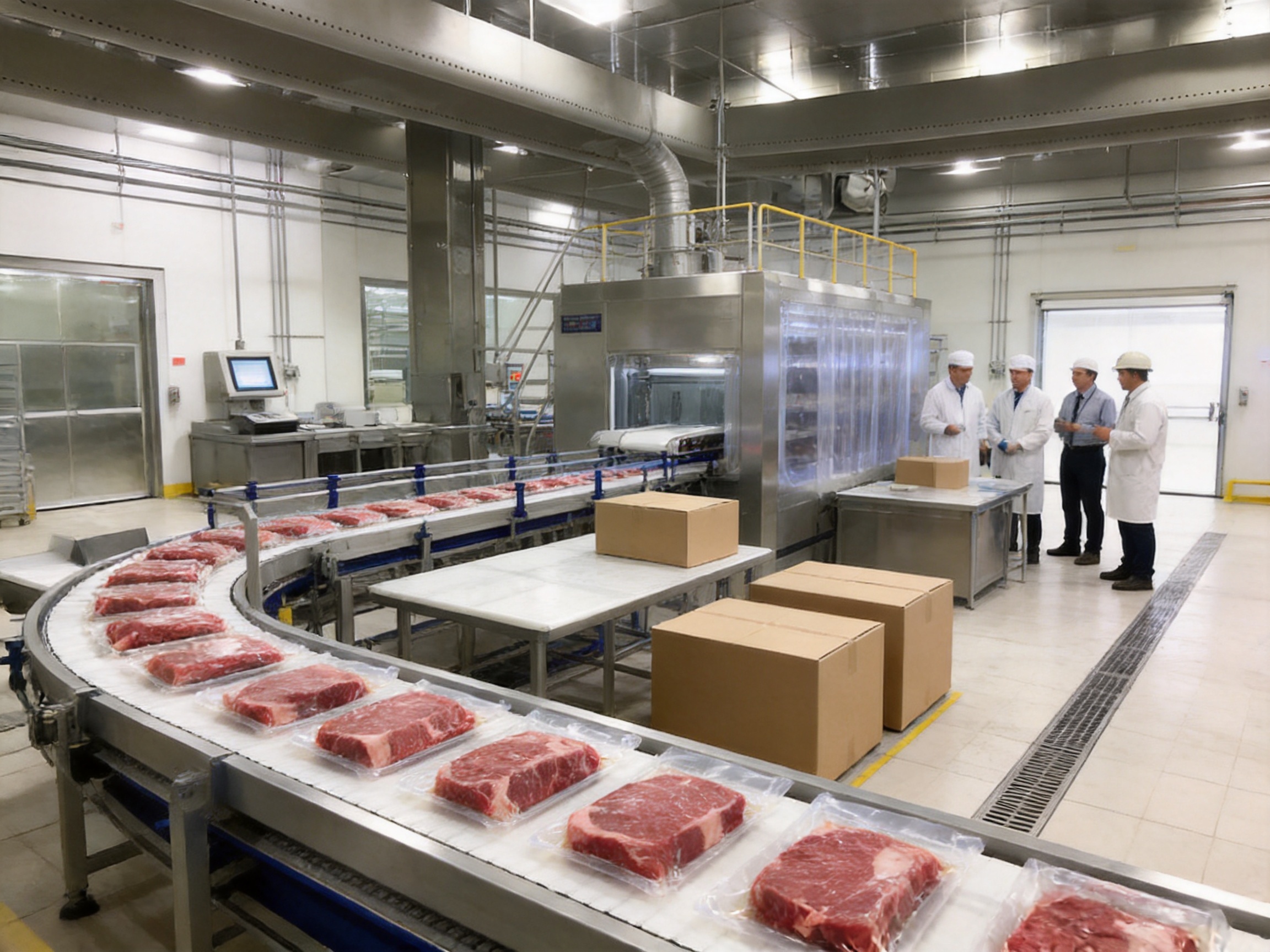
Cattle cutting and deboning are among the most demanding stages in a modern meat processing operation. After slaughtering and carcass chilling, the processor must transform whole cattle carcasses into accurately separated primals, sub-primals, boneless portions, trim, and customer-ready products. This work requires a carefully coordinated combination of equipment, skilled personnel, hygienic design, quality inspection, material handling, and production management.
A well-designed cattle cutting and deboning solution helps processors improve yield, increase throughput, standardize product quality, and reduce unnecessary labor and resource consumption. It also provides a structured production environment in which deboning, trimming, inspection, sorting, and packaging can be managed as connected operations rather than isolated tasks.
The cattle cutting and deboning solution supplied by Zhejiang Ribon Intelligent Equipment Co., Ltd. is designed as an integrated project rather than a single machine. The solution includes proposal design, layout planning, equipment manufacture, installation, commissioning, and project handover. Its principal production areas are the deboning area, trimming area, and packaging line, allowing the complete process to be organized according to the customer’s facility, product specifications, hygiene requirements, and market needs.
Since its establishment in 2003, the company has focused on the research, development, and manufacture of meat processing machinery. Its product scope includes meat processing smokehouses, vacuum tumblers, cattle cutting and deboning lines, and related processing solutions. Through continuous technical improvement and international project experience, the company has developed a practical approach to meat processing system design that emphasizes reliability, usability, maintainability, and long-term customer value.
Cattle Cutting And Deboning Solution
Content
- 1 Understanding the Cattle Cutting and Deboning Process
- 2 Integrated Solution Design Instead of Isolated Equipment
- 3 Core Areas of the Solution
- 4 Resource Optimization Through Intelligent Process Planning
- 5 Quality Inspection and Product Sorting
- 6 Advantages Compared with Fragmented or Conventional Setups
- 7 Advanced Manufacturing and Engineering Strengths
- 8 Project Delivery from Proposal to Commissioning
- 9 Hygiene, Safety, and Maintainability
- 10 Digital and Data-Based Process Management
- 11 Flexibility for Different Customer Requirements
- 12 Why Choose a Specialized Meat Processing Manufacturer?
- 13 Company Capabilities and Customer Value
- 14 Frequently Asked Questions
- 14.1 What is included in a cattle cutting and deboning solution?
- 14.2 Which main areas are included in the solution?
- 14.3 Can the system be customized for different meat cuts?
- 14.4 How does the solution improve labor efficiency?
- 14.5 How can water consumption be reduced?
- 14.6 How can energy consumption be controlled?
- 14.7 How are meat cuts inspected?
- 14.8 Can products be sorted according to customer requirements?
- 14.9 What makes an integrated solution different from purchasing individual machines?
- 14.10 Does the supplier provide installation and commissioning?
- 14.11 Is operator training necessary?
- 14.12 Can the system support future expansion?
- 14.13 What information should a customer provide before requesting a proposal?
- 15 Conclusion
- 16 References
- 17 Product: Cattle Cutting And Deboning Solution
Understanding the Cattle Cutting and Deboning Process
Cattle cutting and deboning convert chilled carcasses into commercially valuable meat products. Although the specific cutting pattern varies according to local regulations, customer contracts, animal characteristics, and market requirements, the process generally includes carcass transfer, primal separation, bone removal, trimming, inspection, sorting, weighing, and packaging.
The process begins with the controlled movement of carcass sections into the cutting and deboning area. Product flow must be arranged to prevent cross-contamination, avoid unnecessary handling, and maintain appropriate temperature control. Conveyors, workstations, cutting tables, product bins, and transfer points should be positioned so that operators can complete their tasks efficiently without excessive walking, lifting, or product backtracking.
During deboning, bones are removed from selected cuts using knives, specialized tools, and operator procedures. The objective is not simply to remove bone, but to maximize recoverable meat while preserving the shape and value of each product. Accurate deboning requires a combination of equipment design, operator skill, cutting standards, and quality control.
Trimming follows deboning or may be integrated into the same production sequence. At this stage, excess fat, connective tissue, membrane, bruised areas, and other unwanted material are removed according to customer specifications. Some customers may require highly lean products, while others may request a defined fat cover or a particular visual appearance. The trimming area therefore needs to support flexible product standards without disrupting the overall line.
Once cuts have been inspected and sorted, they can proceed to weighing, labeling, packing, or further processing. A packaging line can be arranged for different formats, including bulk cartons, individual portions, vacuum packs, or other customer-defined solutions. The final layout depends on the product range, packaging technology, production volume, available floor space, and downstream distribution requirements.
Integrated Solution Design Instead of Isolated Equipment
One of the most important advantages of a complete cattle cutting and deboning solution is that it is designed around the entire process. Purchasing individual machines from multiple sources can create compatibility problems, inconsistent control systems, difficult maintenance arrangements, and inefficient material flow. An integrated solution addresses these issues during the design stage.
The project begins with an evaluation of the customer’s processing objectives. Important considerations include the type and size of cattle carcasses, the desired cutting pattern, expected production volume, product categories, labor availability, hygiene regulations, existing building structure, cold-chain requirements, and future expansion plans.
Based on this information, the supplier can prepare a process proposal and layout drawing. The layout identifies the location of workstations, conveyors, equipment, product movement routes, personnel movement routes, cleaning access, inspection points, storage areas, and packaging operations. A well-prepared layout reduces unnecessary movement and helps establish a logical separation between raw material, finished products, waste, personnel, and cleaning traffic.
Integrated planning also supports better coordination between the deboning, trimming, and packaging areas. For example, deboned products can be directed to designated trimming stations, while bones, fat, trim, and approved meat products follow separate routes. This improves visibility and reduces the possibility of product confusion.
Another benefit is simplified project responsibility. When a single solution provider manages design, manufacture, installation, and commissioning, the customer has one technical partner responsible for coordinating the complete system. This can reduce communication delays and make it easier to identify and resolve issues during installation and start-up.
Core Areas of the Solution
Deboning Area
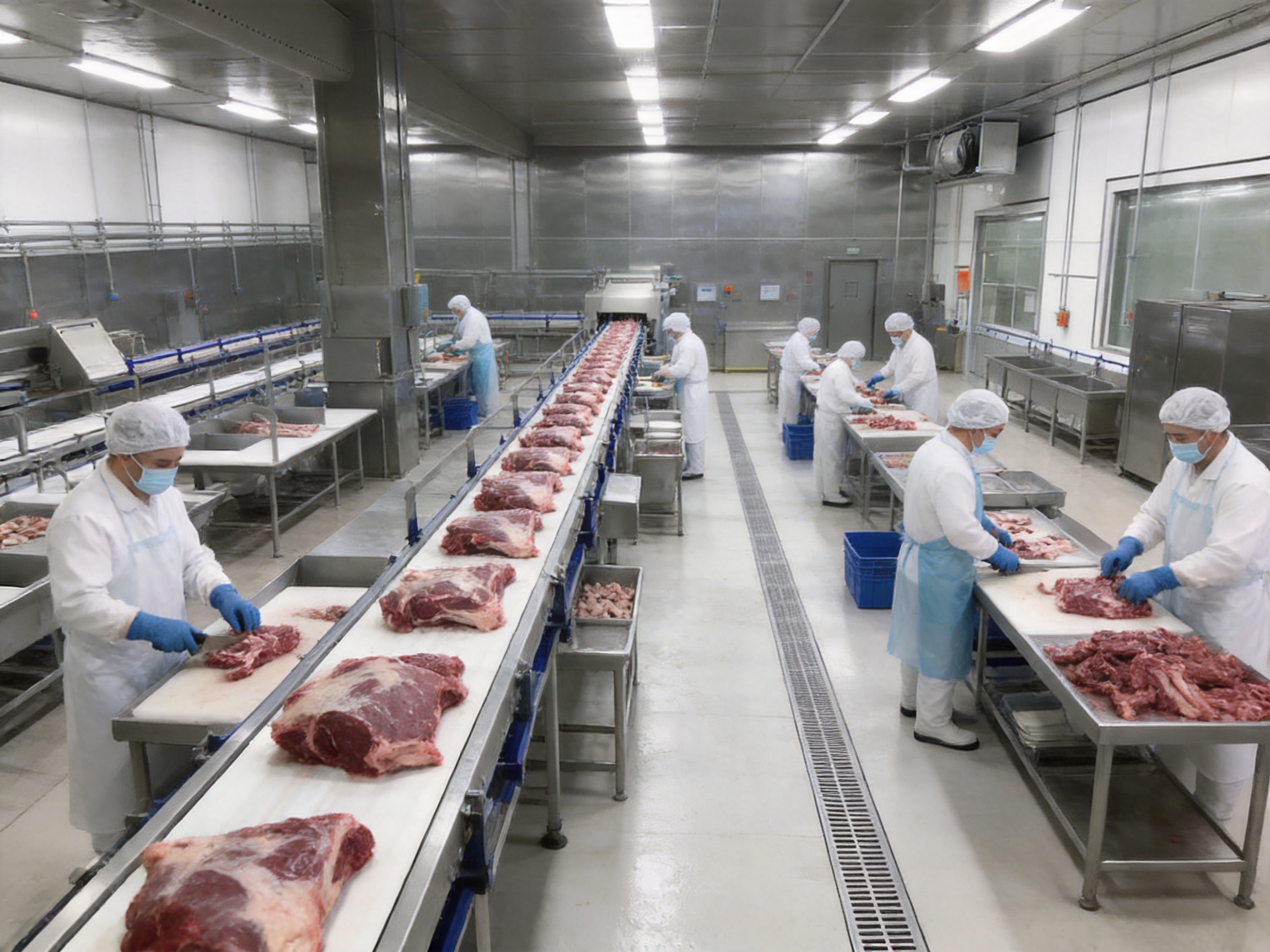
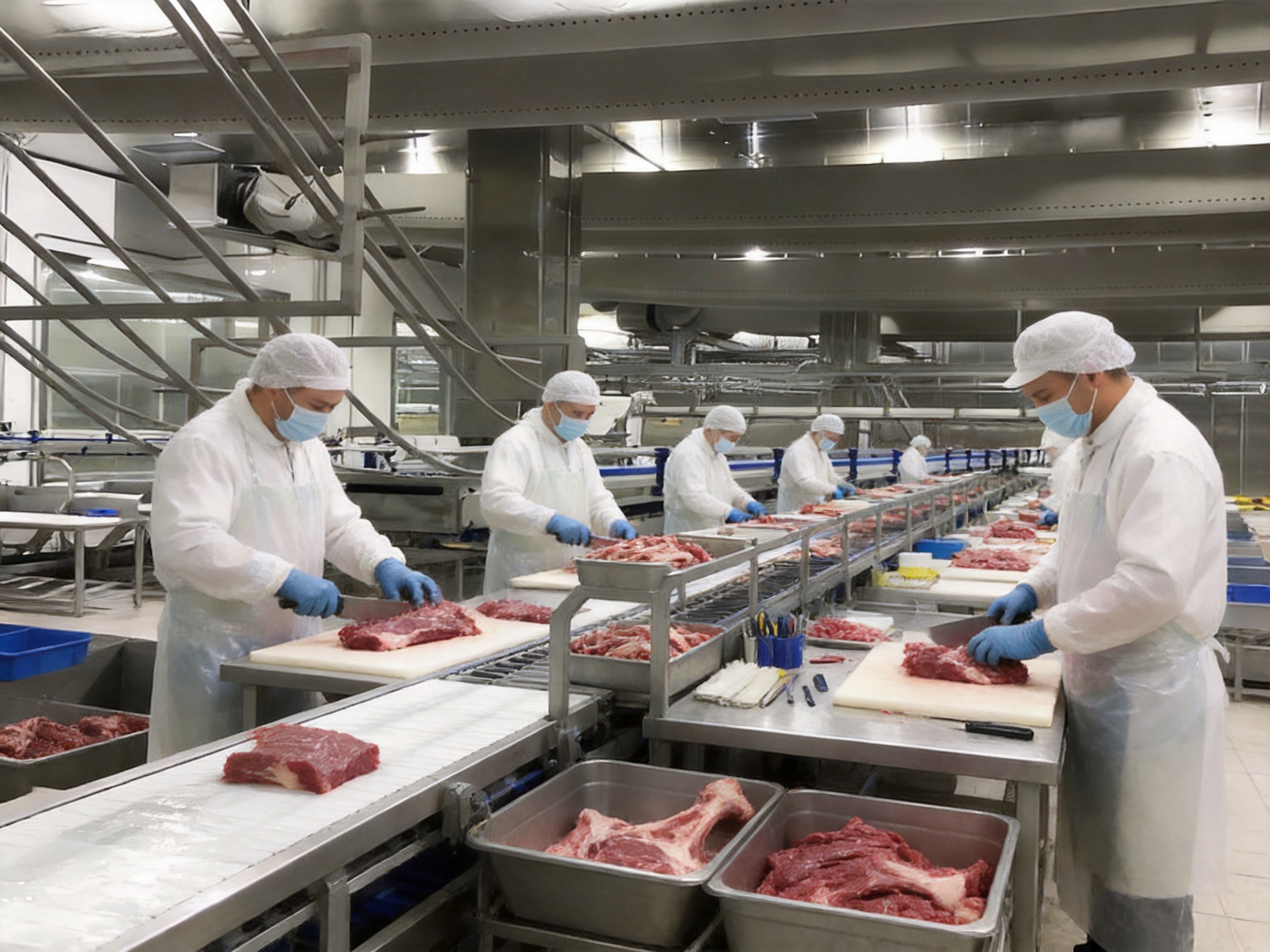
The deboning area is the central production zone for separating meat from bones while preserving yield and product quality. Its design should support comfortable operator positions, clear product presentation, easy access to tools, hygienic surfaces, and efficient movement of raw materials and finished cuts.
Workstations can be arranged according to the specific anatomy of the carcass and the customer’s cutting specifications. Each position may be assigned to a particular deboning operation, allowing operators to develop specialized skills and maintain consistent cutting standards. Alternatively, flexible stations can be used when the product range changes frequently.
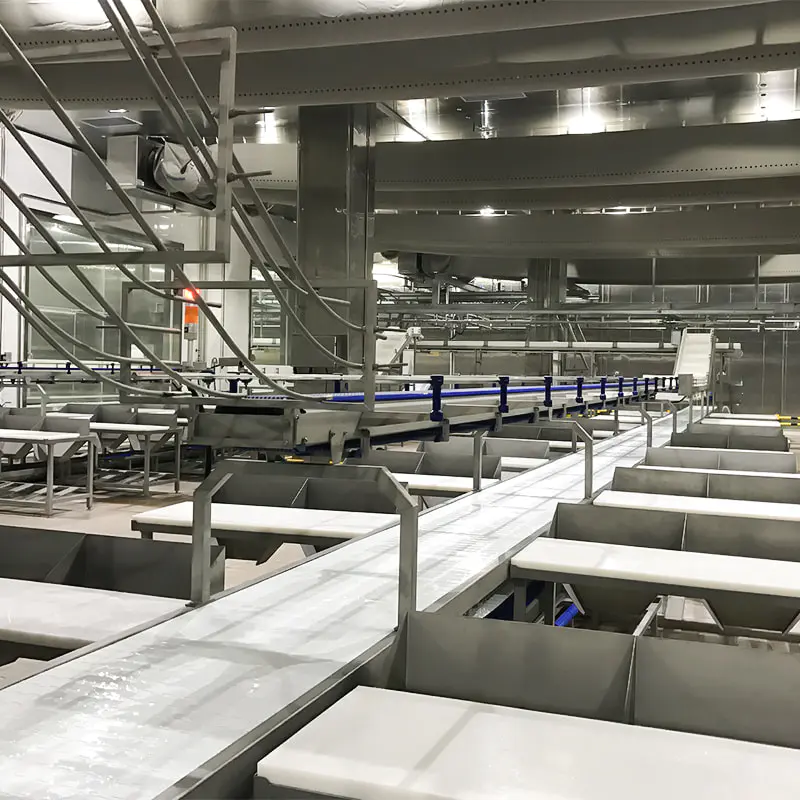
Conveyance is important in the deboning area because it reduces manual carrying and supports a continuous production flow. Properly designed conveyance helps move carcass sections, primals, deboned cuts, bones, and trim between workstations. The system should be easy to clean, resistant to the processing environment, and arranged to minimize product contact with non-food surfaces.
Ergonomics also has a direct effect on productivity. Adjustable or appropriately positioned work surfaces, suitable lighting, accessible tools, and reduced lifting requirements can help lower physical strain. Better ergonomics may improve operator concentration and reduce the risk of fatigue-related errors during long production shifts.
Trimming Area
The trimming area is where products are refined to meet customer-defined standards. Trimming requirements may differ by destination market, retail program, foodservice customer, or further-processing application. The line therefore needs to support accurate decisions about fat content, shape, size, surface appearance, and acceptable defects.
A clearly organized trimming area allows operators and supervisors to identify product specifications quickly. Products can be separated into different categories, such as premium cuts, standard cuts, manufacturing meat, and material for by-product recovery. This supports better yield management and helps prevent valuable material from being downgraded unnecessarily.
Trimming stations should provide sufficient working space without creating excessive distances between operations. Product presentation, waste removal, and transfer to the next stage should occur smoothly. Bins, conveyors, tables, and collection systems must be arranged to prevent accumulation and maintain a clean working environment.
Standard operating procedures are especially important in trimming. Each product specification should define the required level of trimming, acceptable fat coverage, target weight range, packaging method, and labeling information. When these standards are documented and reinforced through training, the facility can provide more consistent products to different customers.
Packaging Line
The packaging line completes the transformation from processed meat cut to marketable product. Packaging operations may include portion arrangement, weighing, product identification, bagging, vacuum packaging, carton packing, labeling, and transfer to cold storage or dispatch.
The exact equipment combination depends on the customer’s product requirements. A facility producing bulk products may require a different packaging arrangement from a plant supplying retail-ready portions. The solution can therefore be planned around the desired packaging format rather than forcing every customer into the same configuration.
Packaging integration improves traceability and production control. Product information can be associated with specific lots, cutting dates, weights, grades, destinations, and customer orders. Accurate identification is particularly important when a plant handles multiple cuts and specifications during the same shift.
A well-planned packaging area should also be separated appropriately from earlier raw-product operations. This supports hygiene control and makes it easier to manage finished goods, packaging materials, personnel access, and dispatch procedures.
Resource Optimization Through Intelligent Process Planning
Modern meat processors must improve productivity while using labor, water, and energy responsibly. A cattle cutting and deboning solution contributes to this objective through equipment selection, layout design, process control, and operating practices.
Labor Optimization
Automation and mechanized conveyance can reduce the amount of manual handling required for carcass sections, primals, bones, trim, and finished products. This does not eliminate the importance of skilled workers. Instead, it allows employees to concentrate on operations that require judgment, precision, and product knowledge.
Reducing unnecessary lifting and walking can increase the effective working time available to operators. When products arrive at the correct workstation in a predictable sequence, employees spend less time searching for materials or moving containers. This supports a more stable production rhythm.
Ergonomic design is another important labor advantage. Worktables, conveyors, tools, and product collection points should be positioned to reduce awkward reaches and repetitive strain. Improved working conditions can support employee comfort, productivity, and retention while helping reduce the risk of workplace injuries.
Training is equally important. Operators should understand equipment functions, cutting procedures, hygiene requirements, quality standards, emergency procedures, and cleaning methods. Technicians should receive appropriate training in equipment adjustment, preventive maintenance, troubleshooting, and safe isolation procedures.
A complete project provider can support more consistent training because the operating logic of the equipment, layout, and process is developed as one system. This is an advantage over fragmented installations in which operators must learn several unrelated equipment platforms.
Water Optimization
Water is essential for sanitation in meat processing, but uncontrolled water use can increase operating costs and wastewater volumes. Water efficiency begins with good facility organization and continues through appropriate equipment selection and cleaning management.
High-efficiency cleaning devices, suitable spray nozzles, controlled pressure, and planned cleaning cycles can help reduce unnecessary water consumption. Cleaning procedures should distinguish between routine product removal, intermediate sanitation, and full end-of-shift cleaning so that water is used according to the actual requirement.
Where permitted by local regulations and the facility’s sanitation program, water management systems may support reuse or recycling for suitable non-product-contact applications. Any recycling arrangement must be engineered carefully to protect food safety and comply with applicable regulations.
Equipment with smooth, cleanable surfaces and accessible construction can also reduce water demand. If dirt and residue are difficult to remove, operators may need longer cleaning times or higher water volumes. Hygienic design therefore contributes to both sanitation performance and resource efficiency.
Energy Optimization
Energy consumption in a cutting and deboning facility is influenced by conveyors, pumps, motors, refrigeration interfaces, lighting, packaging equipment, and cleaning systems. Selecting efficient motors and properly sized equipment can reduce energy waste during normal operation.
Process planning can also reduce energy demand. Coordinating production schedules, avoiding unnecessary idle running, and maintaining equipment correctly can improve the relationship between energy use and output. In some facilities, energy management systems can monitor consumption and identify abnormal operating conditions.
Renewable energy may also be considered where site conditions and investment plans make it practical. Solar generation, for example, may support selected facility loads, although the appropriate solution depends on the local energy profile and regulatory environment.
The most effective energy strategy is usually a combination of equipment efficiency, process discipline, preventive maintenance, and data-based management. The objective is not merely to install low-energy components, but to ensure that the entire production system operates efficiently.
Quality Inspection and Product Sorting
Meat cuts must be inspected and sorted according to customer requirements, internal quality standards, food safety procedures, and applicable grading systems. Inspection should be integrated into the process rather than treated as an isolated final check.
Trained personnel may visually assess color, texture, marbling, fat distribution, surface condition, shape, and visible defects. Depending on the product and regulatory requirements, additional checks may include product temperature, pH, weight, and packaging condition.
Quality control checkpoints can be positioned at important stages, such as after deboning, during trimming, before packaging, and at finished-product release. These checkpoints help identify deviations early, reducing the amount of material that must be reworked or downgraded.
Standard operating procedures should define the criteria for accepting, reworking, sorting, or rejecting products. These procedures may include size, weight, fat content, trim level, bone presence, visual appearance, and packaging requirements.
Grading systems can also support classification. Depending on the market, a facility may use national or regional beef grading standards to categorize products by characteristics such as maturity, tenderness indicators, marbling, and expected eating quality. The sorting system can then match products with customer programs and market segments.
Customization is a major feature of a professional cattle cutting and deboning solution. Customers may request different portion sizes, packaging formats, labels, fat specifications, or product combinations. A flexible line layout and well-organized product routing make it easier to manage these variations without creating excessive disruption.
Advantages Compared with Fragmented or Conventional Setups
The principal advantage of an integrated solution is coordination. A fragmented processing setup may contain capable individual machines, yet still produce inefficiencies if the equipment does not work together. Operators may need to transfer products manually between incompatible work areas, maintenance teams may manage different control systems, and supervisors may find it difficult to balance output across the line.
An integrated cattle cutting and deboning solution is planned around a unified process flow. Equipment, conveyors, workstations, hygiene routes, and packaging operations are evaluated together. This can improve the use of available floor space and reduce unnecessary product movement.
Another advantage is improved scalability. A solution designed around current requirements can be planned with provisions for future expansion, additional packaging formats, or increased production. The appropriate level of automation can be selected according to the customer’s budget, labor conditions, product mix, and growth plans.
Integrated project responsibility can also reduce implementation risk. The supplier coordinates drawings, equipment production, installation, commissioning, and operational handover. This helps ensure that equipment dimensions, connection points, conveyor elevations, and control arrangements are considered before installation begins.
Hygiene and cleanability are additional competitive strengths. A line designed specifically for food processing can provide more consistent attention to drainage, access, surface finish, equipment spacing, product separation, and cleaning procedures than an improvised arrangement assembled from unrelated equipment.
Finally, a professionally engineered solution provides a foundation for consistent product quality. Clear workstations, defined routing, standardized operating procedures, and inspection points help reduce variation between operators and shifts.
| Evaluation Area | Integrated Cattle Cutting and Deboning Solution | Fragmented Equipment Arrangement |
|---|---|---|
| Layout planning | Designed around complete product and personnel flow | Often assembled step by step with limited coordination |
| Product handling | Conveyors and workstations are coordinated to reduce manual movement | May require additional lifting, carrying, or temporary storage |
| Hygiene management | Cleaning access and product separation can be considered during design | Hygiene performance may vary between equipment sections |
| Project responsibility | One provider coordinates design, manufacture, installation, and commissioning | Several suppliers may have divided responsibilities |
| Quality control | Inspection points and sorting routes can be integrated into the process | Checks may be located inconsistently or added later |
| Future development | Expansion and product changes can be considered during initial planning | Future modifications may require extensive rework |
| Operator efficiency | Ergonomic stations and logical routing support stable work patterns | Work may involve greater walking, reaching, or manual handling |
Advanced Manufacturing and Engineering Strengths
The performance of a complete solution depends heavily on the quality of its engineering and manufacturing processes. A meat processing line must operate in a demanding environment characterized by moisture, cleaning chemicals, temperature variation, intensive daily use, and strict hygiene expectations.
The manufacturer’s research and development focus supports the continual improvement of equipment design. Practical development is especially valuable in meat processing because the best solution is not necessarily the most complicated one. Equipment must be understandable to operators, accessible to maintenance staff, compatible with sanitation procedures, and appropriate for the actual production conditions.
Manufacturing quality begins with the translation of the process proposal into technical drawings and equipment specifications. Dimensions, materials, connection points, product clearances, conveyor routes, workstation locations, and safety provisions must be checked before fabrication.
Food-processing equipment requires careful material selection. Surfaces that contact products or are exposed to frequent cleaning should be suitable for the operating environment and designed to resist corrosion and contamination. Smooth construction, accessible components, and minimized dirt traps help support sanitation.
Fabrication accuracy is important for equipment alignment and reliable operation. Conveyors, frames, tables, product guides, and transfer components must fit the intended layout. Accurate manufacture reduces the need for extensive modification during installation and supports smoother commissioning.
Manufacturing should also include inspection and quality checks before shipment. Mechanical functions, moving components, electrical interfaces, safety devices, and control sequences should be verified as far as practical. Factory preparation can reduce installation time and help identify potential issues before the equipment reaches the customer’s facility.
Because the company has supplied meat processing solutions to customers in different regions, its engineering work must account for varied plant layouts, production practices, regulations, and customer specifications. This international experience supports a more adaptable design approach rather than a single fixed equipment model.
Project Delivery from Proposal to Commissioning
A successful processing project requires more than the delivery of machines. The project should be managed through clearly defined stages that connect commercial objectives with technical implementation.
Requirement Analysis
The first stage is understanding the customer’s requirements. This includes product types, carcass characteristics, expected output, labor resources, packaging needs, hygiene procedures, available utilities, building dimensions, and future plans.
Accurate requirement analysis prevents overdesign and underdesign. A solution that is too small may restrict future growth, while an unnecessarily complex solution may increase investment and training demands without producing corresponding benefits.
Process and Layout Design
The next stage is process planning and layout development. The layout drawing should show how products enter the area, move through deboning and trimming, pass inspection, reach packaging, and leave as finished goods. It should also show personnel access, waste movement, cleaning access, and service areas.
Layout planning should pay attention to bottlenecks. If deboning capacity exceeds trimming capacity, products may accumulate. If packaging is slower than upstream operations, finished cuts may require temporary storage. Balanced planning helps ensure that each area supports the others.
Equipment Manufacture
After the design is approved, equipment is manufactured according to the technical proposal. Components should be checked for dimensional accuracy, surface condition, mechanical function, and compatibility with the overall system.
Manufacturing quality also includes documentation. Equipment identification, maintenance information, operating instructions, and recommended spare parts help the customer manage the line after handover.
Installation
Installation requires coordination between the supplier and the customer’s facility team. The building, utilities, drainage, floors, power supply, water connections, refrigeration interfaces, and access routes must be prepared appropriately.
Correct installation is essential for conveyor alignment, equipment stability, safety, drainage, and cleanability. The installation team should verify the position of each major component against the approved layout.
Commissioning and Handover
Commissioning confirms that the equipment and process operate as intended. Tests may include empty running, product transfer, control functions, safety devices, conveyor coordination, packaging interfaces, and cleaning access.
Training should be provided for operators, supervisors, maintenance personnel, and relevant hygiene staff. The customer should understand normal operation, adjustment procedures, cleaning requirements, routine inspection, and emergency response.
Project completion should include a structured handover. The customer receives the operational system after installation and commissioning, together with relevant technical information and guidance for continued use.
Hygiene, Safety, and Maintainability
Hygiene is a fundamental requirement in cattle processing. The design of the cutting and deboning solution should support separation of product flows, controlled personnel movement, regular cleaning, and effective inspection.
Equipment should be arranged so that operators can access surfaces that require cleaning and maintenance. Components that are difficult to reach may become points of residue accumulation. Easy access can shorten cleaning time and improve the consistency of sanitation procedures.
Drainage and floor organization are also important. Water, melted ice, product residue, and cleaning solutions should be directed away from clean product zones as appropriate. The final arrangement must follow the customer’s local construction and food safety requirements.
Safety provisions should include suitable guarding, emergency stop arrangements, safe access, clear operating procedures, and appropriate training. Knives and cutting tools require special attention because they are essential to the process but can create significant hazards if used incorrectly.
Preventive maintenance protects both safety and productivity. Regular inspection of conveyors, bearings, motors, electrical components, fasteners, product guides, and safety devices can identify issues before they lead to breakdowns. A maintenance schedule should be adapted to operating hours, cleaning frequency, environmental conditions, and equipment design.
Maintainability is a competitive advantage because equipment downtime affects the entire processing operation. Accessible components, clear documentation, and reliable support can reduce the time needed to diagnose and correct problems.
Digital and Data-Based Process Management
Although the physical design of the line remains essential, data can improve control over modern processing operations. Production records can be used to compare planned and actual output, identify recurring bottlenecks, and monitor product losses.
Quality data can include product weights, trim percentages, rejection reasons, inspection results, temperature measurements, and packaging information. Reviewing this information helps management understand where process improvements can create the greatest benefit.
Energy and water data can also be monitored. Abnormal consumption may indicate leaks, inefficient cleaning procedures, equipment problems, or production scheduling issues. Data-based management transforms resource optimization from a general objective into a measurable operating program.
Future development may include greater use of sensors, production monitoring, digital maintenance records, and automated identification. The practical value of such systems depends on the customer’s requirements, budget, existing infrastructure, and technical capabilities.
Flexibility for Different Customer Requirements
Cattle processors serve a broad range of markets. Some focus on wholesale primals, while others produce retail portions, foodservice cuts, private-label products, or ingredients for further manufacturing. A solution must therefore be adaptable.
Flexibility can be achieved through adjustable workstations, configurable product routes, multiple sorting destinations, modular conveyors, and packaging arrangements that support more than one product format. The design should make product changes manageable without creating excessive downtime.
Customer specifications may also change over time. A buyer may request a different fat level, portion size, carton weight, labeling format, or packing method. A flexible line allows the processor to respond to these changes and pursue additional markets.
However, flexibility must be balanced with operational simplicity. A system with too many unnecessary options can be difficult to operate and maintain. Professional engineering focuses on the features that create real value for the customer rather than adding complexity for its own sake.
Why Choose a Specialized Meat Processing Manufacturer?
A specialized manufacturer understands that meat processing equipment must be designed around food safety, product yield, operator behavior, cleaning routines, and continuous production. General industrial equipment suppliers may provide mechanical components, but a meat processing specialist is better positioned to address the combined requirements of hygiene and production.
Specialization supports more relevant engineering decisions. The manufacturer can evaluate how carcass sections move, where operators need access, how trim is collected, how products are sorted, and how packaging connects with upstream operations.
Experience across smokehouses, vacuum tumblers, cutting lines, and deboning systems also creates a broader understanding of meat processing operations. This can be useful when customers plan an integrated factory or future expansion into marinated, cooked, smoked, or vacuum-packed products.
A specialized provider is also more familiar with the practical challenges of installation and commissioning. Building constraints, utility limitations, local labor conditions, and customer training needs must all be considered for the project to perform successfully after delivery.
Company Capabilities and Customer Value
Zhejiang Ribon Intelligent Equipment Co., Ltd. was founded in 2003 by Mr. Shi Ming and specializes in the research, development, and manufacturing of meat processing machinery. The company’s experience includes meat processing smokehouses, vacuum tumblers, cattle cutting and deboning solutions, and related equipment systems.
Its approach combines product development with complete project delivery. Rather than limiting its role to equipment manufacture, the company provides proposal design, layout drawing, manufacturing, installation, commissioning, and project handover.
This full-service model helps customers coordinate technical decisions from the beginning. It also allows the solution to be adjusted to the actual site and production objectives. The result is intended to be a practical system that creates value through reliable operation, efficient use of resources, and improved product consistency.
The company has exported meat processing solutions worldwide since 2003. International project experience can support communication across different operating environments and help the engineering team understand the importance of adapting equipment to local requirements.
Continuous improvement is central to the company’s stated development philosophy. Better design, improved practicality, stronger service, and environmental responsibility are treated as ongoing objectives rather than one-time project features.
Frequently Asked Questions
What is included in a cattle cutting and deboning solution?
The solution is a complete processing system for cattle carcasses. It may include process proposal design, layout planning, deboning equipment and workstations, trimming arrangements, conveyors, sorting routes, packaging line equipment, installation, commissioning, and operational handover. The exact scope depends on the customer’s requirements.
Which main areas are included in the solution?
The solution is divided into three principal areas: the deboning area, the trimming area, and the packaging line. These areas are planned as connected operations so that products can move logically from carcass sections to finished packaged goods.
Can the system be customized for different meat cuts?
Yes. Cutting patterns, trimming standards, portion sizes, packaging formats, and sorting criteria can be considered during the design stage. The final configuration should reflect the customer’s products, markets, facility, labor conditions, and production targets.
How does the solution improve labor efficiency?
Conveyors and organized workstations reduce unnecessary carrying and walking. Ergonomic design can reduce physical strain, while standardized workstations and training support consistent operator performance. Automation can be applied where it creates practical value without making the system unnecessarily complicated.
How can water consumption be reduced?
Water efficiency can be improved through hygienic equipment design, high-efficiency cleaning devices, controlled spray nozzles, planned cleaning cycles, and responsible water management. Where regulations permit, recycling or reuse systems may support suitable non-product-contact applications.
How can energy consumption be controlled?
Energy efficiency can be supported by selecting suitable motors and pumps, avoiding unnecessary idle operation, maintaining equipment, scheduling production effectively, and monitoring energy use. Renewable energy may also be considered according to site conditions and investment plans.
How are meat cuts inspected?
Trained inspectors and quality personnel can evaluate color, texture, marbling, fat distribution, shape, visible defects, temperature, pH, weight, and other defined characteristics. Standard operating procedures specify the criteria for acceptance, sorting, rework, or rejection.
Can products be sorted according to customer requirements?
Yes. Products can be sorted according to size, weight, fat content, trim level, grade, packaging format, labeling requirement, and destination market. Customization helps the processor match products with individual customer specifications.
What makes an integrated solution different from purchasing individual machines?
An integrated solution is designed around the complete material flow, including product handling, workstation arrangement, hygiene routes, inspection, sorting, packaging, and future development. This can reduce compatibility problems and provide clearer project responsibility.
Does the supplier provide installation and commissioning?
The project model includes installation and commissioning. After the equipment is installed, the system is tested and adjusted so that the customer can receive the completed solution after project handover.
Is operator training necessary?
Yes. Training helps operators understand production procedures, equipment functions, hygiene requirements, quality standards, safety precautions, and cleaning practices. Maintenance personnel should also receive guidance on inspection, adjustment, and preventive maintenance.
Can the system support future expansion?
Future expansion can be considered during the initial proposal and layout stage. Possible considerations include additional workstations, expanded packaging capacity, new product specifications, revised sorting routes, or integration with other meat processing operations.
What information should a customer provide before requesting a proposal?
Useful information includes the expected cattle processing volume, carcass and product types, desired cuts, trimming standards, packaging formats, available building dimensions, utility conditions, labor resources, hygiene requirements, current equipment, and future production plans.
Conclusion
A cattle cutting and deboning solution is more than a collection of cutting tables, conveyors, and packaging machines. It is a coordinated production environment designed to transform carcasses into consistent, valuable, and customer-specific meat products.
The most effective solution combines logical layout planning, efficient product flow, ergonomic workstations, hygienic construction, inspection and sorting procedures, suitable packaging, resource management, and reliable project execution.
The three-part structure of deboning, trimming, and packaging provides a clear foundation for organizing the production process. When these areas are designed together, processors can improve labor utilization, reduce unnecessary handling, support better quality control, and create a more flexible operation.
Zhejiang Ribon Intelligent Equipment Co., Ltd. brings together meat processing equipment manufacturing, solution design, installation, commissioning, and service support. Its experience since 2003 and focus on practical, continuously improved solutions make it a suitable partner for customers seeking a complete cattle cutting and deboning project.
For processors planning a new facility, upgrading an existing line, or expanding into new product categories, a carefully engineered cattle cutting and deboning solution can provide long-term benefits in productivity, hygiene, resource efficiency, product consistency, and customer satisfaction.
References
1. Codex Alimentarius Commission. General Principles of Food Hygiene and HACCP System and Guidelines for Its Application.
2. Food and Agriculture Organization of the United Nations. Good Practices for the Meat Industry.
3. International Organization for Standardization. ISO 22000, Food Safety Management Systems.
4. United States Department of Agriculture. Beef Quality and Grading Principles.
5. European Commission. Hygiene Rules for Food of Animal Origin.
6. International Labour Organization. Ergonomic Principles in Industrial Workplaces.
7. Relevant national and regional regulations for meat processing equipment, sanitation, occupational safety, and environmental management.