

 English
 русский
 Español
 عربى

Content
- 1 Introduction
- 2 What Is a Cattle Cutting and Deboning Solution?
- 3 Main Objectives of the Processing System
- 4 Engineering Design and Layout Planning
- 5 Deboning Area
- 6 Trimming Area
- 7 Packaging Line
- 8 Inspection and Sorting for Customer Requirements
- 9 Labor Optimization and Ergonomics
- 10 Water Management and Hygiene
- 11 Energy Optimization
- 12 Advanced Manufacturing Processes
- 13 Installation and Commissioning
- 14 Advantages Over Disconnected Equipment Purchases
- 15 Competitive Strengths of the Solution
- 16 Company Manufacturing and Industry Experience
- 17 Maintenance and Long-Term Reliability
- 18 Resource Efficiency and Lean Production
- 19 Implementation Roadmap
- 20 Typical Equipment and Function Table
- 21 Quality, Safety, and Compliance Considerations
- 22 Q&A
- 22.1 What products can be processed with a cattle cutting and deboning solution?
- 22.2 Does the solution include only machinery?
- 22.3 How is the line adapted to different factory sizes?
- 22.4 Can customer-specific cuts and trimming standards be supported?
- 22.5 How does the solution reduce labor requirements?
- 22.6 How can water consumption be reduced?
- 22.7 How can energy use be controlled?
- 22.8 What materials are used for the equipment?
- 22.9 How are meat cuts inspected and sorted?
- 22.10 Is installation support available?
- 22.11 What training is provided?
- 22.12 What is the advantage of purchasing a complete line from one specialist?
- 22.13 Can the line be expanded later?
- 22.14 How does the manufacturer support long-term operation?
- 23 Conclusion
- 24 References
- 25 Product: Cattle Cutting And Deboning Solution
Introduction
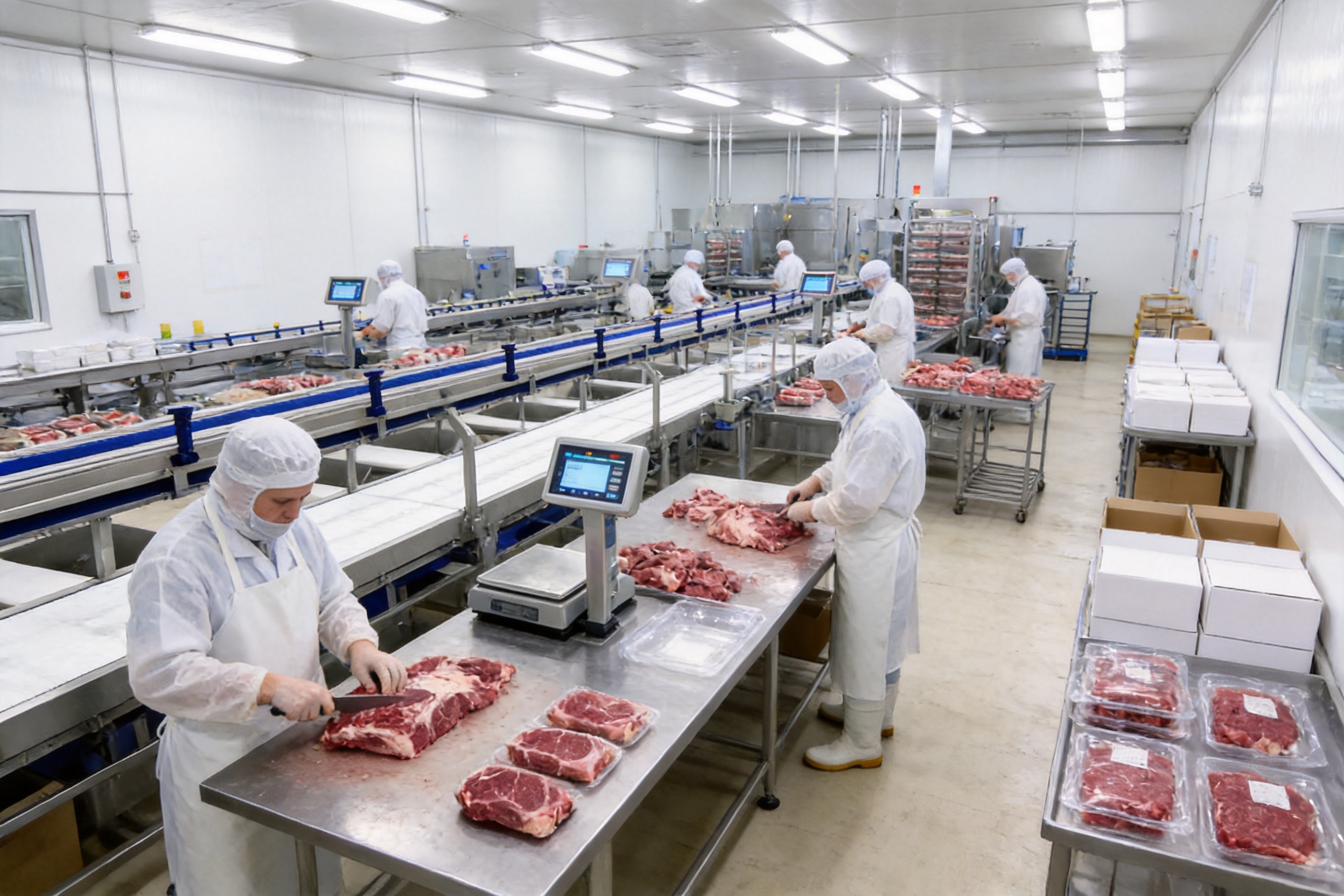
Modern beef processors must achieve more than high production volume. They must deliver consistent cuts, maintain strict hygiene, protect worker safety, control operating costs, and respond quickly to changing customer requirements. A cattle cutting and deboning solution brings these objectives together in one coordinated processing system, covering the movement of carcasses, deboning, trimming, inspection, sorting, and final packaging.
The solution described in this article is designed for processors seeking a complete and professionally engineered cattle processing line rather than a collection of unrelated machines. It is developed around three principal processing areas: the deboning area, the trimming area, and the packaging line. The complete project can include layout design, equipment manufacturing, installation, commissioning, operator support, and technical handover.
By integrating these stages, a processor can improve material flow, reduce unnecessary handling, standardize work procedures, and obtain better control over product quality. The system is also designed to support responsible resource management through labor-saving automation, water-efficient cleaning practices, energy-conscious equipment selection, and process monitoring.
A successful cattle cutting and deboning line must be adapted to the customer’s building, production target, carcass specifications, labor structure, product portfolio, and food safety requirements. For this reason, a professional solution provider should offer engineering support before manufacturing begins. The objective is not simply to supply machines, but to create a practical processing environment in which every stage supports the next one.
Cattle Cutting And Deboning Solution
What Is a Cattle Cutting and Deboning Solution?
A cattle cutting and deboning solution is an integrated system used to convert chilled cattle carcasses or primal sections into boneless meat cuts, trimmed products, portions, and packaged goods. Depending on the plant design, the line can process whole carcasses, quarters, or selected primal cuts. Its configuration may vary according to production capacity, product specifications, labor availability, and the degree of automation required.
The core activities normally include product transfer, bone removal, cutting, trimming, inspection, sorting, weighing, portion preparation, packing, labeling, and dispatch preparation. Supporting systems may include stainless-steel conveyors, worktables, product hooks, cutting tools, weighing equipment, washing systems, waste collection equipment, control panels, and refrigeration interfaces.
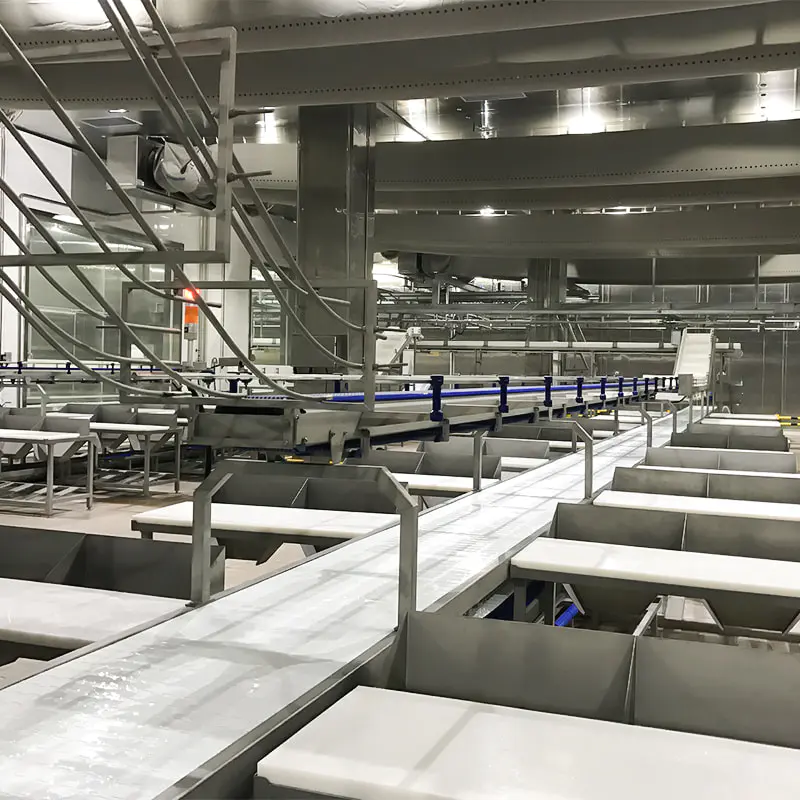
The solution is commonly divided into three functional zones:
Deboning area: Operators separate meat from bones according to established cutting procedures. The arrangement is designed to provide an appropriate working height, clear product identification, safe tool access, and smooth transfer of meat and bone by-products.
Trimming area: Meat cuts are inspected and adjusted to remove excess fat, connective tissue, bruising, bone fragments, or other unwanted material. Trimming can be organized according to customer specifications, retail requirements, food-service needs, or further-processing applications.
Packaging line: Finished cuts are weighed, sorted, packed, labeled, and transferred to cold storage or shipping. The packaging arrangement can be adapted for vacuum bags, trays, bulk cartons, portion packs, or other formats.
The value of the solution lies in the coordination between these zones. A poorly connected system may force workers to carry products repeatedly, create bottlenecks, increase contamination risks, and make production data difficult to collect. A properly engineered line establishes a logical sequence that reduces unnecessary movement while preserving product identity and hygiene control.
Main Objectives of the Processing System
The primary objective is to produce safe and consistent meat efficiently. However, the system must achieve several related objectives at the same time.
First, it must maintain a controlled product flow. Carcasses and cuts should move through the processing sequence without unnecessary backtracking or long waiting periods. Controlled flow supports temperature management and reduces the possibility of product mix-ups.
Second, it must improve cutting consistency. Standardized workstations and defined product routes make it easier for trained operators to follow cutting specifications. Consistency is especially important when customers require fixed cut names, weight ranges, fat limits, or packaging formats.
Third, the line should reduce labor pressure. Mechanical conveying, ergonomic workstations, organized tool placement, and appropriate levels of automation can reduce lifting, carrying, and repetitive motion. These improvements help operators maintain productivity throughout a shift.
Fourth, the solution must support hygiene. Food-contact surfaces should be easy to clean, resistant to corrosion, and designed without unnecessary gaps or difficult-to-reach areas. Processing areas should also permit effective separation between incoming products, finished products, by-products, and cleaning operations.
Finally, the line should be sufficiently flexible to accommodate different products. Beef processors rarely produce only one type of cut. A practical system must allow changes in product size, trimming standards, packaging style, and customer order requirements without major reconstruction.
Engineering Design and Layout Planning
Layout planning is one of the most important stages in developing a cattle cutting and deboning solution. The layout determines how people, products, equipment, packaging materials, waste, and cleaning personnel move through the facility. Good planning can improve productivity without requiring excessive automation.
The design process begins with an understanding of the customer’s production requirements. Important design inputs include daily throughput, peak production volume, carcass weight, chilling method, number of product categories, number of operators, working shifts, packaging specifications, available floor area, ceiling height, drainage position, cold-room location, and future expansion plans.
The engineering team can then develop a layout drawing showing the major processing zones and the connection between them. This drawing can identify the location of deboning tables, cutting stations, conveyors, inspection points, scales, packaging machines, hand-washing stations, tool sterilizers, waste routes, and product exits.
A good layout avoids crossing flows. Raw or unfinished material should not repeatedly cross the route used by packed products. Bones and trimming waste should have a separate and efficient removal path. Packaging materials should enter the packaging zone without interfering with deboning activities. Personnel access points should be arranged to support hygiene control and controlled movement.
The layout should also consider maintenance access. Motors, bearings, drive units, control cabinets, pumps, and other service components need sufficient space for inspection and replacement. Equipment that is difficult to access may reduce the effective availability of the entire line, even if its original performance is high.
Another important consideration is future development. A processor may begin with semi-automatic handling and later add more conveyors, weighing points, packing equipment, or data systems. Reserving appropriate space and connection points during the original design can make future expansion more economical.
Deboning Area
The deboning area is the central production zone where meat is separated from bones and prepared for further trimming. It must provide a balance between product accessibility, operator safety, hygiene, and output consistency.
Workstations can be positioned along a conveyor or organized around fixed tables, depending on the processing method and required capacity. Conveyors help maintain a continuous flow and reduce manual carrying. Fixed tables may be suitable for smaller operations or specialized products. A combined configuration can provide flexibility by using conveyors for primary movement and dedicated tables for detailed cutting tasks.
Ergonomic height is essential. If a work surface is too low, operators may bend repeatedly. If it is too high, shoulder and wrist strain may increase. The appropriate height depends on the cutting activity, operator position, product size, and tool use. A well-planned workstation allows operators to work with the product close to the body and within a comfortable reach zone.
Tools should be stored and handled in a controlled manner. Knife sterilizers, tool holders, sharpening devices, and protective equipment should be positioned where operators can access them without leaving the workstation unnecessarily. Tool hygiene is especially important because knives and hand tools come into direct contact with product surfaces.
Product identification should be maintained throughout deboning. Clear trays, hooks, conveyors, and work instructions help prevent the mixing of different product categories. When several customer specifications are processed during the same shift, visual management and production records can further improve traceability.
Bone removal must be performed in a manner that protects both yield and product quality. Excessive meat left on bones reduces saleable yield, while aggressive cutting may create bone fragments or damage the appearance of the meat. Standardized work instructions and operator training are therefore important complements to the physical equipment.
Waste removal should be immediate and organized. Bones and unusable trimmings should not accumulate around workstations. A separate collection route helps improve cleanliness, reduce obstruction, and make by-product handling more efficient.
Trimming Area
The trimming area converts deboned pieces into cuts that match defined customer requirements. Trimming may involve removing surface fat, connective tissue, bruised portions, bone fragments, membrane, or other material. The precise trimming standard depends on the intended market and product category.
Some customers may request lean cuts with strict fat limits, while others may accept a higher level of fat for flavor, further processing, or food-service applications. The processing line should therefore allow operators to work according to clearly defined product standards rather than applying one universal trimming method.
Trimming stations should provide adequate lighting, stable product support, easy access to tools, and sufficient working room. Visual inspection is more effective when operators can clearly see the color, texture, surface condition, and fat distribution of each cut.
Production can be divided by product type or processing task. For example, one group of stations may handle high-volume standard cuts, while another handles specialty cuts or products requiring more detailed preparation. This type of specialization can improve consistency and simplify training.
Trimming is also a key point for yield management. The amount of product removed during trimming directly influences profitability. Excessive trimming may lower saleable yield, while insufficient trimming may cause customer complaints or fail to meet specifications. A controlled system combines written standards, operator training, inspection, and production feedback.
The trimming area can include quality checkpoints where product is examined before moving to packaging. These checkpoints may verify cut identity, appearance, trimming level, cleanliness, temperature, weight range, and the presence of foreign material. Defective or nonconforming pieces can be redirected for rework rather than entering the finished-product stream.
Packaging Line
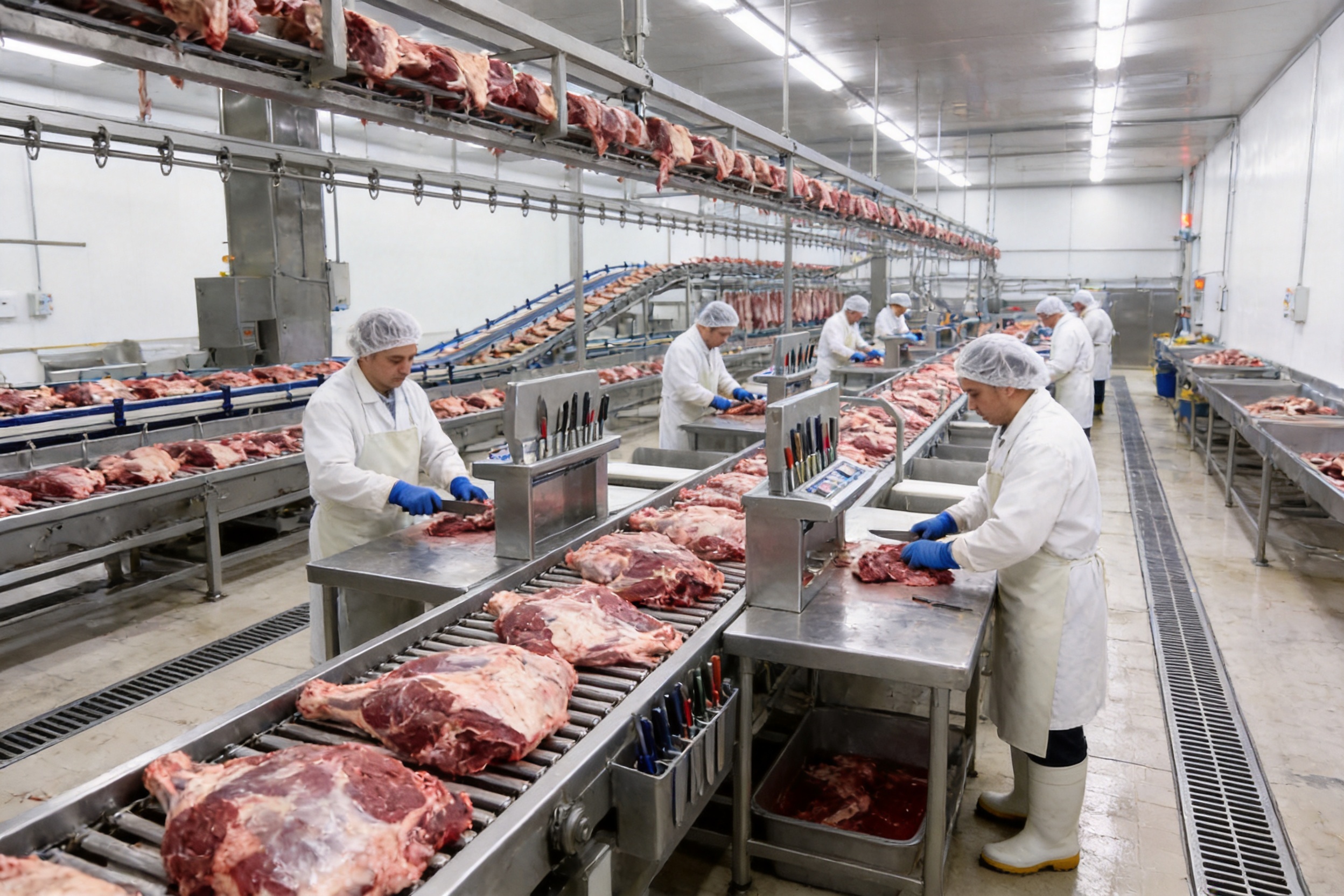
The packaging line is responsible for protecting finished meat cuts, preserving product identity, and preparing products for storage and distribution. It is also the stage at which information such as product name, weight, batch number, production date, storage condition, and customer code may be associated with the product.
Packaging requirements vary considerably. Some customers need bulk cartons for industrial processing. Others require individual vacuum packs, retail trays, fixed-weight portions, or assorted cartons containing several specified cuts. The packaging line should be designed around the actual product mix rather than a general assumption about packaging.
Weighing equipment can be placed before or during packing, depending on the process. Weight information may be used for portion control, pricing, production records, carton composition, and customer order fulfillment. Accurate weighing helps reduce underweight claims and limits unnecessary product giveaway.
Inspection at the packaging stage can confirm that the product corresponds to the label and packaging format. This is particularly important when several similar cuts are produced simultaneously. A clear product identification system reduces the risk of incorrect labeling and supports traceability.
Packaging materials must be stored and delivered in a hygienically controlled manner. The line should avoid unnecessary exposure of packaging materials to wet processing activities, waste routes, or cleaning splash. Operators should have sufficient room to load products, seal packs, inspect seals, and arrange finished goods.
Where vacuum packaging is used, the package seal must be checked for integrity. Poor seals can cause leakage, shorten shelf life, and create customer dissatisfaction. The line can be arranged to provide a clear transfer from product preparation to vacuum packing, carton formation, coding, and cold storage.
Inspection and Sorting for Customer Requirements
Meat cuts are inspected and sorted through a combination of visual assessment, standardized procedures, quality control checkpoints, and, when necessary, measurement instruments. The purpose is to ensure that finished products meet customer specifications and applicable food safety requirements.
Visual inspection is performed by trained personnel. They assess characteristics such as color, texture, marbling, fat distribution, surface condition, cut shape, and visible defects. Any abnormality can be recorded and directed to a suitable rework or disposition route.
Quality control personnel may use thermometers to verify product temperature and pH meters to support quality monitoring. Other checks may include weight measurement, seal inspection, package integrity assessment, and verification of product codes. The specific inspection program should be established according to the processor’s food safety plan and customer requirements.
Standard operating procedures provide consistency. They can define acceptable cut dimensions, fat limits, trim levels, weight ranges, packaging arrangements, and labeling rules. Without documented procedures, product quality may vary significantly between operators or shifts.
Grading systems may also be used. Regional or customer-specific grading methods can classify beef according to characteristics such as tenderness, marbling, maturity, color, and expected eating quality. Grading allows products to be directed toward appropriate markets and price categories.
Sorting can be performed by product type, quality grade, weight, trim level, customer, destination, or order number. A flexible sorting arrangement improves the processor’s ability to serve different markets without creating confusion on the production floor.
Customer customization is a major advantage of a professionally designed line. Portion sizes, packaging formats, labeling preferences, carton composition, and trimming standards can be established during the engineering stage. The system can then be configured to support these requirements with appropriate workstations, weighing positions, conveyors, and packing equipment.
Labor Optimization and Ergonomics
Labor is one of the most important operating resources in a cattle processing facility. The objective is not simply to reduce the number of employees, but to use labor more effectively while creating safer and more sustainable working conditions.
Automation can support carcass conveyance, product transfer, weighing, sorting, and selected packing activities. By reducing manual carrying and repeated lifting, automated handling allows workers to focus on tasks that require judgment, cutting skill, inspection, and product control.
Ergonomic workstations reduce physical strain. Appropriate working heights, short reach distances, stable product presentation, non-slip flooring, and organized tool placement can improve both comfort and productivity. A worker who is less fatigued is more likely to maintain consistent cutting quality throughout the shift.
Training is equally important. Operators should understand equipment operation, knife safety, sanitation procedures, product specifications, emergency stops, and basic troubleshooting. Technicians should receive additional instruction in preventive maintenance, electrical safety, mechanical adjustment, and control-system operation.
A complete project handover should include operating guidance and practical training. This helps the customer use the equipment correctly from the beginning and reduces the risk of performance problems caused by improper setup or inconsistent operating methods.
Automation should be selected carefully. Excessive automation may increase investment and maintenance requirements without creating sufficient value for a smaller plant. On the other hand, inadequate automation may leave the processor dependent on difficult manual handling. The best solution is usually a balanced configuration based on throughput, labor cost, product variety, and the customer’s development plan.
Water Management and Hygiene
Water is essential for cleaning and sanitation, but uncontrolled water use can increase operating costs and environmental impact. A modern cattle cutting and deboning solution should support efficient water management while maintaining the required hygiene level.
Closed-loop or partial water recycling systems may be considered where technically and legally appropriate. Reused water can support selected cleaning tasks, provided that the system separates suitable applications from critical final sanitation activities and complies with the facility’s food safety requirements.
High-efficiency spray nozzles and controlled water pressure can remove residues with less water than unrestricted hoses. Operators should be trained to use water only when necessary and to avoid cleaning methods that spread contamination from one area to another.
Cleaning schedules should be planned around production activities. Pre-rinse, detergent application, mechanical action, intermediate rinse, disinfection, and final inspection should follow an organized sequence. Equipment should be designed so that surfaces can be reached easily and water can drain effectively.
Stainless-steel construction supports hygiene and durability. Smooth surfaces, suitable weld finishing, accessible frames, and minimized dirt traps can reduce the time required for cleaning. Components that are frequently removed for sanitation should be designed for practical disassembly and reassembly.
Hygiene zoning is another important principle. Deboning, trimming, packaging, waste handling, personnel movement, and cleaning activities should be arranged to reduce cross-contamination risks. The physical layout should support the facility’s sanitation procedures rather than work against them.
Energy Optimization
Energy efficiency affects both production cost and environmental performance. The main energy-consuming elements in a meat processing facility may include refrigeration, motors, pumps, conveyors, lighting, compressed air systems, vacuum equipment, and packaging machinery.
Energy-efficient motors and drives can reduce consumption during normal operation. Variable-speed control may allow conveyors and pumps to operate at the rate required by current production rather than continuously running at maximum speed.
Process scheduling can also reduce energy waste. Production runs may be organized to minimize unnecessary equipment starts and stops, avoid idle operation, and coordinate with refrigeration demand. Where electricity pricing varies by time, selected non-critical activities may be scheduled during lower-cost periods.
Energy monitoring systems provide useful information about consumption patterns. Real-time data can identify equipment that is running without production, abnormal motor loads, compressed-air leaks, or refrigeration performance problems. This information supports maintenance and evidence-based improvement.
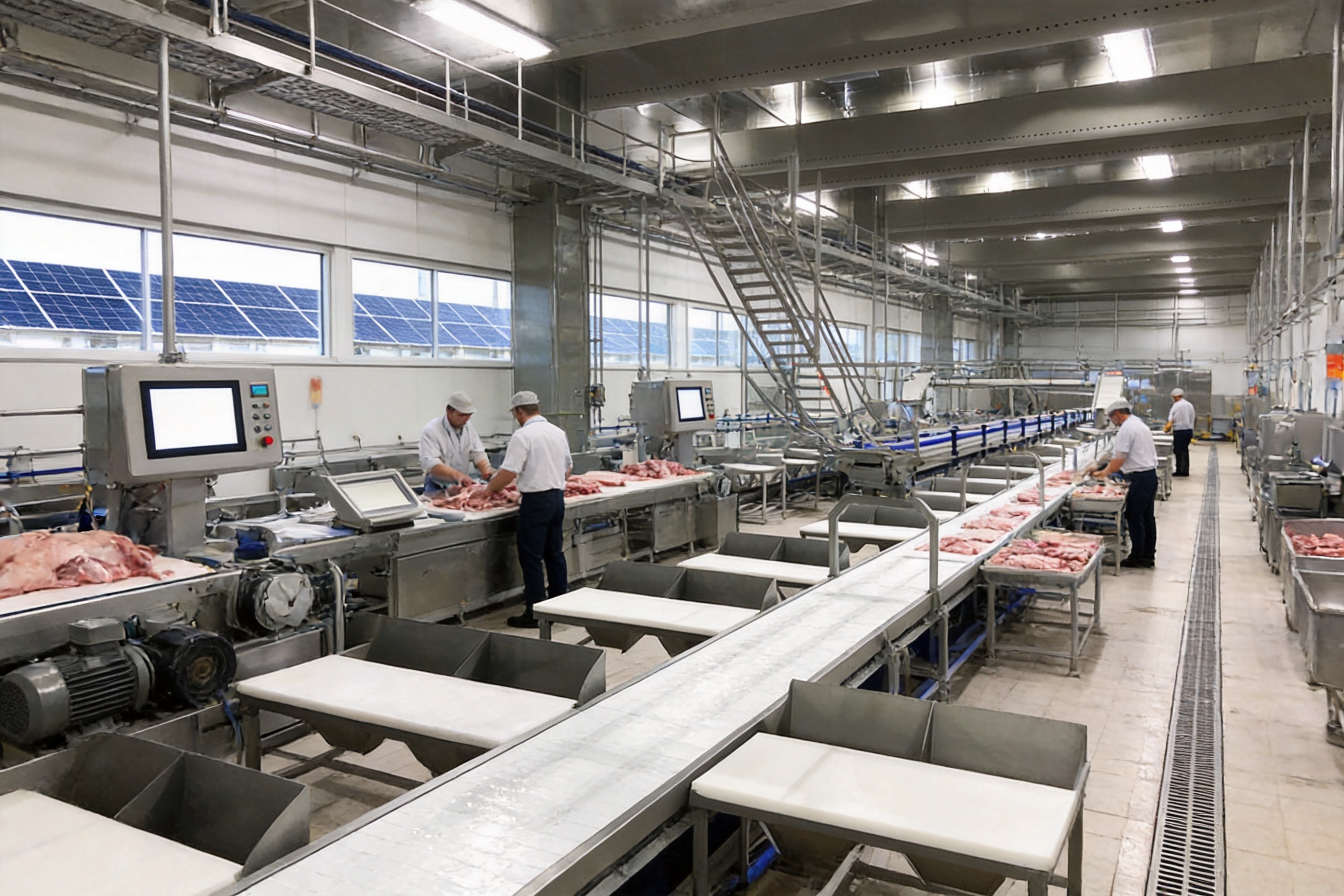
Renewable energy may be integrated into the wider facility. Solar panels or other renewable sources can offset part of the electricity used for lighting, control systems, or selected processing equipment. The suitability of renewable energy depends on local conditions, available roof area, investment planning, and grid requirements.
Energy reduction should not compromise food safety. Refrigeration, sanitation, ventilation, and temperature control must remain within the limits established by the processor’s food safety procedures. Efficiency improvements are most successful when they reduce waste without weakening process control.
Advanced Manufacturing Processes
The strength of a complete processing solution depends partly on the quality of its manufacturing process. Advanced manufacturing is not limited to the final appearance of equipment. It includes design accuracy, material selection, fabrication, assembly, testing, documentation, and after-sales technical support.
The process begins with engineering review. Customer requirements are analyzed together with the proposed layout, production capacity, equipment interfaces, utilities, hygiene standards, and future expansion needs. This stage helps prevent conflicts between individual machines and ensures that the final system works as an integrated line.
Stainless steel is selected for components exposed to moisture, cleaning chemicals, and food products. The grade and thickness should be appropriate for the application. Structural components must provide sufficient strength while remaining practical to clean and maintain.
Precision fabrication helps maintain dimensional consistency. Accurate cutting, forming, drilling, and welding ensure that conveyors, frames, tables, guards, and transfer points align correctly during installation. Poor dimensional control can cause product accumulation, belt tracking problems, vibration, and unnecessary maintenance.
Welding quality is especially important in hygienic food equipment. Welds should be strong, smooth, and appropriately finished. Surfaces that contact food or cleaning water should not contain rough areas that trap residue. Proper finishing also improves corrosion resistance and simplifies sanitation.
Mechanical components are assembled according to design specifications. Conveyor drives, bearings, chains, belts, shafts, supports, and adjustment mechanisms must operate smoothly and remain accessible for service. Guards and safety devices should protect operators while allowing authorized maintenance access.
Electrical and control systems coordinate the movement of equipment and support safe operation. Emergency stops, overload protection, sensor functions, interlocks, and control-panel arrangements should be verified before delivery. Where a line contains several linked machines, the control logic must account for upstream and downstream conditions to reduce blockages and idle operation.
Factory testing is an important part of the manufacturing process. Equipment can be inspected for dimensions, operation, safety functions, component quality, and interface compatibility before shipment. Identifying problems in the factory is generally faster and less expensive than resolving them after installation at the customer’s site.
Documentation should include layout drawings, equipment lists, operating instructions, maintenance recommendations, electrical information, spare-parts guidance, and cleaning considerations. Clear documentation helps the customer train personnel and manage future maintenance.
Installation and Commissioning
Installation connects the manufactured equipment with the customer’s building, utilities, refrigeration system, drainage, electrical supply, and existing production equipment. Professional installation helps ensure that the line performs as intended in actual operating conditions.
Before installation, the site should be checked against the approved layout. Floor levels, anchor positions, power supply, water connections, drainage, ceiling clearance, access routes, and cold-room interfaces should be confirmed. Early site preparation reduces delays during equipment assembly.
Installation normally includes positioning frames, assembling conveyors, connecting drives, fitting guards, installing control panels, connecting sensors, aligning transfer points, and verifying utility connections. Hygienic details such as drainage direction, cleaning access, and separation between product and non-product areas should also be reviewed.
Commissioning begins with dry testing. Equipment is operated without product to verify direction, speed, interlocks, emergency stops, sensor response, and communication between machines. Wet testing may then be performed to confirm cleaning arrangements and drainage behavior.
Product testing is necessary to evaluate actual performance. Sample carcasses or cuts can be processed to check product flow, operator access, cutting sequence, sorting, weighing, packaging, and output capacity. Adjustments may be made to conveyor speeds, workstation positions, guides, sensors, or operating procedures.
Commissioning should conclude with a clear handover. The customer should understand normal operation, cleaning, preventive maintenance, safety procedures, spare-part requirements, and troubleshooting steps. This complete handover is more valuable than simply placing equipment in the building and leaving the customer to solve integration problems independently.
Advantages Over Disconnected Equipment Purchases
Purchasing individual machines from different suppliers may appear simple, but it can create technical and operational challenges. Each supplier may use different dimensions, control standards, transfer heights, materials, and maintenance requirements. The customer may then become responsible for solving integration problems between machines.
A complete cattle cutting and deboning solution provides one coordinated engineering concept. Equipment dimensions are designed to work together, product transfer points are considered from the beginning, and the layout can be reviewed as a single production system.
Integrated planning also improves accountability. When one project team is responsible for design, manufacturing, installation, and commissioning, it is easier to identify the source of a performance issue and coordinate corrective action.
Another advantage is the ability to balance automation with manual operations. Not every activity requires a fully automated machine. A complete solution can use automation where it creates the greatest value, such as conveying, weighing, or packing, while retaining skilled manual cutting where flexibility and judgment are important.
Hygiene design is more consistent when equipment is planned together. Product routes, waste routes, cleaning access, personnel movement, and packaging operations can be considered as a complete system rather than as separate machine requirements.
Competitive Strengths of the Solution
The solution offers several advantages for processors comparing equipment suppliers and project approaches.
Complete project responsibility: The solution can cover layout design, equipment manufacture, installation, commissioning, and technical handover. This reduces the burden on the customer’s internal engineering team.
Modular configuration: The three-zone structure allows the line to be adapted to different production sizes and product categories. A customer can begin with essential equipment and add additional functions as the business develops.
Practical automation: Conveyance, weighing, sorting, and selected packaging functions can be automated without eliminating the flexibility of trained operators in cutting and trimming activities.
Improved ergonomics: Workstations can be organized around appropriate heights, reduced carrying distances, controlled tool placement, and safer product handling.
Hygienic construction: Stainless-steel structures, cleanable surfaces, accessible components, and planned drainage support sanitation and durability.
Customer-specific production: Cut specifications, trimming levels, packaging formats, weight ranges, and labeling needs can be included in the design rather than treated as afterthoughts.
Resource efficiency: The line can support better use of labor, water, energy, raw material, and floor space through coordinated process design.
Global project experience: The manufacturer’s experience in supplying meat processing solutions to customers in different markets supports an understanding of varied production practices, regulatory expectations, and plant conditions.
Company Manufacturing and Industry Experience
The equipment manufacturer behind this solution was established in 2003 and specializes in the research, development, and manufacture of meat processing machinery. Its product scope includes meat processing smokehouses, vacuum tumblers, cutting systems, deboning equipment, and complete processing solutions.
This specialization provides an important advantage because cattle cutting and deboning projects rarely exist in isolation. Processors may also require tumbling, smoking, further processing, refrigeration coordination, or packaging integration. Experience across several types of meat processing equipment helps the engineering team understand how different production stages influence one another.
Continuous optimization is a central part of the company’s approach. Equipment designs are improved in response to practical operating conditions, customer feedback, process changes, cleaning requirements, and the need for better labor and resource efficiency.
Manufacturing strength is supported by a focus on practical design. The objective is to provide equipment that is not only technically capable but also understandable for operators, accessible for maintenance, and suitable for real factory conditions. This practical orientation can be particularly valuable for processors that need dependable production rather than unnecessary complexity.
The company has supplied meat processing solutions internationally since 2003. International project experience can help in managing differences in plant layouts, electrical standards, customer expectations, product specifications, and local working practices. It also encourages the use of clear documentation and structured commissioning procedures.
Environmental responsibility is addressed through ongoing technical improvement. More efficient equipment, better process organization, reduced material waste, water-conscious cleaning, and energy monitoring can all contribute to improved sustainability. These measures may also reduce operating costs over the life of the project.
Maintenance and Long-Term Reliability
A processing line must remain productive after installation. Preventive maintenance is therefore an essential part of the solution rather than an optional service.
Maintenance planning should identify inspection intervals for conveyors, bearings, chains, belts, motors, sensors, fasteners, guards, scales, and control components. Cleaning schedules should be coordinated with maintenance tasks so that equipment is inspected after sanitation and before production restarts.
Wear components should be identified in advance. Maintaining suitable spare parts can reduce downtime when a belt, bearing, seal, sensor, or other component requires replacement. The correct spare-parts list depends on the equipment configuration and expected production intensity.
Operators should be encouraged to report unusual noise, vibration, product accumulation, belt tracking problems, or changes in equipment speed. Early reporting can prevent a minor issue from becoming a major failure.
Equipment accessibility influences maintenance cost. Components that can be reached safely and quickly require less downtime during inspection. Hygienic design and maintainability should therefore be considered together during engineering.
Technical support after commissioning helps the customer sustain performance. Support may include operating advice, troubleshooting, component recommendations, process adjustments, and guidance for future line expansion.
Resource Efficiency and Lean Production
Lean manufacturing principles can be applied to cattle cutting and deboning operations by identifying activities that consume time or resources without adding value. Examples include unnecessary product movement, excessive waiting, repeated handling, avoidable rework, overproduction, and inefficient cleaning practices.
A logical line layout reduces transport waste. Conveyors and correctly positioned workstations help products move directly from one stage to the next. The reduction in handling can improve both productivity and product protection.
Standard work reduces variation. When operators follow documented procedures for deboning, trimming, inspection, and packing, the line can achieve more predictable output. Standard work also makes it easier to identify the cause of quality problems.
Yield monitoring is another important lean practice. Comparing incoming carcass or primal weight with finished product weight and by-product weight can reveal opportunities to improve cutting and trimming. Small yield improvements can generate significant financial value over a high-volume operation.
Rework should be analyzed rather than simply accepted as a normal part of production. Frequent rework may indicate unclear specifications, incorrect sorting, inadequate training, poor equipment adjustment, or problems with product presentation.
Resource efficiency is most effective when all departments participate. Production, quality control, maintenance, sanitation, engineering, and management should share information about bottlenecks and improvement opportunities.
Implementation Roadmap
A project can be organized into a series of coordinated stages.
Stage one—requirement definition: The customer provides information about products, capacity, building conditions, labor, packaging, utilities, and future development.
Stage two—concept design: The engineering team proposes the process sequence, zoning concept, equipment arrangement, and initial capacity assumptions.
Stage three—layout confirmation: The customer reviews the layout drawing and confirms the location of processing areas, access routes, utilities, cold storage, waste flow, and finished-product dispatch.
Stage four—technical specification: Equipment sizes, materials, conveyor speeds, control requirements, weighing points, packaging interfaces, and hygiene details are finalized.
Stage five—manufacturing: Equipment is fabricated, assembled, inspected, and tested according to the approved design.
Stage six—shipment and site preparation: The customer prepares foundations, electrical connections, water, drainage, ventilation, refrigeration interfaces, and access for installation.
Stage seven—installation: Equipment is assembled, aligned, connected, and checked at the customer’s facility.
Stage eight—commissioning: Dry testing, wet testing, product testing, adjustments, and performance verification are completed.
Stage nine—training and handover: Operators and maintenance staff receive instruction, documents are delivered, and the customer accepts the completed system.
Stage ten—continuous improvement: Production data and operator feedback are used to refine work procedures, maintenance intervals, resource use, and future expansion plans.
Typical Equipment and Function Table
| Processing Zone | Typical Equipment or Feature | Primary Function | Operational Benefit |
|---|---|---|---|
| Deboning | Stainless-steel workstations and product conveyors | Present carcass sections or primal cuts to operators | Improves flow, access, and ergonomic working conditions |
| Deboning | Knife sterilizers and tool holders | Support controlled tool hygiene and safe handling | Helps maintain sanitation and reduce unnecessary movement |
| Deboning | Bone and by-product collection routes | Remove bones and unusable material | Reduces accumulation and keeps work areas organized |
| Trimming | Inspection and trimming tables | Remove excess fat, tissue, bruising, and defects | Supports customer-specific appearance and yield control |
| Trimming | Quality checkpoints | Verify cut identity, temperature, appearance, and trim level | Reduces nonconforming product and rework |
| Packaging | Scales and weighing stations | Measure portions, cartons, or product batches | Improves weight accuracy and production records |
| Packaging | Vacuum or other packing equipment | Protect finished meat and extend product usability | Supports different customer and market requirements |
| Packaging | Labeling and coding equipment | Apply product and traceability information | Strengthens order accuracy and product identification |
| Utilities | Energy-efficient motors and control systems | Drive conveyors, pumps, and associated equipment | Can reduce energy consumption and support monitoring |
| Hygiene | Cleanable stainless-steel construction and drainage | Support sanitation and moisture control | Improves cleaning efficiency and equipment durability |
Quality, Safety, and Compliance Considerations
Food safety must be considered from the beginning of the project. Equipment design, process flow, employee movement, cleaning procedures, temperature management, and product inspection should support the processor’s hazard analysis and critical control program.
Worker safety is equally important. Guards, emergency stops, safe access, non-slip surfaces, appropriate lighting, knife safety procedures, and training all contribute to a safer working environment. Safety devices should be tested during commissioning and inspected during routine maintenance.
Product temperature should be protected throughout processing. The line should minimize unnecessary waiting and provide efficient transfer between chilled areas. The final temperature requirements depend on the product, process, and applicable regulations, but the equipment layout should support reliable temperature control.
Traceability requires accurate identification of raw materials, work-in-progress, finished products, packaging, and dispatch batches. Weighing, labeling, production records, and sorting procedures should be designed to support the customer’s traceability system.
Compliance requirements vary by region and market. The customer should confirm applicable rules for equipment materials, electrical systems, food-contact surfaces, sanitation, worker safety, labeling, and documentation. A professional engineering discussion at the beginning of the project helps identify these requirements before manufacturing.
Q&A
What products can be processed with a cattle cutting and deboning solution?
The solution can be configured for deboned beef cuts, trimmed primal sections, portioned products, bulk meat, retail-oriented cuts, food-service products, and further-processing materials. The final configuration depends on the customer’s product range and packaging requirements.
Does the solution include only machinery?
No. A complete project can include process consultation, layout design, equipment manufacturing, installation, commissioning, operator training, and technical handover. This integrated approach helps ensure that the equipment operates as a coordinated line.
How is the line adapted to different factory sizes?
The line can be designed with different numbers of workstations, conveyor lengths, weighing positions, packaging modules, and automation levels. A smaller plant may use more manual operations, while a high-capacity facility may require extensive conveying, sorting, and packing integration.
Can customer-specific cuts and trimming standards be supported?
Yes. Cut dimensions, weight ranges, fat limits, trim levels, product categories, packaging formats, and labeling preferences can be incorporated into the process design and standard operating procedures.
How does the solution reduce labor requirements?
Conveyors and organized product routes reduce manual carrying. Ergonomic workstations reduce physical strain, while automation can support conveying, weighing, sorting, and packaging. Skilled operators remain important for cutting, trimming, inspection, and quality decisions.
How can water consumption be reduced?
Water-saving nozzles, controlled cleaning procedures, efficient spray systems, planned sanitation cycles, and suitable water-recycling arrangements can reduce consumption. Any recycling system must be designed according to food safety requirements and local regulations.
How can energy use be controlled?
Energy-efficient motors, variable-speed drives, production scheduling, preventive maintenance, energy monitoring, and renewable energy integration can help control energy use. Refrigeration and sanitation requirements must remain fully protected.
What materials are used for the equipment?
Stainless steel is commonly used for food-contact surfaces and areas exposed to moisture and cleaning chemicals. Material selection, thickness, weld finishing, and surface accessibility should be matched to the operating environment.
How are meat cuts inspected and sorted?
Trained personnel perform visual checks for color, texture, marbling, fat distribution, defects, and cut appearance. Additional checks may include weight, temperature, pH, packaging integrity, product codes, and customer-specific quality criteria.
Is installation support available?
A complete solution can include on-site installation and commissioning. The equipment is assembled, connected, tested, adjusted, and evaluated with product before the final handover.
What training is provided?
Training can cover normal operation, product flow, sanitation, safety, emergency stops, basic troubleshooting, preventive maintenance, tool handling, and customer-specific production procedures.
What is the advantage of purchasing a complete line from one specialist?
A specialist can coordinate layout, equipment dimensions, product transfer, hygiene design, control systems, installation, and commissioning as one project. This reduces interface problems that may occur when unrelated machines are supplied by several vendors.
Can the line be expanded later?
Expansion can be considered during the original layout and utility design. Reserved space, modular conveyors, additional weighing points, packing modules, or upgraded control functions may allow the facility to increase capacity over time.
How does the manufacturer support long-term operation?
Support may include technical documentation, spare-parts guidance, maintenance recommendations, troubleshooting, process advice, and assistance with future improvements or extensions.
Conclusion
A cattle cutting and deboning solution is a strategic investment in production organization, product quality, worker safety, and resource efficiency. The most effective system is not defined by one machine alone. Its performance depends on the relationship between layout, equipment, operators, hygiene procedures, quality control, packaging, utilities, and maintenance.
The three-zone structure of deboning, trimming, and packaging provides a clear foundation for a flexible and scalable processing line. By coordinating these areas, the solution can reduce unnecessary handling, improve product flow, support customer-specific specifications, and strengthen traceability.
Labor optimization is achieved through practical automation and ergonomic design. Water efficiency is supported by controlled cleaning methods and suitable recycling strategies. Energy performance can be improved through efficient motors, process control, monitoring, and responsible scheduling. Product quality is protected through standardized inspection, sorting, trimming, weighing, and packaging procedures.
The manufacturer’s experience in meat processing machinery, combined with its ability to provide layout design, manufacturing, installation, commissioning, and handover, gives customers a more complete project pathway. Its focus on practical equipment, international applications, continuous improvement, and environmental responsibility supports processors seeking dependable long-term value.
For a cattle processor planning a new facility, upgrading an existing plant, or expanding into higher-value products, a professionally engineered cutting and deboning solution can provide the operational structure needed for sustainable growth. When the line is designed around actual production requirements and supported by proper training and maintenance, it becomes more than a group of machines: it becomes an integrated platform for safe, efficient, and customer-focused meat production.
References
1. General principles of hygienic design for food-processing equipment and facilities.
2. Food safety management systems and hazard-analysis practices for meat-processing operations.
3. Guidance on ergonomic workstation design, manual handling, and worker safety in food manufacturing.
4. Standard practices for beef carcass fabrication, deboning, trimming, grading, and product classification.
5. Principles of lean manufacturing, process flow optimization, yield management, and waste reduction.
6. Technical guidance on industrial water conservation, sanitation planning, and cleaning-system efficiency.
7. Technical guidance on energy management, efficient motors, variable-speed drives, and industrial monitoring.
8. Equipment project-management practices covering layout design, fabrication, installation, commissioning, and operator training.
9. Manufacturer information concerning meat processing machinery, smokehouses, vacuum tumblers, cutting systems, deboning lines, and integrated processing solutions.