

 English
 русский
 Español
 عربى

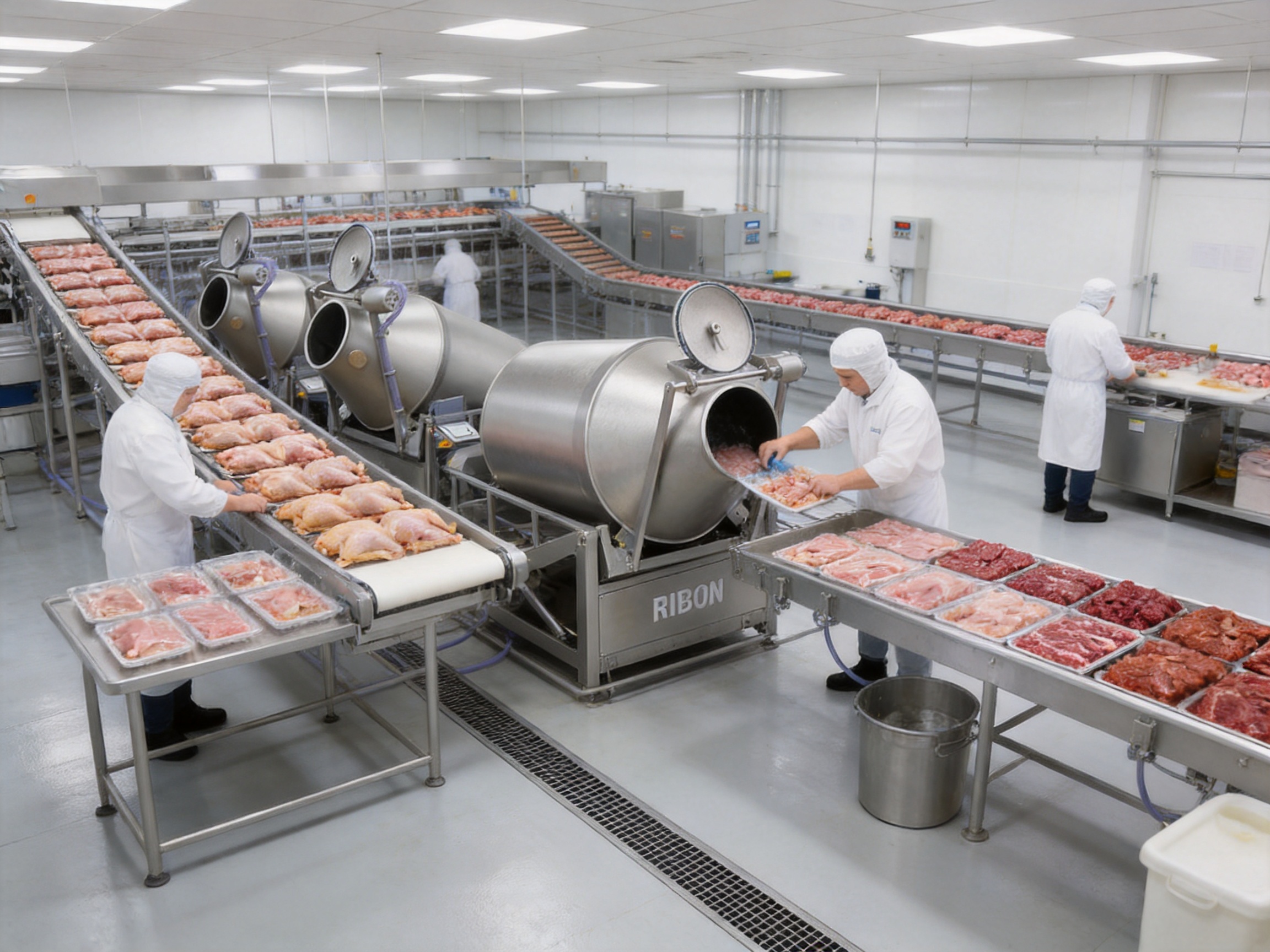
Modern meat processors must achieve several objectives at the same time. They need to produce safe food, maintain consistent quality, improve yield, reduce labor requirements, and meet increasingly demanding production schedules. Marination and tumbling are especially important because these operations influence product tenderness, flavor distribution, moisture retention, appearance, and final weight. A refrigerated vacuum tumbler provides a controlled environment in which these objectives can be addressed more effectively than with conventional tumbling equipment.
The refrigerated vacuum tumbler described in this article combines vacuum processing, adjustable drum rotation, tilting capability, and integrated refrigeration. This combination enables processors to manage product temperature during extended marination and tumbling cycles. It is designed for meat-processing plants that require reliable, repeatable, and hygienic operation across a wide range of products and production volumes.
Manufactured by Zhejiang Ribon Intelligent Equipment Co., Ltd., the equipment is part of a broader portfolio that includes meat-processing smokehouses, vacuum tumblers, slaughtering systems, cutting equipment, and deboning solutions. The company has specialized in meat-processing machinery since 2003 and has supplied equipment and complete processing solutions to customers in international markets.
Content
- 1 What Is a Refrigerated Vacuum Tumbler?
- 2 Why Temperature Control Matters in Meat Marination
- 3 How Vacuum Tumbling Improves Product Performance
- 4 Core Advantages of the Refrigerated Design
- 5 Control System and Operating Functions
- 6 Vacuum System Design
- 7 Tilting Frame and Hydraulic Operation
- 8 Manufacturing Capability and Production Capacity
- 9 Laser Cutting for Precision Components
- 10 Automated Welding and Structural Reliability
- 11 Drum Balancing for Stable Operation
- 12 Quality Control for Key Components
- 13 International Electrical Components
- 14 Models and Technical Range
- 15 Comparison with Conventional Tumblers
- 16 Applications in Meat Processing
- 17 Hygiene, Cleaning, and Maintenance Considerations
- 18 Product: Refrigerated vacuum tumbler
What Is a Refrigerated Vacuum Tumbler?
A refrigerated vacuum tumbler is a processing machine used to mix, massage, and marinate meat products under reduced pressure while controlling the temperature inside the drum. The machine consists of a rotating drum, a vacuum system, a control system, a tilting frame, and an independent refrigeration system connected to a jacket around the outer wall of the drum.
During operation, meat and marinade are loaded into the drum. The vacuum system removes air from the processing chamber, while the drum rotates at a selected speed. As the product moves through the drum, internal carriers lift and release the meat, promoting the distribution and absorption of the marinade. The vacuum condition helps improve contact between the marinade and the product while supporting protein extraction and moisture retention.
The refrigeration system removes heat generated by product movement, mechanical action, and the surrounding environment. The cooling medium circulates through the jacket around the drum, allowing the product temperature to be managed throughout the processing cycle. This is especially important when products require prolonged marination or when ambient factory temperatures fluctuate.
Unlike a standard tumbler without integrated cooling, a refrigerated model is not dependent solely on the temperature of the raw material or the surrounding room. Its independent cooling system offers a more stable process environment and helps processors maintain product temperature within an appropriate operating range.
Why Temperature Control Matters in Meat Marination
Temperature is a critical factor in the handling and processing of meat. When meat remains at an elevated temperature for too long, microbial growth may accelerate, quality may decline, and the product may become more difficult to process consistently. Temperature variation can also affect the performance of the marinade and the ability of the meat to retain added water.
During tumbling, mechanical action creates friction and movement. Even when the machine is operating at a moderate speed, the process can gradually transfer heat to the product. If the production environment is warm, the product may be exposed to additional thermal stress. A refrigerated vacuum tumbler counteracts these effects by removing heat through the drum jacket.
Stable temperature control supports several important production objectives:
First, it helps inhibit the growth of undesirable microorganisms and supports food-safety management. Temperature control does not replace sanitation, validated processing procedures, or regulatory compliance, but it is an important part of a comprehensive food-safety program.
Second, it helps maintain product quality during extended processing. Meat can become more difficult to handle when it warms excessively. A stable temperature may help preserve the desired texture and appearance while the product absorbs marinade.
Third, it improves process repeatability. If the product temperature changes significantly from one batch to the next, the processor may experience variations in marinade absorption, yield, texture, and cooking performance. Refrigeration reduces the influence of external conditions and contributes to a more consistent process.
Fourth, it can make production planning easier. Processors do not need to rely entirely on a cold room with a narrowly controlled ambient temperature. The tumbler’s own cooling system provides an additional layer of process control and can support more flexible plant layouts.
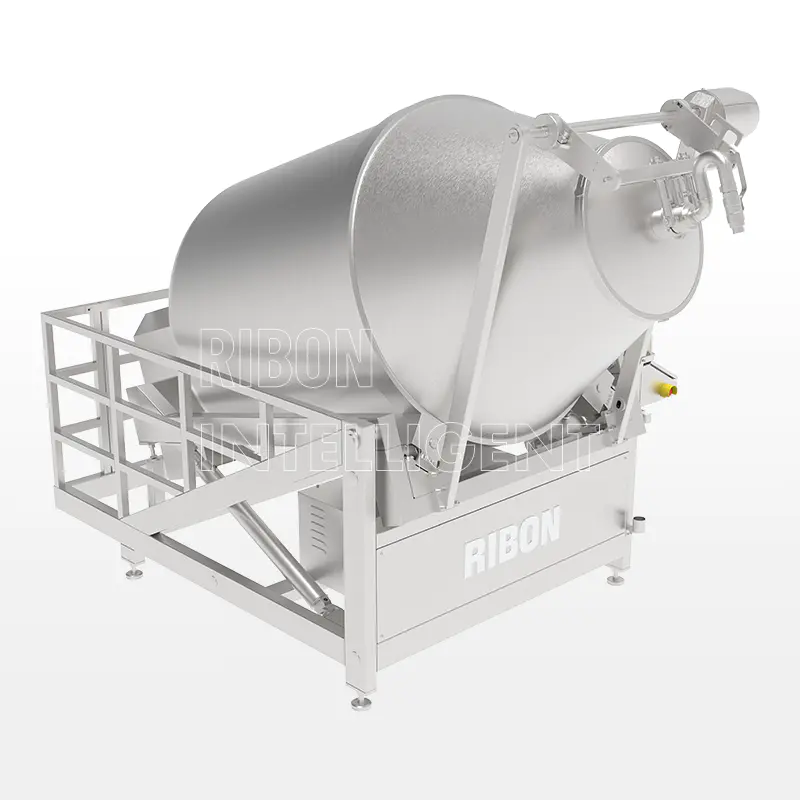
Refrigerated vacuum tumbler
How Vacuum Tumbling Improves Product Performance
Vacuum tumbling is more than a simple mixing operation. It is a controlled mechanical and pressure-based process that can improve the interaction between meat and marinade. By removing air from the drum, the vacuum environment promotes closer contact between the product and the liquid. This can help the marinade reach surfaces and spaces that may not be contacted as effectively under atmospheric conditions.
Vacuum processing also supports the extraction of myofibrillar proteins from the meat. These proteins are important for binding water and contributing to the structure of processed meat products. When the extracted proteins are distributed across the product surface, they can help improve adhesion, cohesion, moisture retention, and slicing performance after cooking.
The results depend on the type of meat, formulation, loading level, vacuum degree, tumbling speed, processing time, and temperature. For this reason, the ability to adjust operating parameters is essential. A machine that provides only one fixed speed or one fixed operating mode may not be suitable for the full range of products processed in a modern plant.
The refrigerated vacuum tumbler provides adjustable drum rotation from 2 to 12 revolutions per minute through a frequency inverter. This broad range allows operators to select a slower movement for delicate products or a more active movement for products requiring stronger mixing and protein extraction.
The machine can also operate with continuous vacuum or breathing rotation. Continuous vacuum maintains the reduced-pressure environment throughout the selected operation. Breathing rotation provides an alternative process pattern in which the vacuum condition can be managed in cycles. These options allow processors to adapt the process to different product structures and formulations.
Core Advantages of the Refrigerated Design
Improved Food-Safety Support
The most immediate advantage of integrated refrigeration is the ability to control product temperature during the full tumbling cycle. This is particularly valuable when batches require long processing times or when the production area is subject to seasonal temperature changes.
By helping maintain a cooler and more stable product environment, the tumbler supports measures designed to limit bacterial growth. It also helps protect the product from unnecessary temperature increases between loading, marination, and unloading. Processors should still operate the equipment according to their approved food-safety procedures, but refrigeration provides a practical engineering control within the processing stage.
Better Water Retention and Yield
Yield is one of the most important economic indicators in meat processing. A product that absorbs and retains the intended quantity of marinade can produce a better return on raw material, provided that the formulation and process comply with applicable regulations and customer requirements.
Vacuum tumbling encourages close contact between meat and marinade, while mechanical action supports the extraction and distribution of proteins. Stable cooling helps maintain suitable processing conditions for these actions. The combined effect can support improved water retention, stronger binding, and a more uniform distribution of ingredients.
The exact yield improvement depends on the recipe and operating conditions, so processors should conduct product trials before finalizing a production program. However, the machine’s ability to control temperature, speed, pressure, and drum position gives users more tools for optimizing their process.
Consistent Texture and Appearance
Uniform tumbling helps distribute marinade throughout a batch. This is important for products such as marinated poultry, pork, beef, prepared meat portions, and other value-added items. Uneven processing may result in differences in color, flavor, tenderness, or moisture from one portion to another.
The internal carriers help lift and release the product during drum rotation. The refrigerated tumbler can be equipped with different carrier configurations, including arc-shaped and blade-shaped options. These alternatives can be selected according to product type, product size, desired movement pattern, and processing objectives.
The drum can also be adjusted through a tilting range of 0 to 20 degrees. This capability changes the way products move inside the drum and supports dynamic marination. The supplied information identifies 12-degree inclined arc-shaped carriers as a configuration that helps promote marinade absorption.
Reduced Dependence on Ambient Conditions
Traditional processing arrangements may depend heavily on the temperature of the production room. If the room becomes warmer, the product may heat up more quickly during tumbling. If the plant must maintain a very low room temperature to protect the product, energy consumption and working conditions may become more challenging.
An integrated refrigeration system reduces this dependence. The tumbler has its own cooling unit and a jacket around the drum, allowing the equipment to actively remove heat during processing. This does not eliminate the importance of a properly designed production environment, but it provides an additional means of maintaining stable product conditions.
Greater Flexibility for Different Products
Meat processors rarely produce only one product. A single facility may process whole-muscle cuts, poultry portions, injected or seasoned products, formed products, and different formulations with varying levels of marinade.
The refrigerated vacuum tumbler is designed with adjustable operating parameters and different loading options. Speed, vacuum mode, drum angle, processing time, and carrier design can be selected to suit the product. This flexibility helps one machine serve several production requirements rather than being limited to one narrow application.
Control System and Operating Functions
The machine uses PLC and touch-screen control. A programmable logic controller manages the key operating functions, while the touch screen gives operators a clear interface for setting and monitoring the process. This combination is widely used in industrial food-processing equipment because it supports repeatability and reduces reliance on manual adjustment.
Operators can set the drum rotation speed within the available range and select the preferred vacuum operating mode. The frequency inverter allows the motor speed to be adjusted smoothly rather than relying only on fixed mechanical speeds. Smooth speed control can help reduce sudden movement and allows the production team to fine-tune the tumbling action.
The control system also supports standardized production recipes. A processor can establish a documented process for a particular product, including a target speed, vacuum setting, tumbling period, and drum position. Once the process has been validated, operators can repeat the same settings for future batches. This helps reduce variation between shifts and supports production traceability.
A touch-screen interface can also simplify operator training. Instead of managing numerous manual switches and independent controls, personnel can work through a more organized control panel. Clear operating instructions and appropriate safety procedures remain necessary, but centralized control can make daily operation more straightforward.
For food manufacturers, the value of the control system is not limited to convenience. Process control is directly connected to product consistency, equipment utilization, labor efficiency, and quality assurance. A machine that allows controlled and repeatable processing is better suited to industrial production than equipment that depends heavily on operator judgment.
Vacuum System Design
The refrigerated vacuum tumbler uses a water-sealed vacuum pump. This type of pump is commonly used in industrial environments where reliable vacuum generation and robust operation are required.
The vacuum system must create and maintain the required negative pressure inside the drum. The specified vacuum degree is up to -0.085 MPa at altitudes of 700 meters or below. Actual performance can be influenced by altitude, sealing condition, product loading, operating temperature, and maintenance status.
A dependable vacuum system contributes to stable processing because inconsistent vacuum can affect marinade contact, product movement, and the final texture. The sealing system, lid condition, piping, valves, and pump should be inspected and maintained as part of the plant’s normal preventive-maintenance program.
The water-sealed design is also appropriate for demanding food-processing applications because the pump can operate in an environment where moisture and vapor may be present. As with all vacuum equipment, operators should follow the manufacturer’s requirements for water quality, pump operation, cleaning, and inspection.
Tilting Frame and Hydraulic Operation
The tiltable frame is one of the important features that distinguishes this equipment from basic fixed-position tumblers. A hydraulic system allows the drum to be positioned at different angles, with the available adjustment ranging from 0 to 20 degrees.
Changing the drum angle affects the movement of the product. At one position, the meat may move in a relatively regular pattern. At another position, the product may travel differently through the drum, increasing or reducing lifting, sliding, and falling action. This can be useful when working with products of different sizes, densities, or structural strength.
Tilting also supports unloading. After the tumbling process is complete, the drum can be moved to an appropriate position to assist the transfer of product into containers, conveyors, or the next stage of the production line. This can reduce manual handling and help streamline material flow.
The hydraulic system must be operated within its design limits and inspected regularly. Hydraulic hoses, fittings, cylinders, and control components should be included in the plant’s preventive-maintenance schedule. Proper inspection helps preserve safe operation and reduces the risk of unplanned downtime.
Manufacturing Capability and Production Capacity
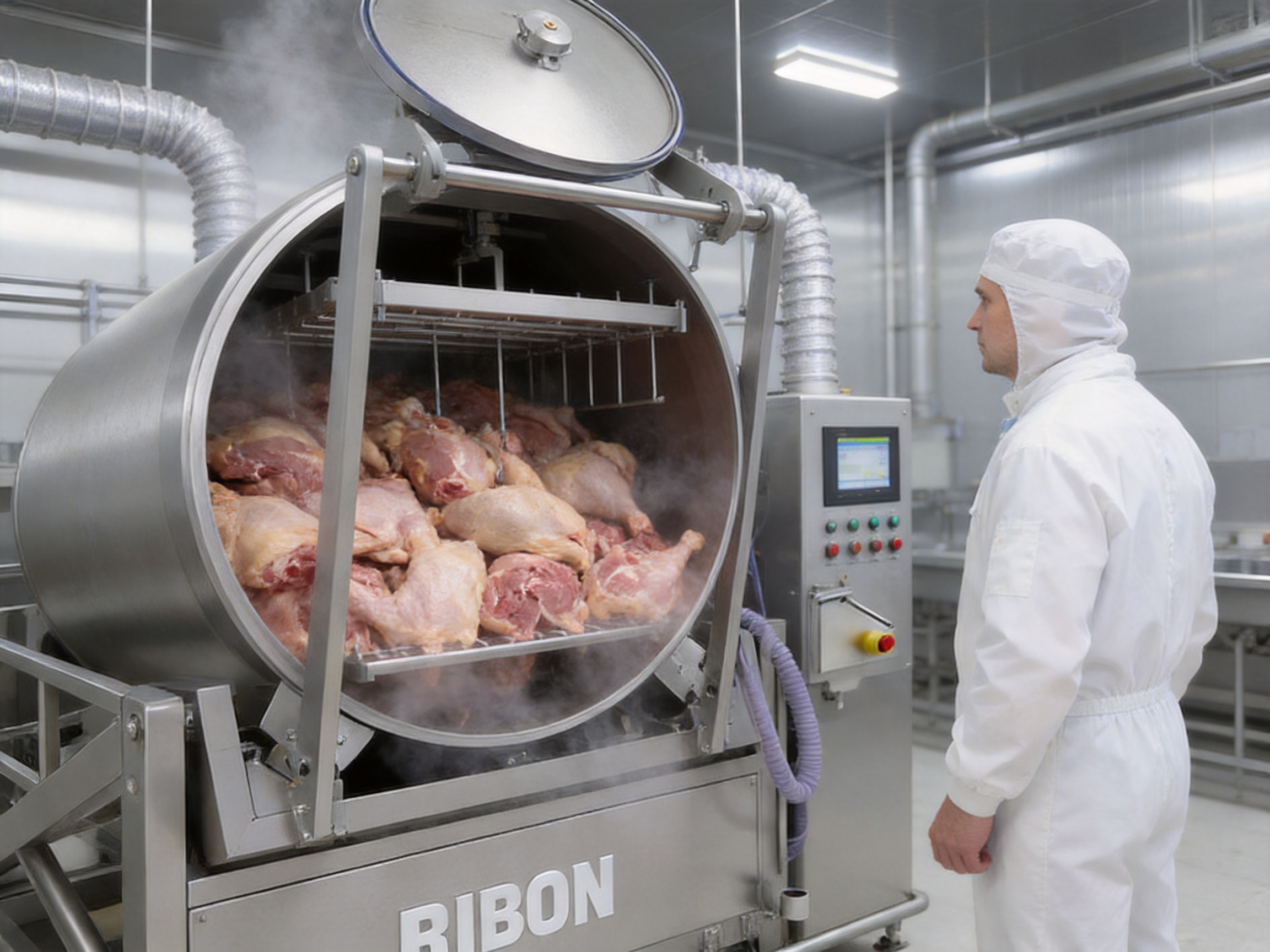
The manufacturer states that it ranks first in vacuum tumbler production capacity in Asia, with a production capacity of approximately 1,000 units per year. This scale is significant because it indicates that vacuum tumblers are not an occasional product within a broad machinery catalog. They are a core area of specialization supported by dedicated experience, production planning, and technical knowledge.
High production capacity can benefit customers in several ways. It may support shorter lead times, more organized spare-parts planning, and greater familiarity with common customer requirements. It also means that the company can draw on experience from a large number of machines manufactured for different processing applications.
Production volume alone, however, does not guarantee equipment quality. The more important factor is how manufacturing capacity is combined with engineering standards, process control, inspection, and commissioning practices. The manufacturing methods described for this equipment indicate an emphasis on precision, welding quality, balance, and component reliability.
Laser Cutting for Precision Components
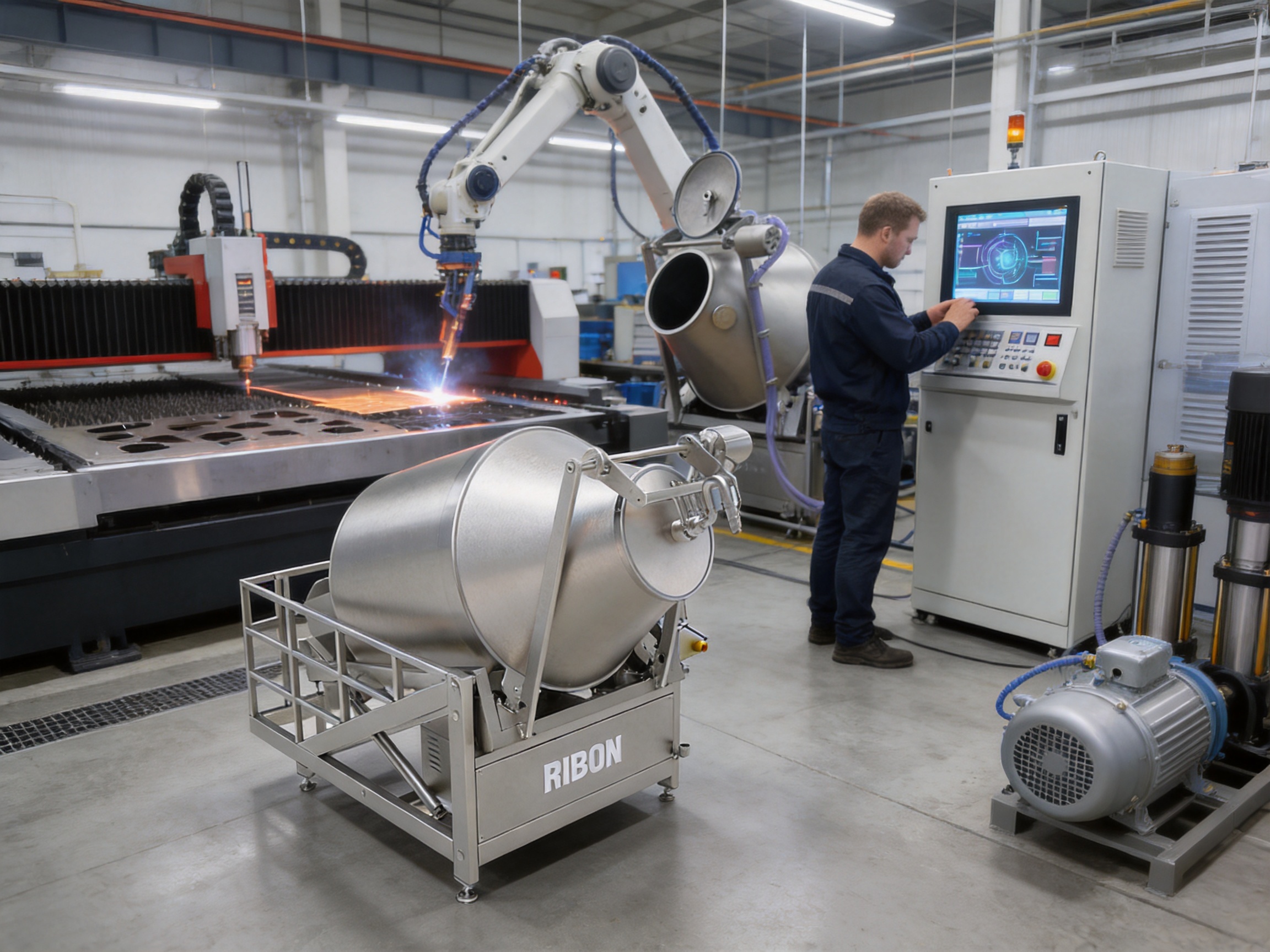
Related parts of the tumbler are cut using fully automated laser-cutting equipment. Laser cutting provides a high level of dimensional accuracy and repeatability. It can produce clean profiles with controlled tolerances, which is important when components must fit together accurately during assembly.
Precision cutting contributes to the quality of the drum, frame, covers, brackets, supports, and other structural elements. Accurate components can reduce alignment problems, simplify assembly, and support consistent performance across multiple machines.
Automated laser cutting also reduces dependence on manual marking and cutting. This helps improve production repeatability and reduces the likelihood of variation between batches. In a machine that includes rotating equipment, vacuum seals, hydraulic systems, and a cooling jacket, dimensional consistency is particularly valuable.
Accurate fabrication can also improve the appearance of the finished equipment. Smooth, consistent edges and well-defined component shapes support a professional finish while making the machine easier to inspect and clean.
Automated Welding and Structural Reliability
The drum and tumbler lid are welded using fully automatic welding machines with gas-shielded welding technology. Automated welding helps maintain consistent welding parameters, bead placement, and penetration from one assembly to the next.
The manufacturer states that this process achieves deeper weld penetration than argon arc welding and supports long-term, maintenance-free performance. While actual service life depends on operating conditions, cleaning procedures, loading practices, and maintenance, strong and consistent welds are essential for a rotating drum exposed to repeated mechanical stress.
Weld quality is important for several reasons. The drum must remain structurally stable while rotating with a heavy product load. The welds must also support the integrity of the vacuum chamber. Any weakness or distortion may affect sealing, balance, durability, or sanitation.
Automated gas-shielded welding can also support a cleaner and more uniform finish. Smooth welds are easier to inspect and less likely to create difficult-to-clean irregularities. In hygienic equipment, surface quality is not merely cosmetic. It affects cleaning efficiency and the ability to maintain sanitary conditions.
The welding process should be considered together with post-weld inspection and drum balancing. A well-executed weld is valuable, but the finished assembly must also be checked for dimensional accuracy, deformation, and rotational stability.
Drum Balancing for Stable Operation
After welding is completed, the drum is balanced to help guarantee stable operation during production. Balancing is particularly important because the drum rotates under load and may operate for extended periods.
An unbalanced drum can create vibration, excessive noise, uneven bearing loads, and premature wear on drive components. It may also affect the movement of the product and place additional stress on the frame. By balancing the drum after fabrication, the manufacturer addresses a key mechanical factor before the machine reaches the customer’s plant.
Balancing also supports operator comfort and equipment reliability. Lower vibration can contribute to a better working environment and reduce the transfer of mechanical forces to surrounding structures. Stable rotation helps the vacuum tumbler perform more predictably at different speeds and loading levels.
For customers, drum balancing is an important example of a manufacturing step that may not be visible during a product demonstration but has a direct influence on long-term performance. It reflects attention to the complete operating system rather than only the external appearance of the equipment.
Quality Control for Key Components
The manufacturer applies quality control procedures throughout the manufacturing process, with particular attention to components that directly affect performance and reliability. The stated procedures include incoming-material inspection, in-process parameter monitoring, and dimensional accuracy verification.
Incoming inspection helps confirm that purchased materials and components meet predefined requirements before they enter production. This is important for structural materials, drive components, electrical parts, valves, pumps, refrigeration elements, and other items that influence the final machine.
In-process monitoring helps verify that manufacturing operations remain within approved parameters. For example, cutting accuracy, welding conditions, assembly alignment, and dimensional tolerances may be checked at relevant stages rather than waiting until the machine is fully assembled.
Dimensional inspection is also essential for components that must fit together precisely. Accurate inspection helps identify deviations early, when correction is easier and less costly. It also supports consistent assembly across different equipment models.
The company states that each batch of key components is subjected to stringent testing based on predefined specifications and that only components meeting the required criteria are approved for assembly. This approach establishes a quality gate before critical parts become part of the finished machine.
For meat-processing customers, this type of quality system can reduce the risk of performance variation and help support predictable operation. It also demonstrates that the manufacturer views quality as a process covering material receipt, fabrication, assembly, testing, and final delivery.
International Electrical Components
The electrical components are sourced from leading international brands. This provides two practical benefits: component familiarity and easier local replacement.
Industrial food-processing plants often operate in regions with different electrical standards, service networks, and spare-parts availability. When control components come from internationally recognized suppliers, local maintenance teams may be more familiar with their operation and replacement procedures.
Local availability can also reduce downtime. If a relay, sensor, inverter, control component, or other electrical part requires replacement, a widely distributed brand may be easier to source than a specialized component with limited regional support.
Using established electrical components does not eliminate the need for proper maintenance. Electrical cabinets should still be kept clean and dry, connections should be inspected, and components should be replaced according to approved procedures. However, the use of recognized brands can simplify service planning and improve confidence in long-term support.
Models and Technical Range
The refrigerated vacuum tumbler is available in several models designed for different drum capacities and loading requirements. The following table summarizes the supplied specifications.
| Model | Power | Drum Capacity | Maximum Loading Capacity | Drum Speed | Cooling Capacity |
|---|---|---|---|---|---|
| RGR-800HY | 5.9 kW | 800 L | Up to 500 kg | 2–12 rpm | 7,250 kcal/h |
| RGR-1700HY | 7.4 kW | 1,700 L | Up to 1,000 kg | 2–12 rpm | 12,300 kcal/h |
| RGR-2500HY | 9.2 kW | 2,500 L | Up to 1,500 kg | 2–12 rpm | 19,250 kcal/h |
| RGR-3500HY | 11.7 kW | 3,500 L | Up to 2,100 kg | 2–12 rpm | 25,000 kcal/h |
All listed models have a stated water-pressure requirement of at least 0.2 MPa. The specified vacuum degree is -0.085 MPa at an altitude of 700 meters or below. The cooling-unit evaporation temperature is listed as -5 degrees Celsius, and the cooling-unit supply pressure is no more than 0.15 MPa.
The maximum loading capacity depends on the product. Different products have different densities, shapes, moisture levels, and movement characteristics. For that reason, the listed loading figures should be considered equipment reference values rather than universal targets for every recipe.
Proper loading is important for product quality. Overloading may restrict product movement, reduce contact with the marinade, increase mechanical stress, and make temperature control more difficult. Underloading may reduce production efficiency and change the tumbling pattern. Product trials and process validation should be used to determine the optimum working load.
Comparison with Conventional Tumblers
A conventional tumbler may provide basic rotation and, in some cases, vacuum processing. However, it may not include an independent cooling system, a broad speed range, a tilting frame, or multiple carrier configurations. The refrigerated vacuum tumbler combines these functions in one integrated system.
The first major difference is temperature control. Without active cooling, the product temperature may depend more heavily on the starting temperature, processing time, room conditions, and heat generated during movement. Integrated refrigeration gives the operator a greater ability to control the process.
The second difference is process flexibility. Adjustable speeds from 2 to 12 rpm allow the machine to accommodate products with different handling requirements. Continuous vacuum and breathing rotation provide additional process options.
The third difference is mechanical adaptability. A tilting range of 0 to 20 degrees allows operators to influence product movement and support unloading. Different carrier designs can also be selected for different product types.
The fourth difference is manufacturing attention. Laser-cut components, automated welding, post-weld balancing, quality inspection, and internationally sourced electrical components support a more controlled equipment platform than machinery assembled with inconsistent manual processes.
These differences can provide a competitive advantage for plants that process multiple products, require stable quality, or operate in environments where ambient conditions change. A lower-cost basic tumbler may be suitable for a narrow application, but a refrigerated vacuum tumbler may offer greater value over its service life when production flexibility, yield, and consistency are considered together.
Applications in Meat Processing
Refrigerated vacuum tumblers are suitable for a broad range of marinated and processed meat applications. They can be used for poultry portions, pork cuts, beef products, prepared meat products, and other items requiring controlled mixing and marinade absorption.
For poultry, the equipment can help distribute marinades across portions and support consistent moisture retention. Different carrier shapes and moderate rotation speeds may be selected to limit excessive mechanical damage while achieving the desired coating and absorption.
For pork and beef, vacuum tumbling can support the extraction of proteins and the binding of marinade. The cooling system is especially useful when the product requires a longer process or when the plant must protect product temperature during extended operation.
For prepared meat products, the machine can help mix ingredients and promote uniform distribution. The exact suitability depends on the formulation, particle size, product structure, and required level of mechanical action.
The equipment can also be integrated into a larger meat-processing line. After tumbling, product may move to forming, stuffing, cooking, smoking, chilling, packaging, or other downstream operations. The manufacturer’s broader experience in smokehouses, slaughtering, cutting, and deboning solutions may support customers that require more than one type of processing equipment.
Hygiene, Cleaning, and Maintenance Considerations
Hygienic design and disciplined cleaning are essential for any machine that handles raw or marinated meat. The refrigerated vacuum tumbler should be operated as part of a documented sanitation program that addresses product-contact surfaces, external surfaces, vacuum lines, drain areas, and accessible components.
Operators should follow the manufacturer’s recommended cleaning procedures and use cleaning agents approved for the facility. Cleaning should remove meat residues, fat, protein deposits, marinade, and other materials that could support microbial growth or interfere with equipment performance.
The drum, lid, seals, carriers, and product