

 English
 русский
 Español
 عربى

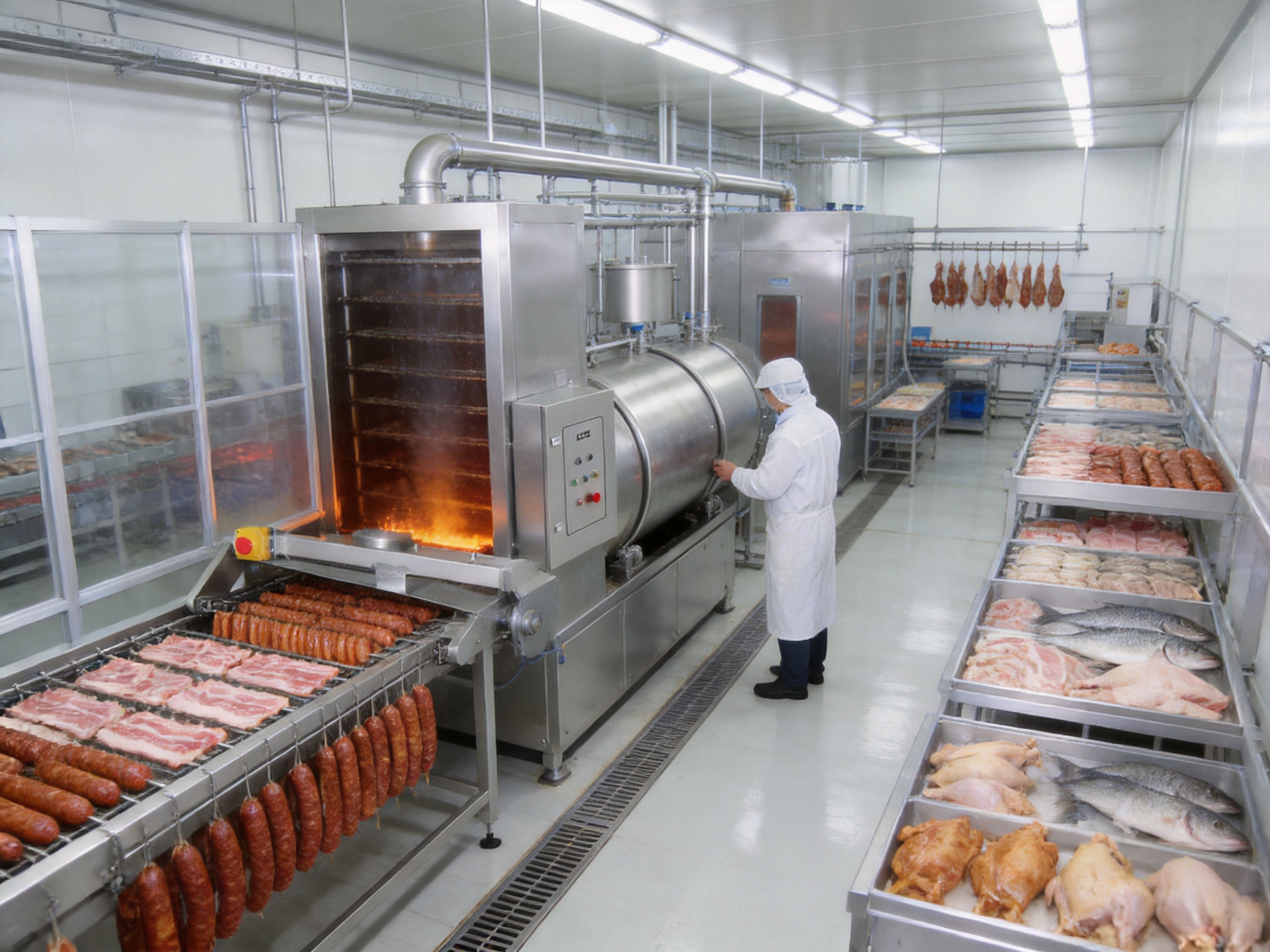
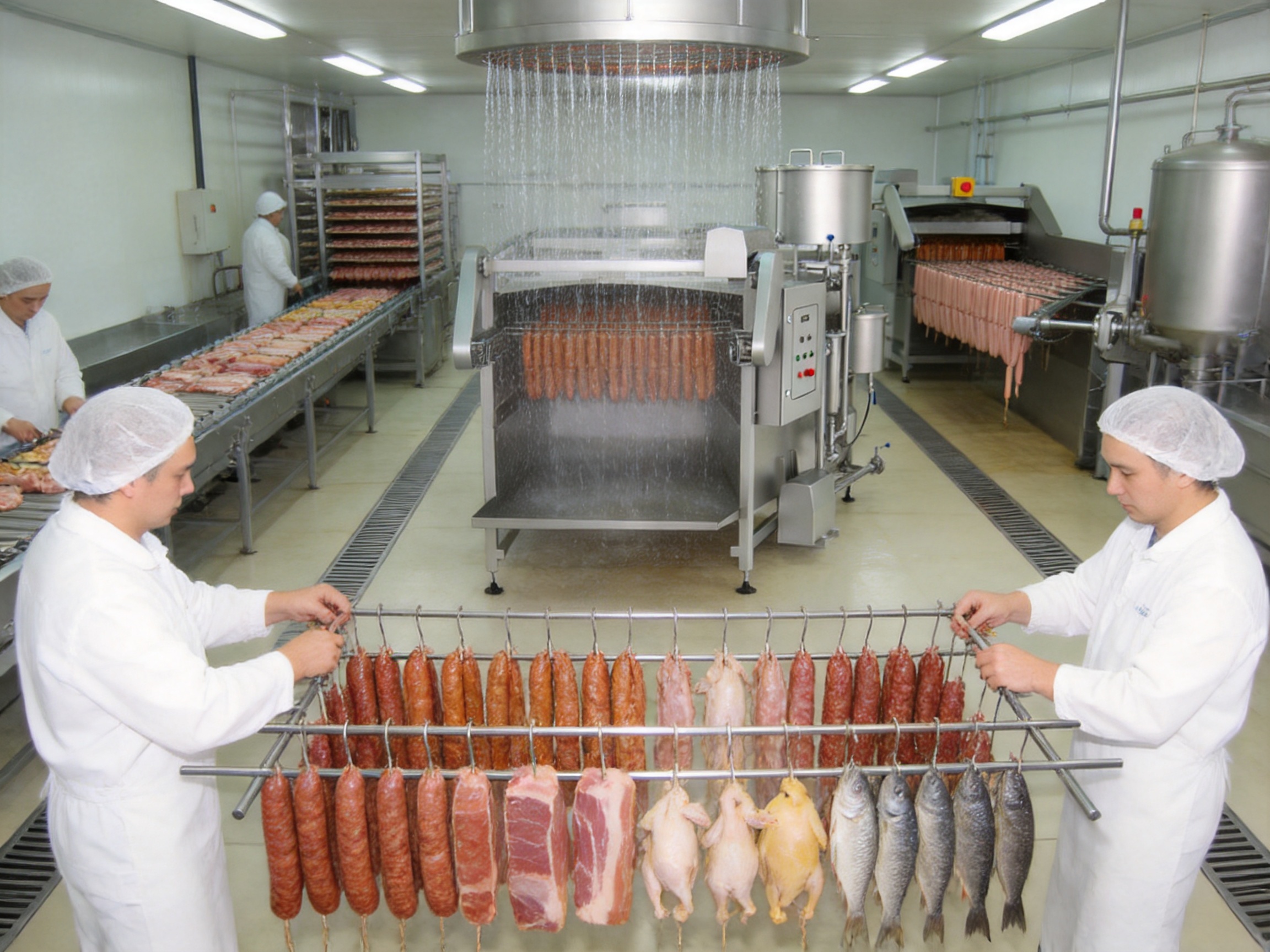
Liquid smoke drenching is an efficient method for adding a consistent smoked flavor, aroma, and attractive surface appearance to meat, poultry, fish, and other food products. Instead of generating smoke inside a traditional smokehouse, a liquid smoke drench system applies a prepared smoke solution directly to products that are suspended from smoke sticks or placed on suitable carriers. The products can then proceed to drying and cooking without requiring a second conventional smoking stage.
This approach offers important benefits for modern food processors. It can reduce smoking time, improve equipment utilization, simplify process control, and support a more predictable finished product. It is particularly useful for sausages, bacon, poultry, fish, and other products that are naturally processed in hanging positions.
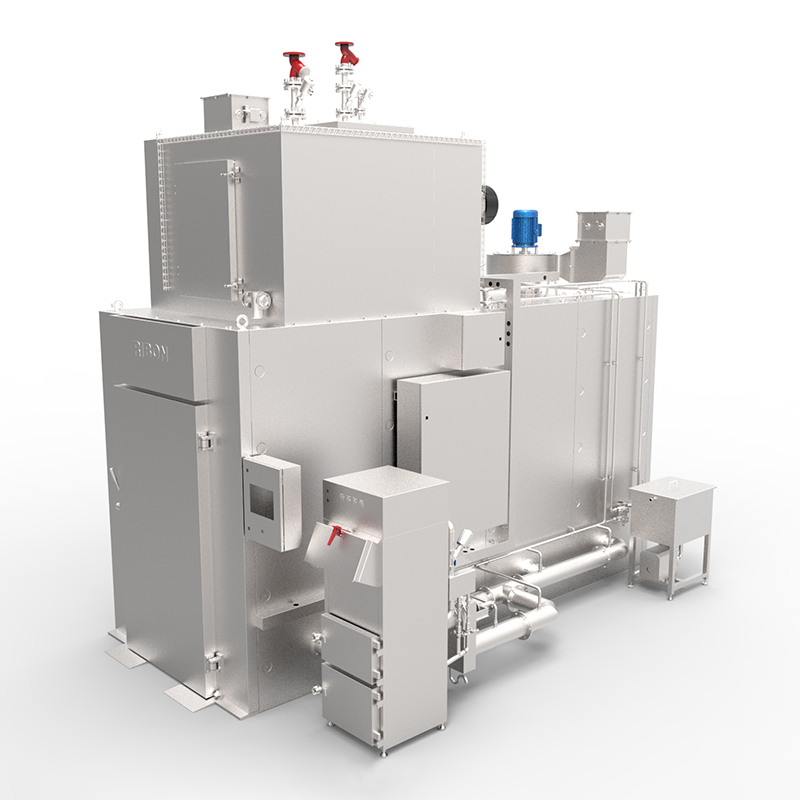
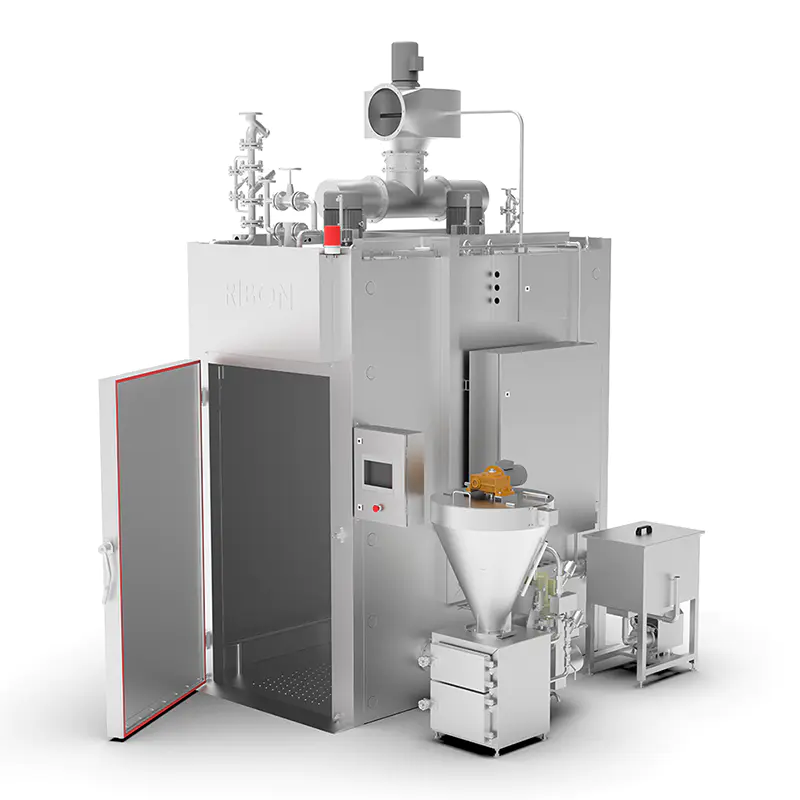
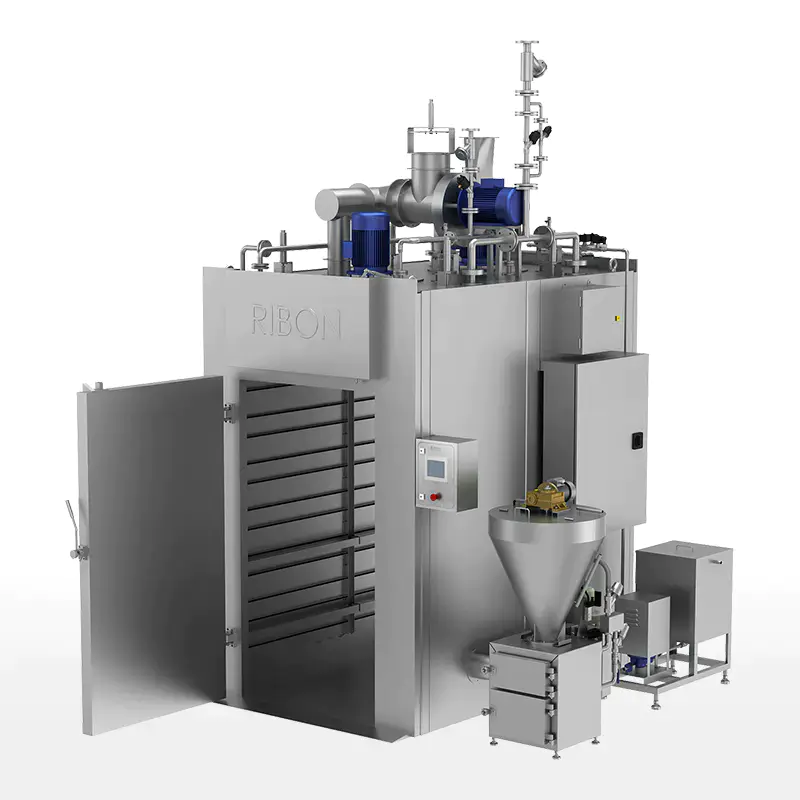
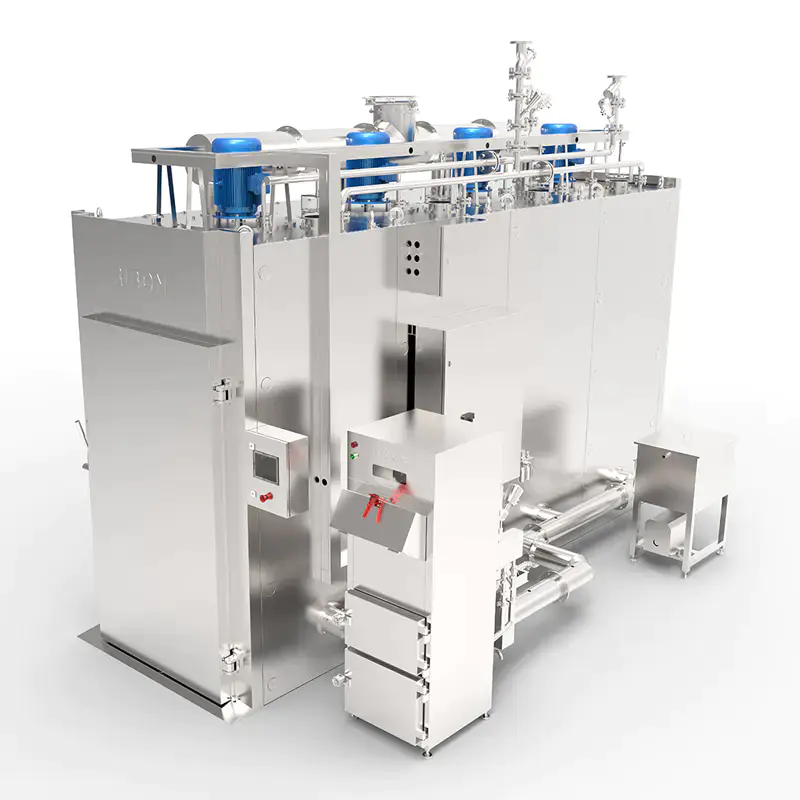
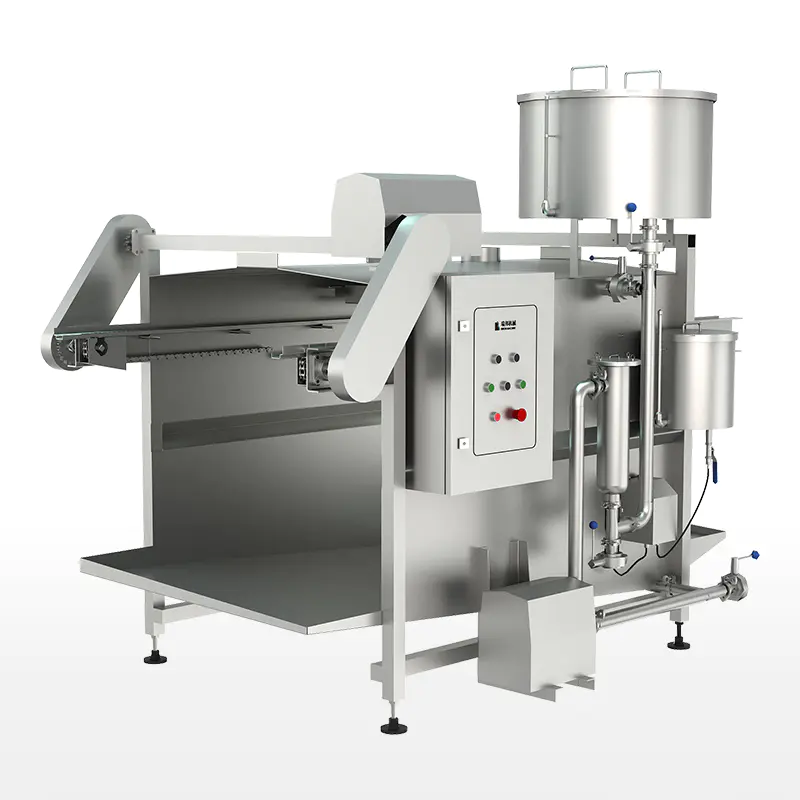
The Liquid Smoke Drench equipment supplied by Zhejiang Ribon Intelligent Equipment Co., Ltd. is designed specifically for this application. Its stated configuration includes a 380V/50Hz electrical supply, 1.3kW power rating, 600kg/h capacity, 990mm stick length, 2145 × 1600 × 2100mm overall dimensions, and an equipment weight of approximately 800kg. These specifications make the system suitable for industrial meat-processing environments that require continuous, practical, and space-conscious production equipment.
Content
- 1 What Is a Liquid Smoke Drench System?
- 2 How the Equipment Works
- 3 Core Product Specifications
- 4 Advantages Over Conventional Smoking Methods
- 5 Why a Dedicated Drench System Can Outperform Improvised Equipment
- 6 Application Areas
- 7 Manufacturing Strengths and Engineering Approach
- 8 Process Control and Product Quality
- 9 Hygiene, Cleaning, and Maintenance
- 10 Installation and Factory Integration
- 11 Operational Benefits for Different Plant Sizes
- 12 Economic and Efficiency Considerations
- 13 Recommended Implementation Procedure
- 14 Common Troubleshooting Considerations
- 15 Safety and Responsible Operation
- 16 Why Choose a Specialized Meat-Processing Manufacturer?
- 17 Conclusion
- 18 Questions and Answers
- 18.1 What products can be processed in a Liquid Smoke Drench system?
- 18.2 Does the system create traditional wood smoke?
- 18.3 Do products need to be smoked again after drenching?
- 18.4 What is the listed production capacity?
- 18.5 What are the electrical requirements?
- 18.6 How long does liquid smoke application take?
- 18.7 Can the system be connected to an existing processing line?
- 18.8 How can uniform results be achieved?
- 18.9 What should be considered when comparing this system with manual spraying?
- 18.10 Who manufactures the Liquid Smoke Drench equipment?
- 19 References
- 20 Product: Liquid Smoke Drench
What Is a Liquid Smoke Drench System?
A Liquid Smoke Drench system is a food-processing machine that showers or sprays liquid smoke onto products suspended on smoke sticks. The liquid smoke is typically produced by condensing smoke generated from wood or other approved plant materials. During condensation and purification, water-soluble smoke compounds are collected in liquid form. The resulting solution contains flavor and aroma components associated with traditional smoking.
In a conventional smokehouse, products are exposed to smoke created by burning or smoldering wood chips, sawdust, or other smoking materials. In a liquid smoke drench process, the smoke flavor is delivered as a controlled liquid application. This eliminates the need to create a smoke atmosphere inside the cooking chamber and can simplify the relationship between flavor application, drying, and cooking.
The system is specially designed for products hung on smoke sticks. Sausages, bacon, poultry portions, fish, ham products, and similar foods can be loaded into the drenching area in an organized arrangement. The machine then applies the liquid smoke solution over the product surfaces, helping to achieve even coverage before the products continue to the next processing stage.
The term “drench” refers to a relatively comprehensive showering application rather than a small spot treatment. As the liquid smoke flows over the products, exposed surfaces receive the solution. The exact application quantity and contact time can be adjusted according to the product shape, recipe, desired color, flavor intensity, and production requirements.
How the Equipment Works
Product Loading
Products are first prepared according to the processor’s standard recipe. Sausages may be linked and hung in rows, bacon may be arranged on suitable hooks, and poultry or fish may be suspended with adequate spacing. The products are loaded onto smoke sticks with a nominal stick length of 990mm for the listed machine configuration.
Correct loading is important because spacing affects the distribution of liquid smoke. If products touch one another excessively, areas between the products may receive less solution. Proper hanging also supports drainage, reduces unnecessary pooling, and helps the products move smoothly through the drenching area.
Liquid Smoke Preparation
The smoke solution is prepared in accordance with the supplier’s instructions and the processor’s approved formulation. Depending on the product, the liquid smoke may be used at a specified concentration or diluted with water. Food processors should establish controlled procedures for storage, mixing, filtration, and replenishment of the solution.
The solution should be handled as a food-processing ingredient. Operators need to follow the relevant product specification, food safety requirements, and local regulations. The application concentration must be validated for each product because different meats and fish absorb liquid smoke at different rates.
Showering and Surface Coverage
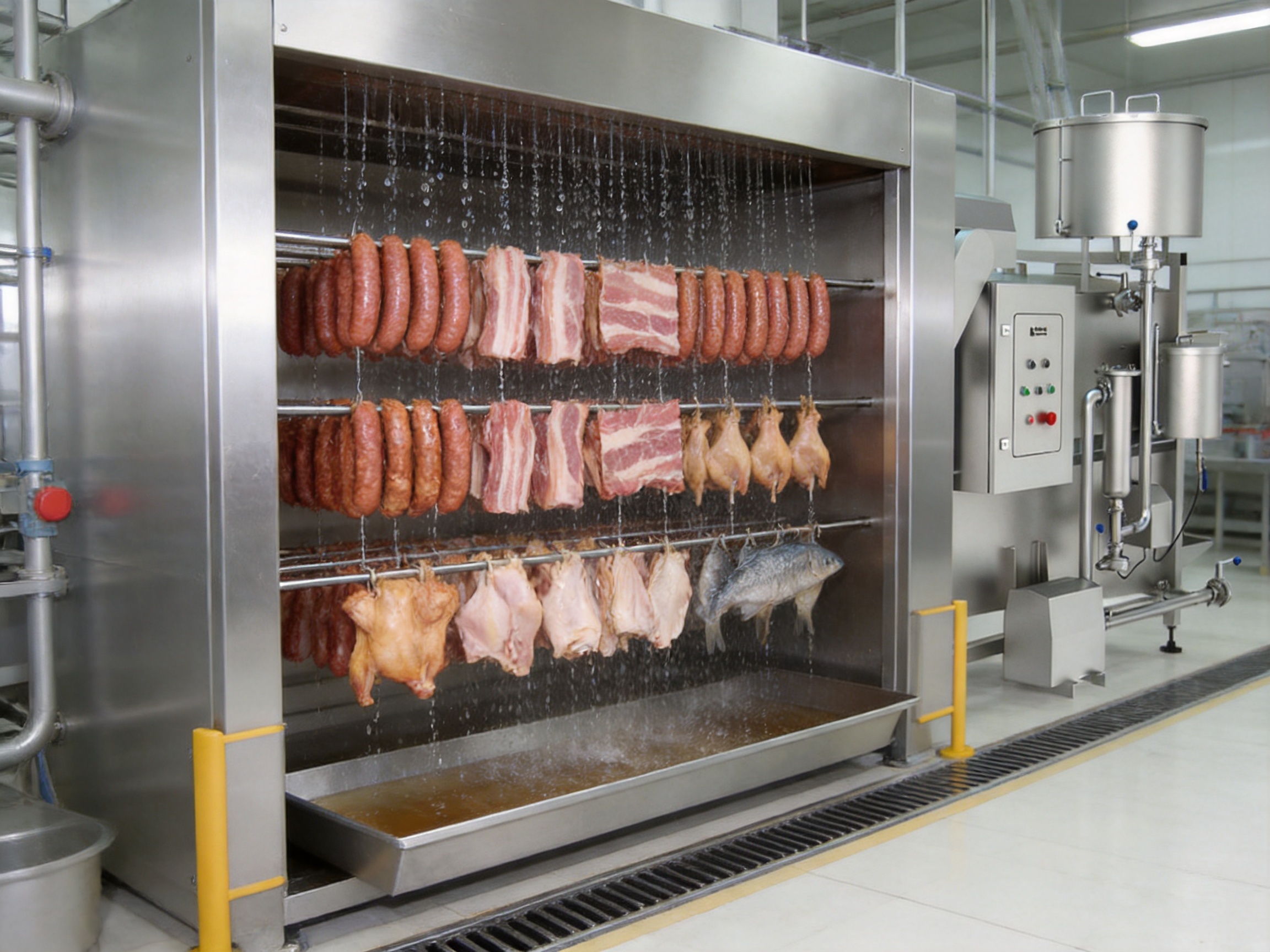
After loading, the smoke sticks enter the application zone. The system showers the liquid smoke onto the hanging products. The arrangement of the showering system is intended to distribute liquid across the product surfaces while the products remain suspended from their sticks.
The liquid smoke reaches the outside of the products and begins to interact with the surface. Depending on the formulation and product characteristics, some flavor compounds remain near the surface while others penetrate into the outer layers. The level of absorption depends on the product’s moisture, temperature, casing, fat content, surface structure, and exposure time.
Uniform application is one of the most important functions of the machine. Inconsistent coverage can create differences in color, aroma, and flavor between products in the same batch. A purpose-built drenching system is more suitable for this task than improvised manual spraying because the equipment provides a dedicated, repeatable process environment.
Drainage and Continued Processing
After the liquid smoke has been applied, excess solution can drain from the products. The products may then continue to drying and cooking equipment. A key advantage of the process is that the products can be dried and cooked without being smoked again in a conventional smokehouse.
The precise sequence depends on the recipe. Some processors may apply liquid smoke before drying and cooking. Others may use a staged process that includes a short holding period, surface drying, cooking, cooling, and packaging. The correct sequence should be determined through product trials and validated process controls.
Core Product Specifications
The following table summarizes the principal specifications supplied for the Liquid Smoke Drench equipment.
| Item | Specification |
|---|---|
| Product type | Liquid Smoke Drench Equipment |
| Primary application | Showering liquid smoke onto products hung on smoke sticks |
| Suitable products | Sausage, bacon, poultry, fish, and similar meat products |
| Power supply | 380V / 50Hz |
| Power rating | 1.3kW |
| Capacity | 600kg/h |
| Overall dimensions | 2145 × 1600 × 2100mm |
| Approximate weight | 800kg |
| Stick length | 990mm |
Capacity should always be understood in relation to product type, loading density, liquid smoke formulation, operating procedures, and the required application result. The stated capacity of 600kg/h provides a useful reference for production planning, but actual throughput may vary according to the processor’s product mix and line organization.
Advantages Over Conventional Smoking Methods
Reduced Smoking Time
The most direct advantage is the reduction or elimination of a separate smoke-generation stage. Traditional smoking can require the preparation of wood materials, control of combustion or smoldering, management of smoke density, and monitoring of the chamber atmosphere. Liquid smoke drenching transfers the flavor application into a dedicated liquid process.
Once the liquid smoke has been applied, products can proceed to drying and cooking without smoking again. This can shorten the overall production route, especially in facilities where smokehouse capacity is limited. Shorter processing routes may also make it easier to schedule different product batches during the same working day.
Improved Equipment Utilization
Traditional smokehouses can become production bottlenecks when they must perform smoking, drying, cooking, and sometimes cooling in one chamber. A liquid smoke drench system separates the flavoring step from the smokehouse function. This gives processors more flexibility in allocating smokehouses to drying, cooking, or other thermal operations.
Better equipment utilization can be valuable for both new factories and existing facilities. A processor may be able to increase output without immediately adding a large number of additional smokehouses. In a growing plant, the drenching system can also support a modular production layout in which flavor application and thermal processing are organized as separate stages.
Consistent Application
Manual application methods depend heavily on operator technique. Hand spraying may create differences in coverage, while dipping may apply more solution than required and may introduce additional handling. A purpose-built drenching machine supports a more repeatable application process.
Consistency is important for brand quality. Consumers expect products from different batches to have similar color, aroma, and flavor. The machine can help processors establish standardized operating parameters, including loading arrangement, liquid concentration, application time, and production speed.
Suitable for Multiple Product Categories
The equipment is designed for a broad range of hanging products. Sausage, bacon, poultry, fish, and other products can be treated when their dimensions and handling requirements are compatible with the machine configuration. This versatility allows a processor to use one system across several product lines rather than purchasing separate flavoring equipment for every category.
Product trials remain necessary before full-scale production. The ideal application method for a thin sausage may differ from that for a thick bacon cut or a whole poultry product. Nevertheless, the basic hanging-stick format provides a useful foundation for flexible production.
Practical Industrial Footprint
The listed dimensions of 2145 × 1600 × 2100mm provide a relatively compact equipment footprint for an industrial liquid smoke application stage. The machine can be considered during line planning where floor space, ceiling height, product flow, and access for cleaning must all be evaluated.
Its approximate 800kg weight also reflects a substantial industrial construction rather than a small laboratory or manual-use device. The final installation should include a suitable foundation or floor area, access for maintenance, appropriate drainage, electrical connection, and enough surrounding space for safe loading and cleaning.
Liquid Smoke Drench
Why a Dedicated Drench System Can Outperform Improvised Equipment
Some small processors apply liquid smoke with handheld sprayers, open shower arrangements, or modified tanks. These methods may appear inexpensive at the beginning, but they can introduce several operational limitations. Manual systems often require more labor, have less predictable coverage, and make it difficult to reproduce the same application conditions from batch to batch.
A dedicated machine is designed around the product flow. The smoke sticks, application area, liquid circulation, operating height, and production capacity are considered as part of one system. This integrated design can reduce unnecessary handling and make the process easier to supervise.
Compared with a conventional smokehouse used only for flavor generation, liquid smoke drenching can also reduce dependence on combustion-related control. There is no need to create the same level of smoke density inside the chamber, and the processor can manage the smoke ingredient as a liquid formulation. This may simplify production planning and reduce variability associated with wood type, moisture, smoldering conditions, and smoke circulation.
Compared with a basic dipping tank, showering is more compatible with products hung on sticks. It can help maintain the shape and arrangement of the products, reduce manual submersion work, and support continuous or organized batch production. The most suitable method will depend on the recipe, but the drench format is particularly appropriate for hanging products that must retain their shape.
Application Areas
Sausage Processing
Sausages are one of the most natural applications for liquid smoke drenching. Linked sausages can be hung on smoke sticks with controlled spacing. The application can provide a smoked aroma and surface color before the sausages enter a drying and cooking cycle.
For sausage producers, the process can be integrated with filling, linking, hanging, drenching, drying, cooking, cooling, and packaging. The processor can develop specific application settings for fresh sausage, cooked sausage, emulsified products, coarse-ground sausage, and other product types.
Bacon and Cured Meat
Bacon and other cured products can also benefit from a controlled surface application. Because bacon may contain a combination of lean meat, fat, and a relatively broad surface area, application parameters should be validated carefully. Excessive liquid may affect drying behavior, while insufficient coverage may produce an uneven result.
A controlled drench process allows the manufacturer to connect the smoke application to the rest of the curing and cooking program. The final product should be evaluated for flavor, appearance, surface moisture, slicing performance, and packaging stability.
Poultry
Poultry products vary considerably in size and shape. Portions, whole birds, wings, legs, and formed poultry products may require different hanging methods and exposure conditions. The equipment’s hanging format can be advantageous when poultry products are already processed on hooks or sticks.
Because poultry surfaces can be irregular, product spacing and liquid distribution are important. The processor should verify that recessed areas and overlapping surfaces receive the intended treatment. Product trials should also confirm that the liquid smoke does not interfere with the desired skin texture or cooking result.
Fish and Seafood Products
Fish products are often associated with traditional smoking, making them a logical application for liquid smoke technology. Fish may be more delicate than many meat products, so careful handling and appropriate application intensity are essential.
A liquid smoke process can support a controlled flavor profile while allowing the processor to use a separate drying and cooking sequence. Factors such as fish species, fat content, skin condition, fillet thickness, moisture, and target flavor should be considered during validation.
Manufacturing Strengths and Engineering Approach
Zhejiang Ribon Intelligent Equipment Co., Ltd. was founded in 2003 by Mr. Shi Ming and specializes in the research, development, and manufacture of meat-processing machinery. The company’s product scope includes meat-processing smokehouses, vacuum tumblers, cutting and deboning lines, and related meat-processing solutions.
This background is relevant to the Liquid Smoke Drench system because a drenching machine does not operate in isolation. In a modern processing facility, it may need to work alongside smokehouses, cooking systems, material-handling equipment, tumblers, cutting equipment, deboning lines, and packaging operations. A manufacturer with experience across these areas can better understand the complete production flow.
The company states that it has exported its solutions worldwide since 2003. International project experience can contribute to a broader understanding of different factory layouts, product categories, production scales, utility conditions, and customer expectations. It also encourages the development of equipment that is practical to install, operate, maintain, and adapt.
Ribon’s stated development philosophy emphasizes better-designed and more practical solutions. For food-processing equipment, practicality includes more than basic mechanical operation. It involves suitable capacity, logical product handling, accessible maintenance points, reliable controls, cleanable surfaces, efficient use of floor space, and compatibility with the customer’s existing line.
The company also describes ongoing optimization of its technologies and solutions. Continuous optimization is especially important in liquid smoke processing because product requirements differ widely. A successful system must be capable of supporting repeatable production while allowing the processor to establish different recipes for different products.
Environmental responsibility is another stated focus of the company. Liquid smoke application can support this objective by reducing the need for conventional smoke generation during the flavoring stage. Environmental performance still depends on the complete process, including liquid management, water use, cleaning procedures, energy consumption, and waste treatment. However, replacing some smoke-generation operations with controlled liquid application can be considered as part of a broader efficiency strategy.
Process Control and Product Quality
Controlling Liquid Smoke Concentration
The concentration of the liquid smoke solution strongly influences the final product. A higher concentration may produce a more pronounced aroma or darker appearance, while a lower concentration may be appropriate for a lighter flavor profile. Processors should not assume that one concentration is suitable for every product.
Concentration control should be supported by written recipes, batch records, and clearly identified measuring procedures. Operators should know the target concentration, acceptable range, replenishment method, and actions required when the solution falls outside the established range.
Controlling Product Spacing
Uniform spacing between products helps the liquid reach exposed surfaces consistently. Overloading a smoke stick can restrict circulation and cause shadowed areas. Excessively wide spacing, on the other hand, may reduce capacity and increase the cost per kilogram.
The ideal arrangement should be determined for each product. Sausages may be arranged in regular hanging rows, while poultry and fish may require greater separation due to their irregular shapes. Standardized loading diagrams can help operators achieve repeatable results.
Monitoring Application Time
Application time affects the amount of liquid smoke deposited on the product. A short application may provide a subtle result, while a longer exposure may increase surface wetting and flavor intensity. The machine’s operating procedure should define the required exposure for each product family.
Changes in line speed, product density, nozzle performance, or liquid temperature can affect the actual result. For this reason, routine inspection and periodic product testing are important even when the equipment is operating normally.
Evaluating the Finished Product
Quality evaluation should include appearance, aroma, flavor, surface moisture, texture, cooking yield, and packaging performance. Sensory evaluation can be combined with measurements appropriate to the product and local regulations.
Processors should compare results from different application conditions before approving a commercial recipe. Small adjustments in concentration or exposure time can have a noticeable effect on the final product. Once a recipe has been approved, changes should be controlled through the plant’s normal quality-management procedures.
Hygiene, Cleaning, and Maintenance
Any machine used in meat processing must be incorporated into the plant’s sanitation program. Liquid smoke residues, proteins, fats, and other organic material can accumulate if cleaning is incomplete. The equipment should be cleaned according to the manufacturer’s instructions and the processor’s approved sanitation procedures.
Cleaning responsibilities may include removing product residues from the application area, checking liquid-contact components, inspecting drainage points, cleaning accessible surfaces, and confirming that no stagnant solution remains in areas where it could affect subsequent production.
The liquid smoke circuit should be managed carefully. Filters, pumps, tanks, pipes, and spray or shower components may require inspection or cleaning at defined intervals. Any filtration or circulation arrangement should be monitored for blockages, changes in flow, or uneven application.
Operators should inspect the equipment before each production shift. Basic checks may include electrical safety, emergency controls, guards, doors or access points, liquid levels, visible leaks, pump operation, and the condition of the showering components. Preventive maintenance can help reduce unexpected downtime.
Maintenance schedules should be based on operating hours, product load, cleaning frequency, and the recommendations supplied with the machine. Bearings, seals, electrical components, pumps, and other wear parts should be checked by qualified personnel. Maintenance records are useful for identifying recurring problems and planning replacement parts.
Installation and Factory Integration
Before installation, the processor should confirm the available floor area and the listed machine dimensions of 2145 × 1600 × 2100mm. Ceiling clearance must be sufficient for installation, operation, smoke-stick handling, cleaning, and maintenance. The surrounding layout should allow products to move efficiently from loading to drenching and then to drying or cooking.
The listed electrical requirement is 380V/50Hz with a power rating of 1.3kW. Electrical work should be completed by qualified professionals in accordance with local regulations and the plant’s safety standards. The actual connection should be confirmed with the final equipment documentation before commissioning.
Drainage is an important consideration because liquid smoke application can produce runoff. The installation should provide a controlled drainage arrangement that is compatible with the site’s wastewater procedures. The floor should support safe cleaning and should not create standing liquid around the equipment.
The machine should be positioned so that operators can load and unload smoke sticks without unnecessary lifting, obstruction, or crossing of clean and unclean product flows. If the drench system is installed between raw-product handling and cooking equipment, the factory should carefully define hygiene zones and employee movement routes.
Commissioning should include an empty run, verification of controls, inspection of liquid flow, confirmation of product loading arrangements, and trial production. The processor should record the selected settings and use approved samples to confirm the desired result.
Operational Benefits for Different Plant Sizes
Small and Medium-Sized Processors
For a small or medium-sized processor, the system can provide a more organized alternative to manual liquid smoke application. The 600kg/h reference capacity may support meaningful production volumes while keeping the equipment focused on one specific process function.
These processors may benefit from the ability to separate flavoring from cooking. Instead of investing immediately in a larger traditional smokehouse, they can evaluate whether liquid smoke drenching meets their product and market requirements while using existing thermal equipment for drying and cooking.
Large-Scale Production Facilities
Large plants may use the system as part of a continuous or semi-continuous line. The dedicated drenching stage can help balance line capacity, reduce pressure on smokehouses, and support multiple product recipes. Where several product types are manufactured, the processor can establish controlled settings for each recipe and organize production campaigns accordingly.
Large facilities may also benefit from the equipment’s role in process standardization. A repeatable application stage can provide a clearer production record than manual spraying and can support more systematic quality checks.
Economic and Efficiency Considerations
The economic value of a liquid smoke drench system should be considered across the complete production process rather than judged only by the purchase price. Relevant factors include labor, throughput, smokehouse availability, energy consumption, wood or smoke-generation materials, product consistency, cleaning time, maintenance, and the cost of rejected or downgraded products.
Reducing a separate smoking stage may increase the availability of existing smokehouse capacity. If a facility already experiences bottlenecks, this capacity improvement can be more valuable than a simple calculation based on machine power consumption.
The equipment’s listed power rating of 1.3kW indicates a relatively modest electrical requirement for the drenching function itself. Total operating costs will also depend on pumps, water, liquid smoke, cleaning chemicals, labor, and connected downstream equipment. A complete cost analysis should therefore include the entire production route.
Product consistency can also have an economic effect. More uniform products may reduce rework, customer complaints, recipe variation, and quality-related waste. These benefits are difficult to estimate without plant-specific data, but they are important when comparing a dedicated machine with manual application.
Recommended Implementation Procedure
A successful implementation begins with product definition. The processor should identify the exact products to be treated, including dimensions, weight, casing or skin type, moisture, fat content, and target flavor profile. Product handling information should include the smoke-stick design and the number of products loaded per stick.
The second step is a controlled liquid smoke trial. The processor should test the recommended solution concentration, product temperature, application time, loading density, and downstream drying and cooking conditions. Samples should be evaluated by production, quality, and product-development personnel.
The third step is process documentation. Once the desired result is achieved, the processor should document the recipe, preparation method, machine settings, loading pattern, inspection requirements, sanitation procedure, and corrective actions.
The fourth step is operator training. Operators should understand the purpose of the machine, safe loading methods, liquid handling, start-up and shutdown procedures, basic troubleshooting, sanitation responsibilities, and escalation procedures for abnormal conditions.
The final step is performance monitoring. During the first production period, the processor should compare throughput, liquid consumption, product appearance, flavor, cooking yield, downtime, and cleaning time against the expected results. Adjustments can then be made through a controlled improvement process.
Common Troubleshooting Considerations
Uneven Product Color or Flavor
Uneven results may be caused by inconsistent product spacing, blocked shower components, variable liquid concentration, insufficient circulation, or changes in application time. Operators should first verify loading and liquid preparation before investigating more complex mechanical causes.
Excessive Surface Wetness
Excess surface liquid may result from excessive application, an overly concentrated solution, insufficient drainage, or a downstream drying stage that is too short. The solution concentration and exposure conditions should be reviewed, and the product should be observed after the drenching stage and after drying.
Reduced Throughput
Lower-than-expected capacity may be related to product size, dense loading, slower manual handling, frequent cleaning interruptions, or downstream equipment limitations. The stated 600kg/h capacity should be compared with actual product conditions rather than treated as an identical result for every product.
Unexpected Equipment Stoppage
Unexpected stoppage may be associated with electrical protection, pump or circulation problems, blocked components, safety interlocks, or incorrect operating conditions. Operators should follow the equipment manual and plant safety procedures rather than bypassing protective devices.
Safety and Responsible Operation
Operators should receive training before using the machine. Product loading and unloading must be performed in a way that prevents falling sticks, unstable loads, and unnecessary strain. Electrical panels, moving parts, and access areas should remain protected and should not be modified without authorization.
Liquid smoke should be treated as a food-processing ingredient and handled according to its safety documentation. Storage containers must be correctly identified, and incompatible materials should not be mixed. The processor should also confirm allergen, labeling, and regulatory requirements relevant to the liquid smoke formulation and finished product.
Cleaning chemicals must be used according to their instructions. The sanitation team should ensure that residues are removed or rinsed as required before production resumes. A documented pre-operation inspection can help confirm that the machine is clean, assembled correctly, and ready for use.
Why Choose a Specialized Meat-Processing Manufacturer?
A specialized meat-processing equipment manufacturer can provide more than a standalone machine. The manufacturer’s understanding of meat handling, smoking, cooking, tumbling, cutting, and deboning helps connect the equipment to the customer’s complete production process.
Zhejiang Ribon Intelligent Equipment Co., Ltd. has focused on meat-processing machinery since its founding in 2003. Its product portfolio includes smokehouses, vacuum tumblers, cutting and deboning solutions, and other equipment used in meat-processing operations. This specialization gives the company a clear industry focus rather than a general-purpose machinery approach.
The company’s experience in research, development, manufacturing, and worldwide export supports a solution-oriented approach. Customers may require different capacities, layouts, product handling methods, and integration plans. A manufacturer that works across international markets must consider practical installation, operation, service, and communication requirements.
Ribon states that its technologies and solutions have been continuously optimized. In the context of liquid smoke drenching, optimization can include more practical product handling, improved use of space, reliable application performance, and easier integration with drying and cooking stages.
The company also emphasizes customer value, convenience, and environmental responsibility. These priorities align with the needs of modern food processors seeking equipment that supports productivity without adding unnecessary complexity. The strongest equipment solution is not always the most complicated one; it is the one that achieves the required result reliably, safely, and economically.
Conclusion
A Liquid Smoke Drench system provides a practical way to apply smoke flavor directly to hanging meat, poultry, and fish products. By showering liquid smoke onto products suspended on smoke sticks, the system can deliver a controlled flavoring step before drying and cooking. Products can proceed without being smoked again, helping to save smoking time and improve the utilization of existing equipment.
The listed equipment provides a 600kg/h capacity reference, a 1.3kW power rating, a 990mm stick length, and a compact industrial configuration measuring 2145 × 1600 × 2100mm. These characteristics make it suitable for processors evaluating a dedicated liquid smoke application stage.
Its advantages over manual spraying, basic dipping arrangements, and some conventional smoking processes include more organized handling, repeatable application, flexible product use, and the potential to reduce production bottlenecks. The final performance depends on correct product loading, liquid smoke preparation, application settings, sanitation, and downstream cooking conditions.
With experience in meat-processing smokehouses, vacuum tumblers, cutting and deboning lines, and related machinery, Zhejiang Ribon Intelligent Equipment Co., Ltd. offers an industry-focused manufacturing background for customers seeking integrated meat-processing solutions. Its development since 2003, international export experience, ongoing technology optimization, and stated commitment to practical and environmentally responsible solutions support the use of the Liquid Smoke Drench system in modern meat-processing plants.
Questions and Answers
What products can be processed in a Liquid Smoke Drench system?
The system is designed for products such as sausage, bacon, poultry, fish, and other foods that can be hung on smoke sticks. Product suitability should be confirmed according to size, shape, weight, surface structure, and the selected smoke-stick arrangement.
Does the system create traditional wood smoke?
No. The system applies a prepared liquid smoke solution. The solution contains flavor and aroma compounds obtained by condensing smoke from wood or other approved plant materials. It delivers smoke characteristics without requiring smoke to be generated inside the drenching equipment.
Do products need to be smoked again after drenching?
According to the supplied product information, products can be dried and cooked after liquid smoke showering without smoking again. The exact production sequence should be validated for each product and recipe.
What is the listed production capacity?
The stated capacity is 600kg/h. Actual throughput may vary according to product size, loading density, liquid smoke concentration, application requirements, operator procedures, and the performance of connected equipment.
What are the electrical requirements?
The listed electrical specification is 380V/50Hz with a power rating of 1.3kW. The final electrical installation should be confirmed with the equipment documentation and completed by qualified personnel in accordance with local requirements.
How long does liquid smoke application take?
The application time can range from seconds to several minutes depending on product size, quantity, equipment settings, and desired flavor intensity. Additional time may be needed for product preparation, liquid absorption, drying, cooking, cooling, and packaging.
Can the system be connected to an existing processing line?
It can be considered for integration with existing hanging, drying, cooking, and handling systems. The processor should evaluate floor space, product flow, smoke-stick compatibility, electrical service, drainage, hygiene zoning, and downstream capacity before installation.
How can uniform results be achieved?
Uniform results depend on consistent liquid smoke concentration, correct product spacing, proper equipment cleaning, stable application time, unobstructed shower components, and validated downstream processing conditions. Operators should follow documented recipes and inspection procedures.
What should be considered when comparing this system with manual spraying?
Comparisons should include labor, consistency, throughput, liquid usage, product handling, hygiene, repeatability, cleaning, and the effect on downstream production. A dedicated machine is generally better suited to organized industrial production than an improvised manual method.
Who manufactures the Liquid Smoke Drench equipment?
The equipment is supplied by Zhejiang Ribon Intelligent Equipment Co., Ltd., a meat-processing machinery manufacturer founded in 2003 in Jiaxing, Zhejiang Province, China.
References
1. Product specification information for Liquid Smoke Drench Equipment, Zhejiang Ribon Intelligent Equipment Co., Ltd.
2. General principles of liquid smoke production, condensation, and food flavor application.
3. General meat-processing practices for product hanging, drying, cooking, sanitation, and quality control.
4. General principles of hygienic design and preventive maintenance for food-processing machinery.
5. General food-processing guidance concerning process validation, recipe control, ingredient handling, and finished-product evaluation.
6. Company information concerning the history, product scope, manufacturing focus, export experience, and development philosophy of Zhejiang Ribon Intelligent Equipment Co., Ltd.
Contact information: Zhejiang Ribon Intelligent Equipment Co., Ltd.; telephone +86-573-83962058; email ribon188@vip.163.com; address No. 969 Kexing Road, Jiaxing City, Zhejiang Province, China.